
Forward-looking: For decades, fusion energy has been hailed as the ultimate clean-power breakthrough – a virtually limitless source of electricity that mimics the reactions fueling the Sun. Yet one of fusion's core paradoxes has stubbornly persisted: the energy required to start the reaction still exceeds the energy it produces. At Sandia National Laboratories, the startup Pacific Fusion believes it may have inched closer to changing that equation.
The company shared results from a new set of experiments with TechCrunch, suggesting that it could eliminate one of the most expensive and complex components of its fusion process – the laser preheating system – by making subtle adjustments to the machinery that ignites the reaction.
The approach, known as pulser-driven inertial confinement fusion, aims to compress a small fuel pellet using massive, precisely timed bursts of electricity. These pulses are directed through a cylinder surrounding the pellet, generating a magnetic field that collapses inward at extraordinary speed – less than 100 billionths of a second – forcing hydrogen atoms to fuse and release energy.
It's the same principle behind the National Ignition Facility's record-setting experiments, but instead of lasers, Pacific Fusion relies on pulsed power. "The faster you can implode it, the hotter it'll get," Keith LeChien, Pacific Fusion's co-founder and CTO, told TC.
Historically, pulser-driven fusion systems have required extra preheating to reach ignition temperatures. Researchers often rely on lasers or magnetic fields for this step, which can account for up to 10 percent of total input energy. Such systems are extremely expensive: large lasers capable of delivering the necessary energy routinely exceed $100 million and require intensive maintenance.
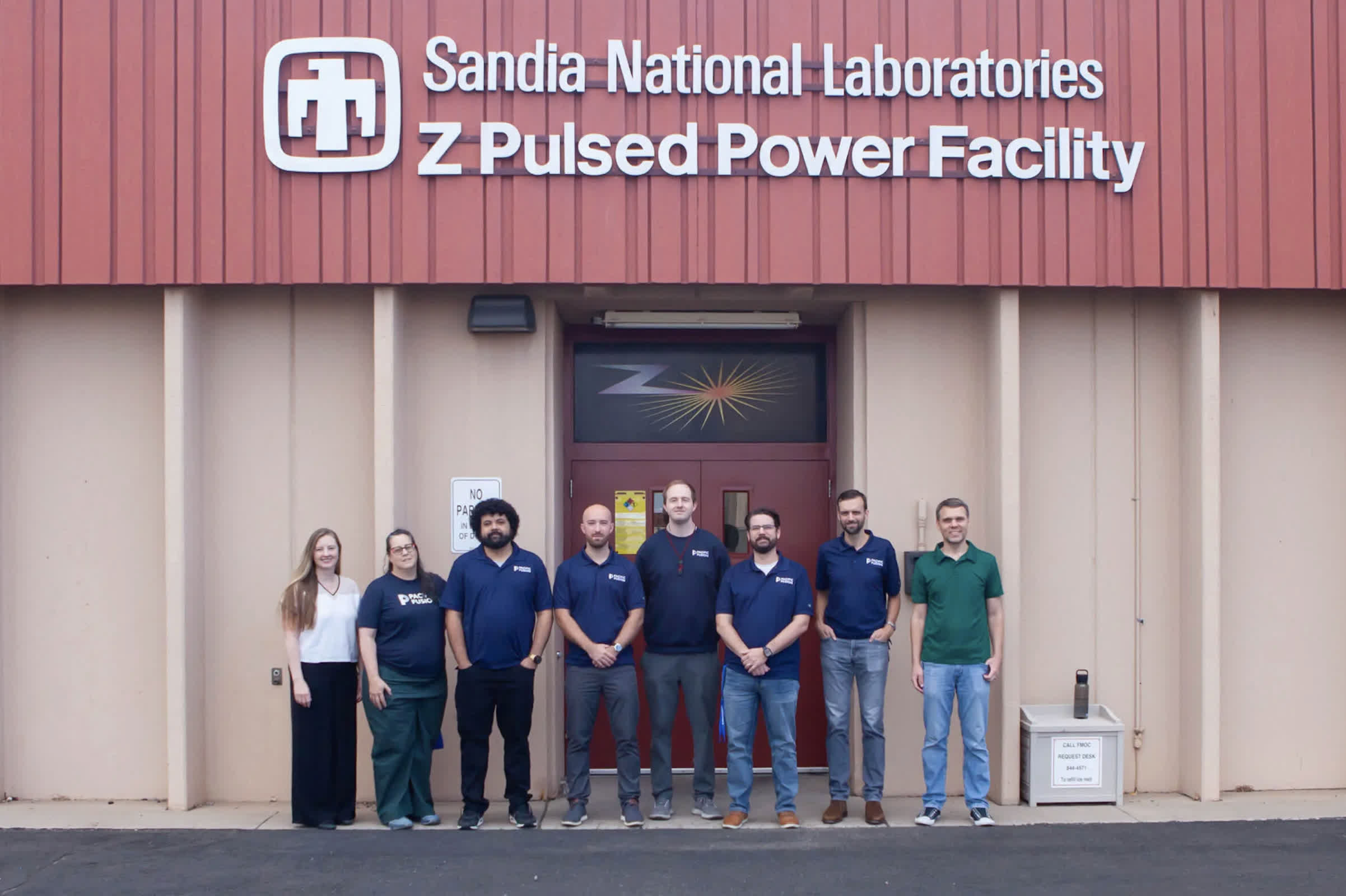
Pacific Fusion's Sandia tests suggest the company may be able to eliminate that step. By altering the structure of the cylindrical chamber and fine-tuning the electrical current profile during the reaction, the team found a way to let a controlled amount of magnetic flux "leak" into the fuel just before compression. This preheats the pellet without the need for lasers or additional magnets.
The company uses plastic fuel targets encased in aluminum, and by adjusting the aluminum's thickness, engineers can fine-tune how much of the magnetic field seeps through. Manufacturing these targets doesn't require exotic materials or extreme tolerances – the precision is comparable to that of a standard .22-caliber bullet casing.
"It doesn't take much energy to actually allow that magnetic field into the center of the fuel," LeChien said. "It's a tiny fraction – much less than one percent of the system's total energy."
Eliminating major components like high-powered lasers could simplify operations and reduce costs, though the impact is modest compared with the broader challenge of making fusion economically viable.
Pacific Fusion, founded only a few years ago, plans to bring its first commercial-scale plant online in the early to mid-2030s, a timeline similar to that of more established competitors. The company also emphasizes that its experiments help refine simulations, ensuring that models more accurately reflect physical reality.
"A lot of people have simulated things and said, 'Oh, this will work or that will work,'" LeChien said. "It's very different to actually build it and have it work. Closing that loop is hard."
Even if these incremental improvements don't immediately make fusion power cheap, they demonstrate progress at the engineering level rather than purely theoretical work. Each iteration – whether in how power is pulsed, fuel is contained, or magnets behave – is bringing the world's most ambitious energy experiment closer to commercial reality.