Why it matters: Elon Musk has long had an apparent obsession with Mars, but he's now pivoted that focus to the Moon – something he called a "distraction" just over a year ago. His latest plan is to build a catapult on the lunar surface and use it to launch AI satellites into space.
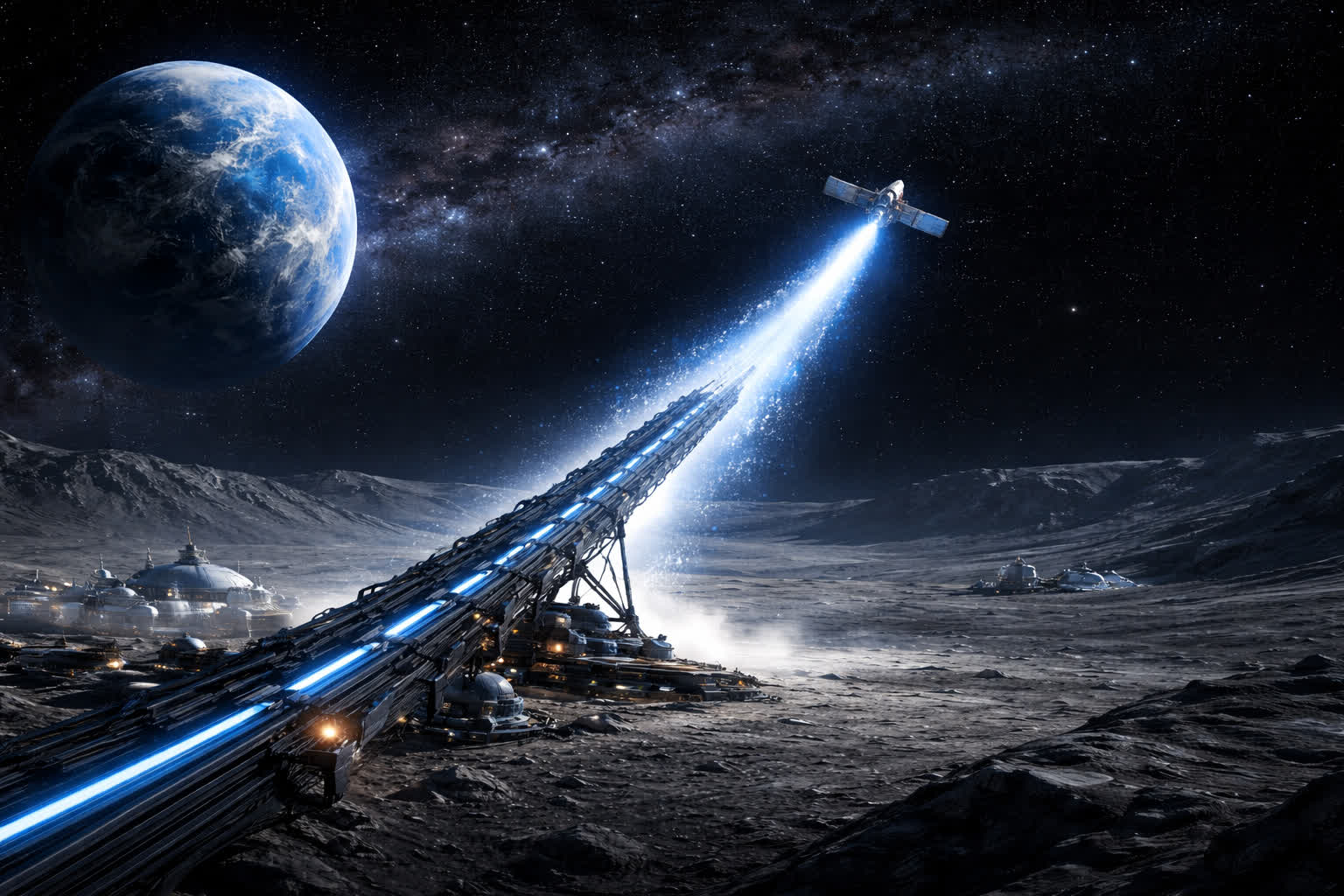
At an internal all-hands meeting this week, Musk laid out an idea that sounds like something ripped straight from a SF novel: build a massive factory on the Moon that manufactures AI satellites and launches them into space using a giant catapult. It's part of his plan to create an orbiting AI data center that uses satellites powered by the sun.
The idea is to leverage the Moon's low gravity and vacuum environment to drastically reduce the energy needed to get hardware into orbit. However, the minimum escape velocity required for orbit is still around 3,800 MPH or five times the speed of sound, so launched satellites would need to withstand acceleration forces around 10,000 g or more.
Instead of firing rockets off Earth's deep gravity well, Musk wants a lunar infrastructure, including a so-called mass driver – an electromagnetic launcher that hurls payloads into space at high speeds without burning tonnes of propellant. The concept of mass drivers has been studied for years as an alternative space launch technique.
According to people familiar with the meeting – audio of which was reported by The New York Times – the intention isn't just to shoot satellites up from a lunar base.
Musk claims these satellites would help xAI, his artificial intelligence company now embedded with SpaceX, to compete by giving it unprecedented AI compute infrastructure and connectivity beyond Earth. "You have to go to the Moon," he reportedly told staff.
Musk is no stranger to talking about big plans without including the details. For the moon concept, he gave no engineering roadmap, no cost estimate, no timeline, and extremely little sense of the real logistical challenge of building industrial capability on an airless, resource-scarce world.
This moon catapult vision also arrives at a moment of internal turbulence for Musk's empire. xAI has seen several co-founder departures recently, and SpaceX is reportedly eyeing a blockbuster IPO. Some industry observers are questioning whether this lunar pitch is visionary strategy or a high-concept distraction timed to take attention off the leadership shakeups.
There's also the bigger shift in Musk's space priorities. For years his priority was Mars – the Red Planet as humanity's insurance policy. Now, he's openly talking about self-sustaining lunar cities and lunar manufacturing hubs as shorter-term stepping stones, partly because Moon missions are easier to launch frequently and cheaper than missions to Mars.
Whether Musk's mass-driver dream becomes an engineering reality or stays one of his unlikely concepts remains to be seen.