Bottom line: After five years of relentless architectural iteration, AMD closed 2025 with its strongest position yet in the x86 CPU market. Data from Mercury Research shows the company captured record unit and revenue shares across both client and server segments, a sign that AMD's strategy of stacking innovation in cache, core count, and integrated acceleration is beginning to pay off.
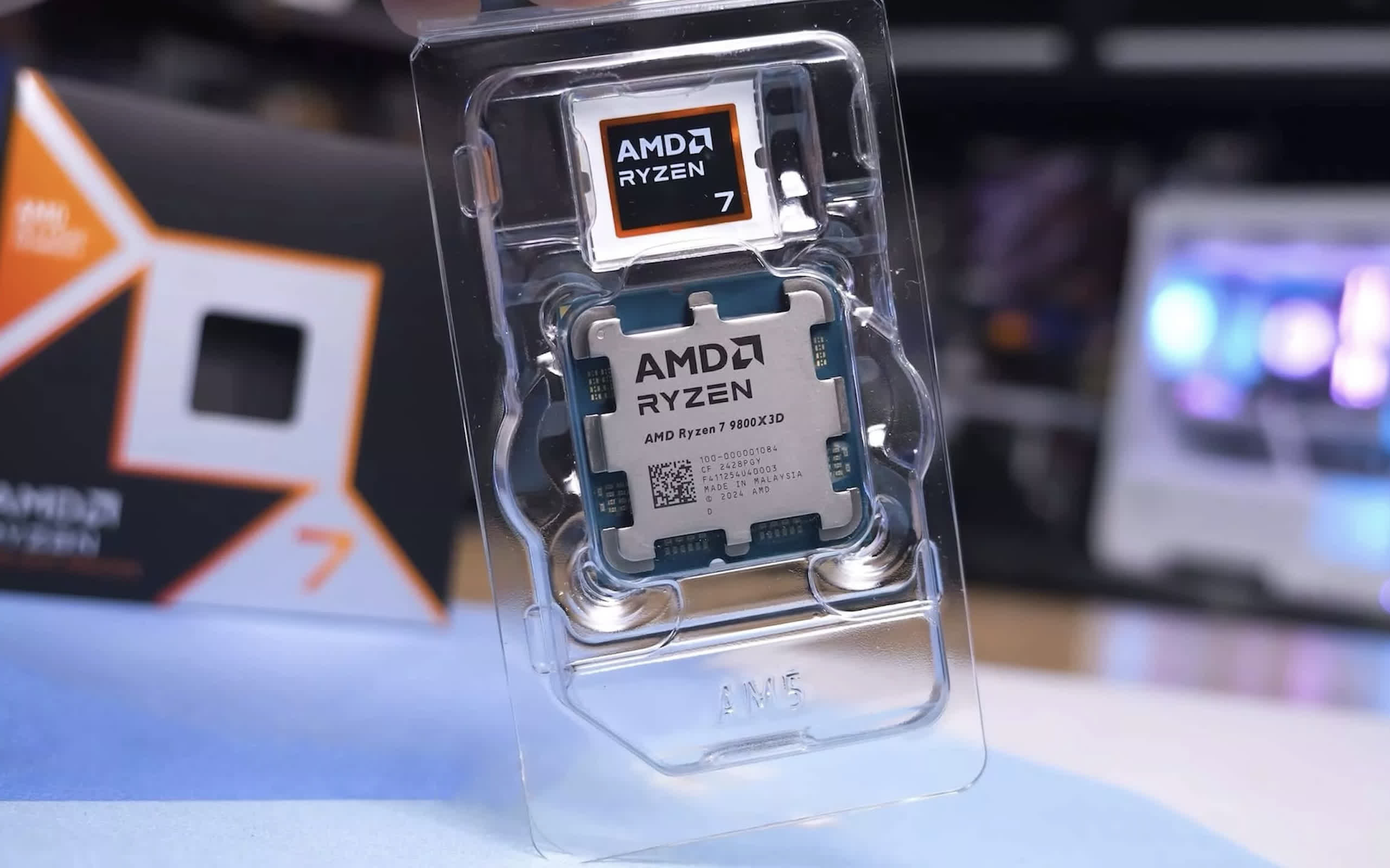
At the desktop level, AMD's Ryzen family continued to lead on performance and efficiency benchmarks, with revenue share rising to 42.6% – its highest since the first generation of Ryzen debuted. Even as the DIY segment slowed, consumer demand for gaming performance kept chips like the Ryzen 7800X3D, 9800X3D, and 9850X3D ahead of the competition.
These processors rely on AMD's 3D V-Cache technology. This vertical cache-stacking method adds substantial L3 memory directly atop compute cores, dramatically reducing latency and improving frame consistency in intensive workloads such as gaming. The result is industry-leading performance per watt, especially when paired with efficient DDR5 memory configurations.
On the mobile side, AMD's share reached 26% of units and nearly 25% of revenue, buoyed by steady notebook shipments and early adoption of the Ryzen AI series. The company's newest Ryzen AI 400 and Ryzen AI MAX chips represent a major leap in hybrid processing.
Built around 12-core Zen 5 CPUs and integrated RDNA 3.5 GPUs, these processors include dedicated neural processing engines capable of delivering up to 60 TOPS of on-device AI compute. That design enables laptops to handle real-time inference tasks, such as image enhancement or language-model acceleration, without relying on cloud resources.
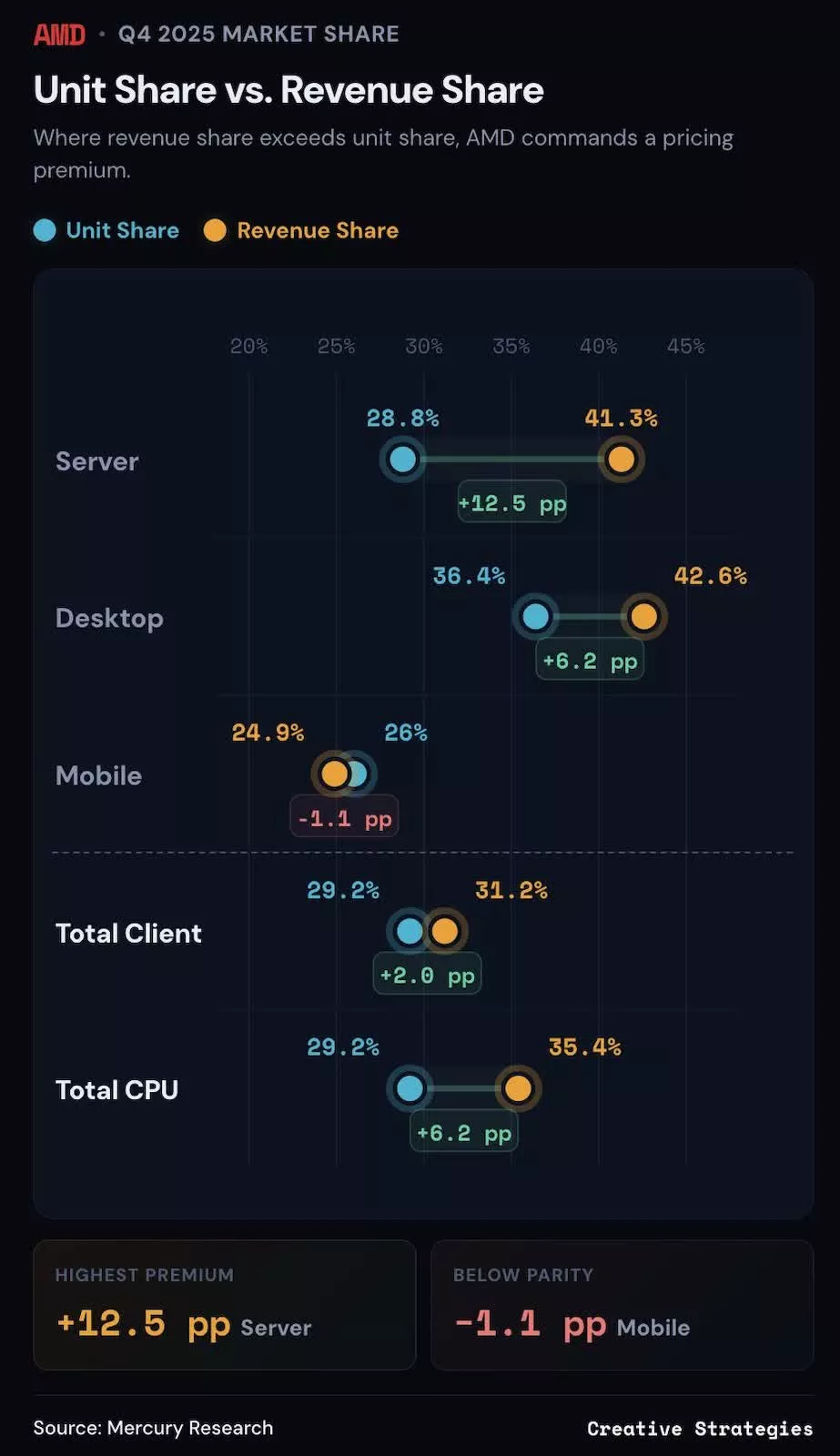
The company's momentum extended to data centers, where Epyc revenue share climbed to 41.3%, with unit share approaching 30%. That strength largely stems from the continued rollout of Genoa and Turin processors, both based on AMD's modular chiplet approach.
By decoupling compute dies from I/O dies, AMD scales performance efficiently across its SKUs, enabling hyperscalers to balance throughput against thermal and energy constraints.
Ahead lies the launch of Venice, the first data-center CPU based on the Zen 6 architecture and built on a 2nm process node. Venice will target next-generation Helios AI racks paired with the Instinct MI450 accelerator series.
Overall, AMD's total x86 CPU revenue share reached 35.4% in the fourth quarter of 2025, with unit share climbing to 29.2%. The company's client-CPU business alone increased its revenue share by more than seven points year-over-year. That trajectory underscores a deeper structural shift: performance leadership has become increasingly tied to AI integration and advanced chip design rather than sheer clock speed.
Mercury Research founder and president Dean McCarron said a partial version of his report would be published on Thursday, with the complete, official figures to follow inside the final release.