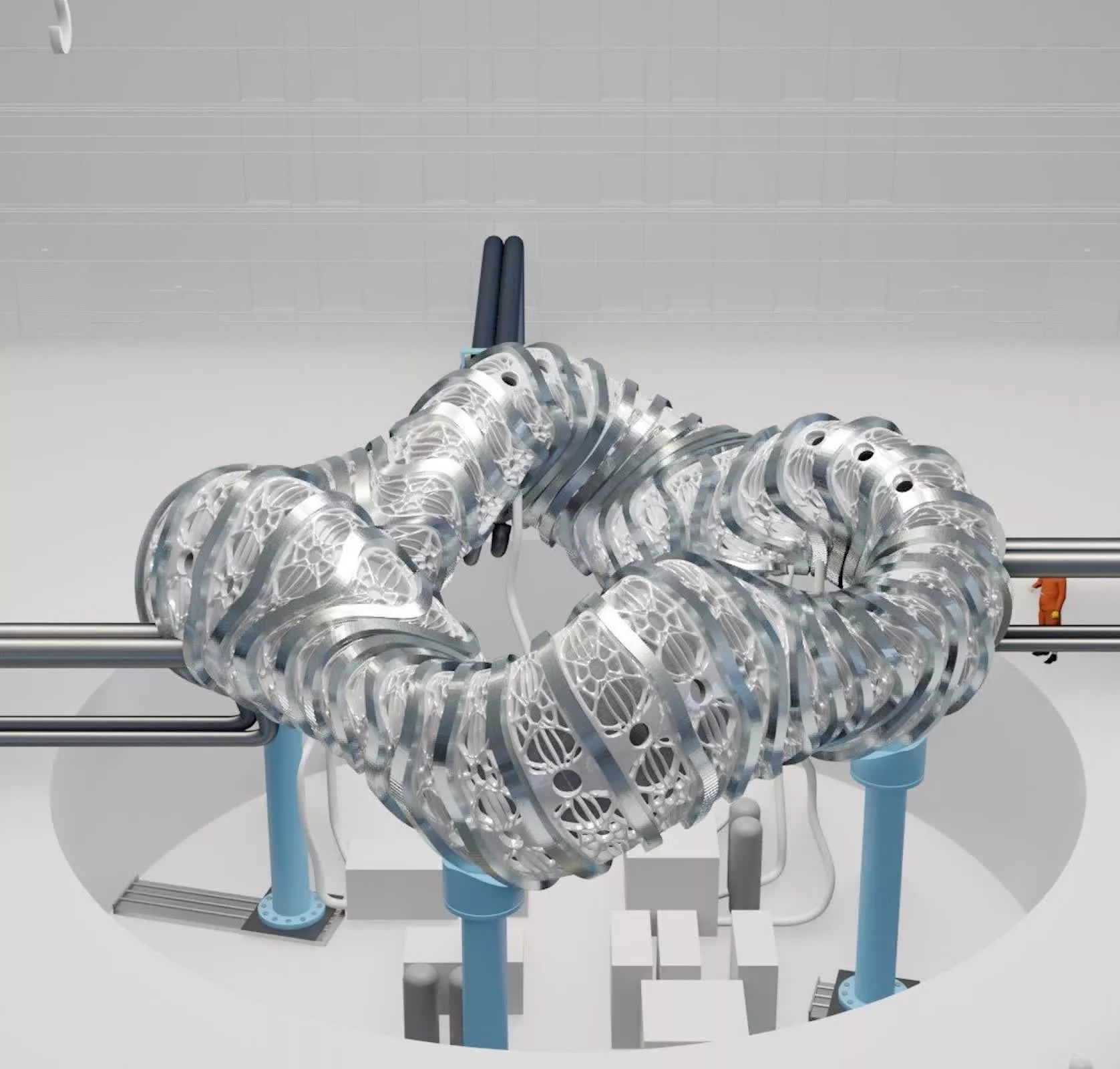
Why it matters: The next chapter of the United States' fusion effort began quietly last month when Type One Energy, a startup backed by Bill Gates, submitted its first construction license application. The filing paves the way for the construction of a stellarator experimental reactor.
For six decades, the Bull Run Fossil Plant in Claxton, Tennessee, powered a region on fossil fuel. Last year, the plant was decommissioned, collapsing the plant's twin smokestacks in a controlled demolition. Their fall didn't just erase a landmark from the Tennessee skyline; it symbolized the state's newly emerging role in high-tech energy innovation. Popular Mechanics reports that the site may soon host the complex magnetic coils of Infinity One – a nuclear reactor designed to confine plasma at temperatures of up to 100 million degrees Celsius.
Type One Energy's design takes a sharp turn from the tokamak reactors more familiar to the fusion world and instead is modeled on a stellarator. Like a tokamak, a stellarator holds a toroidal plasma ring suspended by magnetic fields. However, rather than simple circular coils, stellarators twist their magnetic geometry into intricate paths. This approach promises far more stable confinement – solving a problem that has plagued tokamak experiments for decades – but it introduces much greater engineering complexity.
A key part of Type One's approach is the use of high-temperature superconducting magnets in those complex coils. The company is developing modular HTS magnet technology capable of carrying very high currents and producing multi-tesla magnetic fields in the contorted shapes that stellarators require. These coils operate at cryogenic temperatures, designed to pack strong fields into compact footprints, which is central to keeping the device's size and cost within practical limits. Testing programs are focused on proving that these non-planar HTS coils can withstand the mechanical stresses and field strengths demanded by a next-generation stellarator.
Type One's stellarator concept relies on quasi-symmetry optimization, a design strategy that sculpts the three-dimensional field so that particle orbits behave as though they were in a more symmetric configuration. To get there, the team uses large-scale plasma and magnetostatic simulations on high-performance computing systems, including exascale-class machines at national labs.
The company uses those simulations to refine coil shapes, reduce transport losses, and set the physics basis for the follow-on Infinity Two power plant while trimming risk before it builds the hardware. Infinity One is the prototype stage of a plan that will eventually include a 350-megawatt electric plant dubbed Infinity Two, along with a training center for the region's new fusion workforce.
Type One aims to get the prototype operational by 2029, an ambitious timeline by fusion standards. Infinity Two is laid out as a full pilot power plant, with architecture that accommodates divertors to exhaust helium "ash" and protect the walls, using breeding blankets that both shield the magnets and generate tritium for fuel.
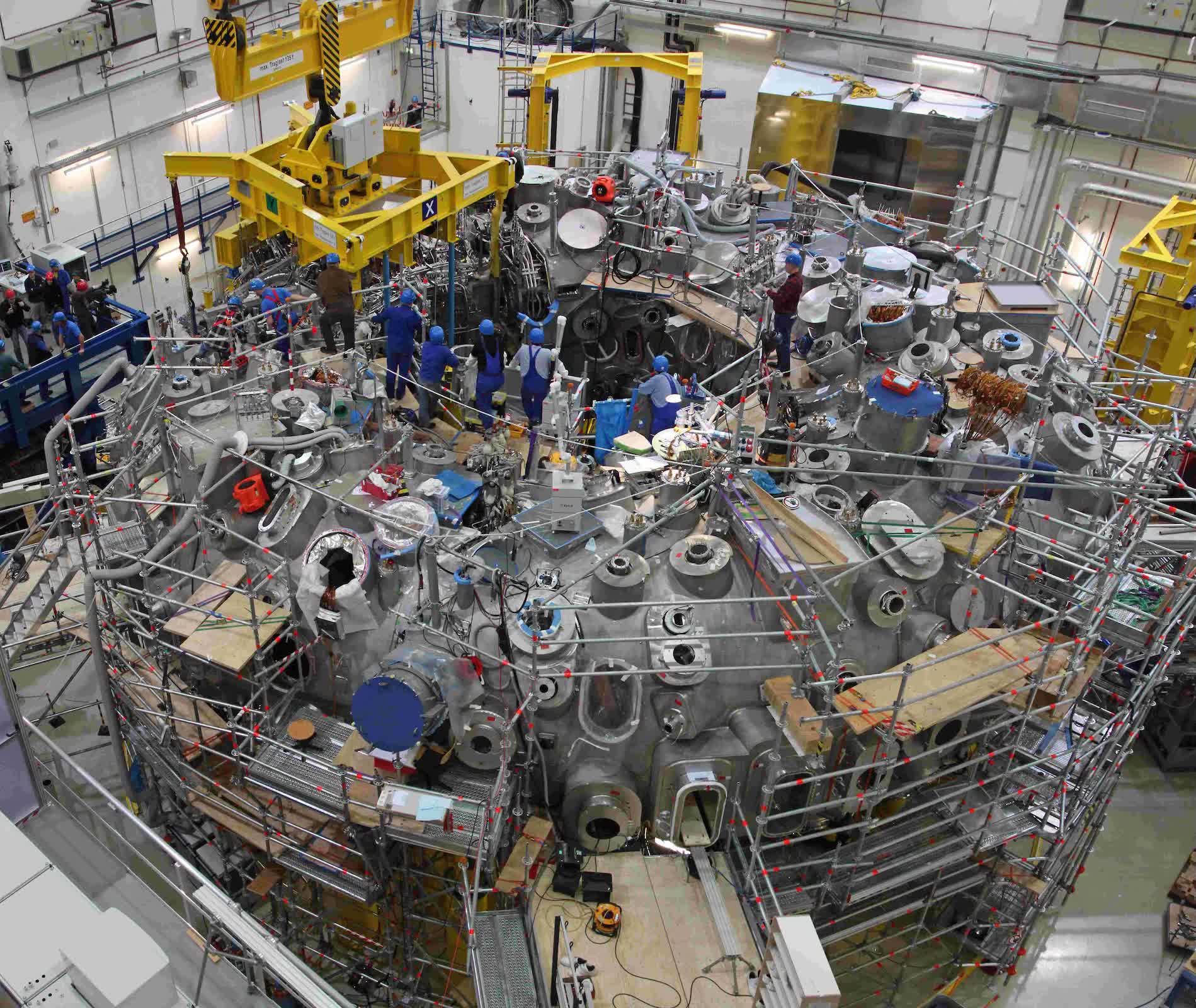
Several of Type One's founders helped design major plasma facilities, including the Helically Symmetric Experiment at the University of Wisconsin--Madison and Germany's Wendelstein 7-X, the world's largest operating stellarator. Experiments on Wendelstein 7-X and other optimized stellarators have already shown improved confinement and reduced neoclassical transport compared with earlier designs, supporting the idea that optimized stellarators can approach tokamak-like performance while retaining their steady-state, disruption-resistant advantages.
Type One CEO Christofer Mowry called the collaboration with the Tennessee Valley Authority a model for "safety by design."
"We've been working closely together since February 2024, sharing relevant design information and knowledge that is essential to establish the appropriate licensing conditions for a fusion power plant," he said.
Mowry described the partnership as making Tennessee an international example of safety and transparency in the licensing of fusion machines.
Bull Run's transformation fits a broader pattern sweeping across US energy redevelopment. Form Energy has located its first iron-air battery manufacturing facility in the former steel-manufacturing town of Weirton, West Virginia. Meanwhile, developers in Lincoln, Maine, are turning a shuttered paper mill into the world's largest grid-scale battery installation.
Another Gates-backed company, TerraPower, is building an advanced fission plant near a retiring coal facility in Kemmerer, Wyoming. Non-nuclear construction of the facility began in June 2024. Instead of discarding the infrastructure of the carbon era, engineers are now reengineering it for the physics of a cleaner one.