The takeaway: When most of the PC modding community spends its weekends fine-tuning fan curves or experimenting with liquid metal, YouTuber mryeester decided to skip the convention entirely. His latest video documents a functioning PC cooling system powered not by liquid coolant or refrigerant gas but by ice – and not just any ice, but ice perpetually replenished by a hacked household ice machine.
The experiment sits halfway between absurdist entertainment and an intriguing case study in thermal engineering. The concept is deceptively simple: use melting ice to absorb the CPU's heat, then recycle the meltwater to make new ice, forming a closed-loop cooling system.
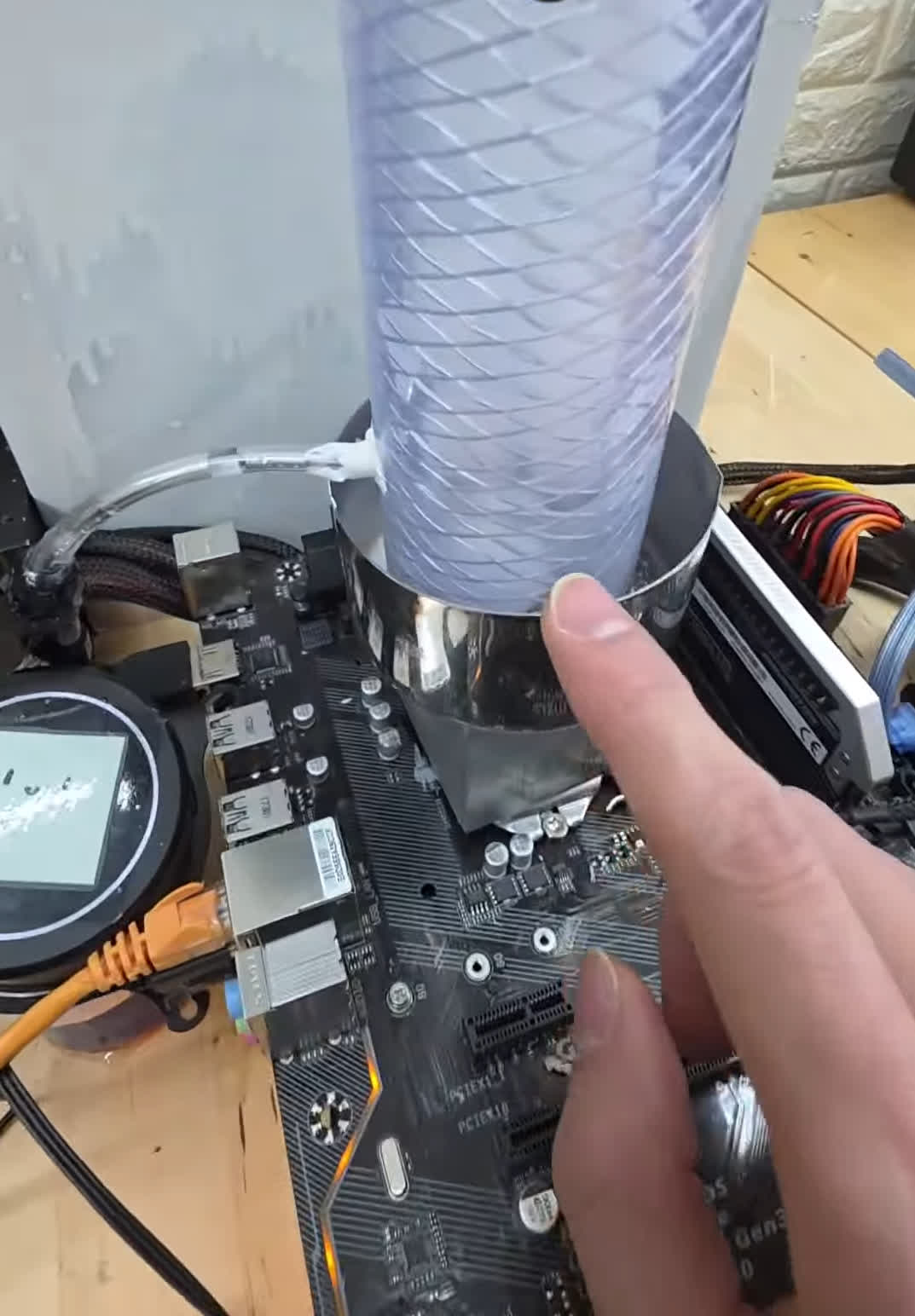
In practice, this required connecting a water pump, controlled via the motherboard's fan header, to draw melted water away from the processor and into the modified ice machine. There, the liquid refreezes into cubes that are automatically dropped back into a tall collection tube positioned directly above the CPU.
At the heart of the setup is an improvised metal cup and aluminum block assembly. The block transfers heat from the CPU to the base of the cup, which holds the stacked ice cubes. As the processor warms, the ice melts, absorbing heat that would otherwise raise the chip temperature. The cycle continues as the pump drives the water back to the ice maker.

Despite the unlikely materials, the system appears to perform surprisingly well. According to mryeester, the build maintains CPU temperatures near 40°C under load, roughly equivalent to entry-level liquid-cooling performance. That result, he admits, "blows his mind."
The efficiency trade-offs are steep, though: constantly running an ice maker adds significant power draw and noise, while the open water system poses obvious electrical risks.

The build demonstrates that thermodynamic curiosity sometimes outweighs practical limits. While pouring melting ice over high-end PC components isn't the best idea, the project underscores how everyday hardware – pumps, tubing, kitchen appliances – can form a working thermal loop.
Clearly, this "infinite ice loop" isn't destined for mainstream adoption. It's messy, inefficient, and precarious – qualities that won't appeal to system builders measuring watts and decibels. But for tech experimenters who thrive on the improbable, the video is a reminder that sometimes the line between proof-of-concept and farce is cold enough to keep a CPU running smoothly.