First look: Lenovo is building its vision of the workplace of the future – not just through faster laptops or thinner tablets, but through machines that can see, listen, and even share a desk. At this year's Mobile World Congress, the company introduced two concept devices designed to explore how artificial intelligence could take on a physical presence in professional environments.
The most striking prototype was the AI Workmate Concept, a desk robot that combines conversational AI with cameras, sensors, and projection hardware. Less dramatic – but more immediately practical – was the AI Work Companion Concept, a stationary desktop assistant with its own display and AI-driven scheduling engine. Together, they signal a shift in Lenovo's exploration of what it calls "spatial and physical AI experiences."
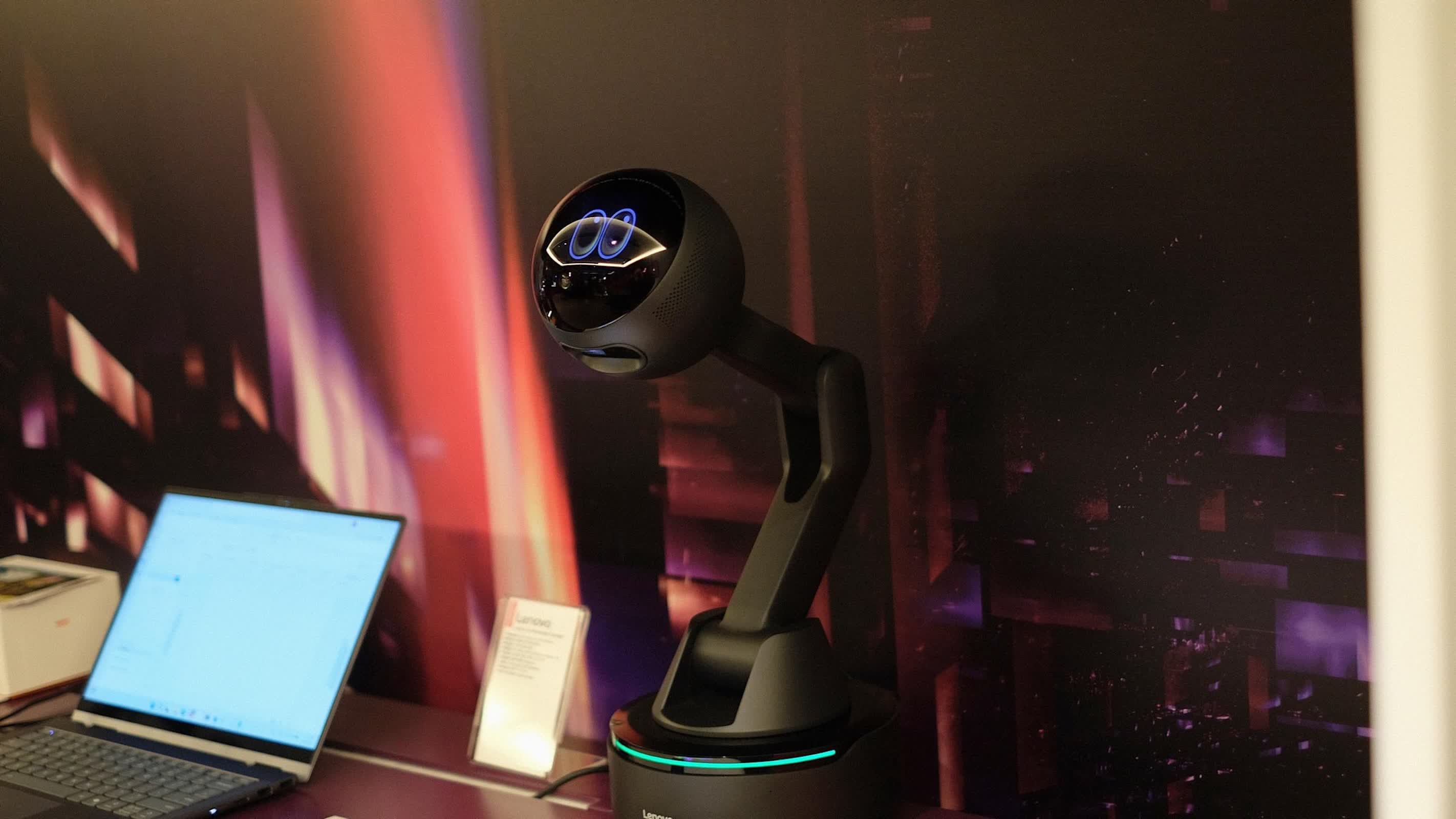
At first glance, the AI Workmate resembles a small, animated speaker. It features a 3.4-inch LCD screen with a low-resolution (480 × 480) animated face that changes expression as it listens, processes, or idles – sometimes sipping imaginary coffee or resting a floating hand against its synthetic chin. The display is not intended to present data, but rather to create the illusion of emotion.
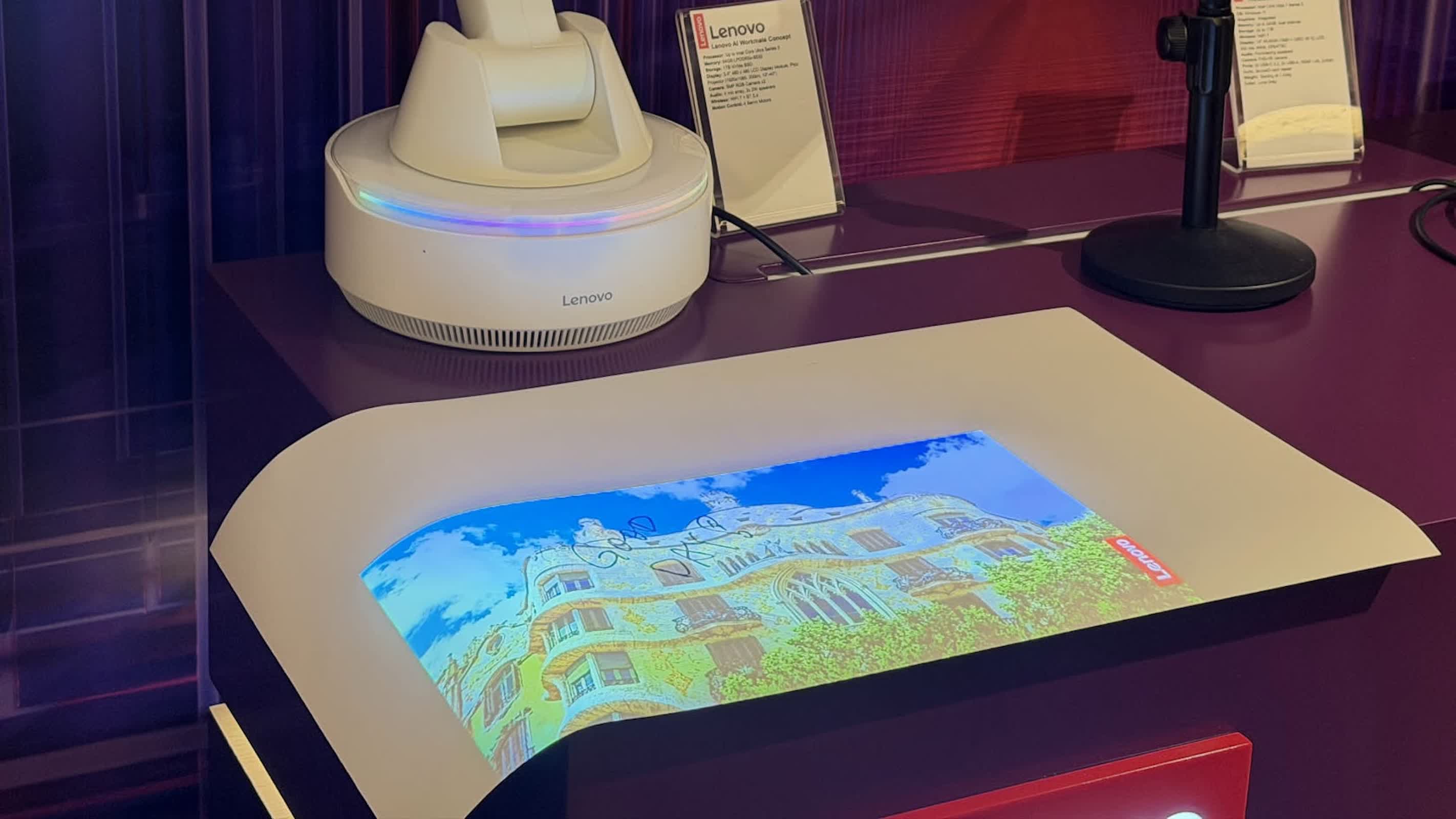
Behind the screen sits a fully articulated head housing an Intel Core Ultra processor, 64GB of memory, an onboard Pico projector, and cameras that support document scanning and gesture input. The projection system is one of its most distinctive features: it can beam documents, images, or presentations onto a desk or nearby wall.
During a live demonstration, Lenovo representatives had the device project an image of Barcelona onto a desk. They then showed how it could scan a signed postcard using two downward-facing 5-megapixel cameras and forward the digital copy to a printer.
Unlike many voice assistants that rely heavily on remote servers, the AI Workmate concept performs much of its processing locally rather than depending entirely on the cloud. It supports speech and gesture recognition, document summarization, and slide creation.
Lenovo describes the device as an early exploration of how embedded AI and generative models might function in professional environments, where privacy and latency remain ongoing concerns.
For now, the system remains a concept, and Lenovo has not indicated whether a commercial version is planned. Some observers note that its human-like presence and constant chatter could become distracting in shared workspaces, especially if one person regularly interacts with it aloud. Still, the company says the project is less about immediate deployment and more about exploring new interaction models for AI-assisted collaboration in office settings.

In addition to the expressive robot, Lenovo showcased a second prototype that takes a different approach to AI-driven productivity. The AI Work Companion Concept trades the robot's personality for utility. Roughly the size of a small clock, it features a solid dial, programmable buttons, and a full-face display capable of showing calendars, to-do lists, and reminders. It connects via USB-C for power and hub functions while wirelessly syncing tasks and schedules from a user's devices.
Its underlying software includes a system Lenovo calls the "Thought Bubble," which synthesizes daily plans across platforms, combining tasks, meetings, and breaks into a coherent workflow. The assistant can suggest rest periods between focus sessions and track screen time to help prevent burnout. At the end of the week, it compiles a brief progress recap intended to serve as both a feedback loop and a lighthearted reward.
The Work Companion forgoes cameras and conversation in favor of a quieter, always-on display that brings intelligence to the edge of the workstation. Rather than embedding AI solely in software, Lenovo is giving it a physical form – an unobtrusive presence that hints at how productivity hardware could evolve.
That theme of physicalizing AI runs through Lenovo's broader demonstrations at MWC. Alongside foldable gaming PCs and modular laptops, the company is using prototypes like the Workmate and Work Companion to test how its "spatial and physical AI experiences" might complement emerging spatial computing use cases. The underlying idea is that the future of computing will extend beyond screens into the surrounding environment – projected onto walls, distributed across surfaces, and responsive to gestures and voice.
Both prototypes remain experimental, but they offer a glimpse of how major device makers are rethinking AI's role in the post-laptop era. Whether such devices ultimately become indispensable tools or remain novelty gadgets will depend on how effectively they blend digital intelligence with the practical realities of office life.
Image credit: Engadget