Bottom line: AI data centers are swallowing so much of the world's memory output that automated scalping operations are now crawling the supply chain itself, from retail DDR5 kits to industrial-grade modules and connector components. A recent campaign uncovered by bot-mitigation firm DataDome shows how web scrapers tuned for RAM pricing can quietly hit product pages tens of thousands of times per hour while staying just under conventional defense thresholds.
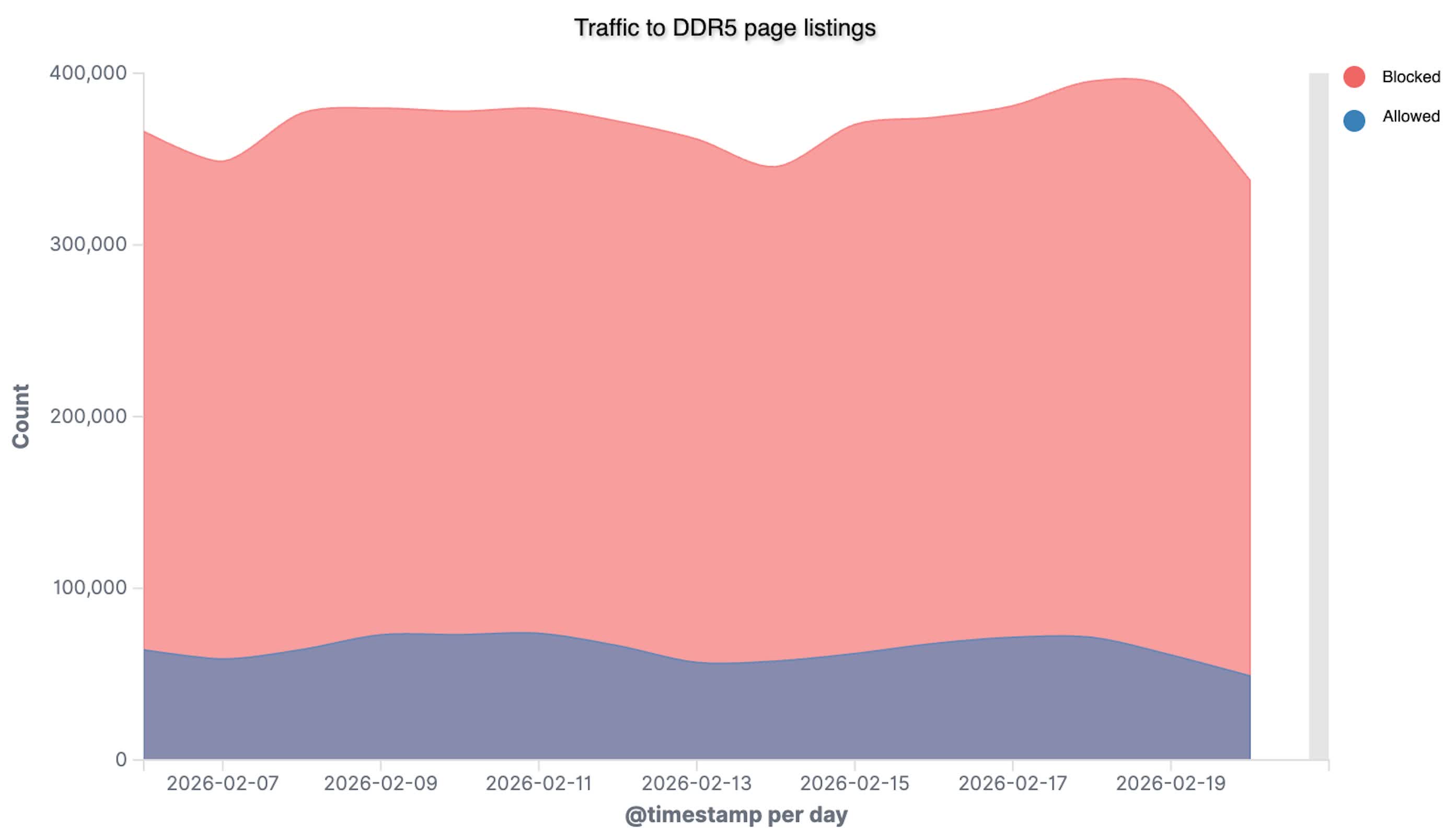
DataDome reports that a single scalping operation has been hammering memory listings with requests every 6.5 seconds, averaging more than 550 automated hits per page and exceeding 50,000 requests per hour across targeted sites. In total, the company says it has blocked more than 10 million requests from this one bot, all aimed at extracting fresh pricing and stock data for DDR5 RAM and related components.
The crawler is not limited to consumer-facing SKUs. According to DataDome's analysis, the bot enumerates multiple tiers of the memory pipeline, including DIMM sockets, CAMM2 connectors, and industrial memory modules typically sold in B2B environments. That targeting suggests an interest not only in reselling finished kits, but in monitoring constraints on upstream parts as well.
To reduce the chance of detection, the operators use a day/night request pattern that mimics human browsing rhythms, with traffic that appears to follow a daily cycle but actually remains unnaturally flat and calibrated. Request rates are tuned to stay just below volumetric alert thresholds that many e-commerce and distribution platforms use to flag abuse.
The campaign relies heavily on cache-busting. Each HTTP request appends unique parameters so that servers treat the visit as a fresh page load rather than serving cached content, guaranteeing up-to-the-second pricing and stock information instead of stale data. Sessions are short and mechanical: a single product page view followed by an immediate exit, no cart interaction, no search queries, and no lateral movement through the site.
Despite the human-like pacing, several signals point clearly to automation. Traffic focuses almost exclusively on RAM listings and does not shift toward other categories, even when a site offers a full catalog of hardware. There are no organic usage patterns such as reduced traffic on weekends or peaks during early evening hours; instead, volumes drop sharply only when the bot encounters a technical issue and then snap back to full capacity once the issue is resolved. That kind of step-function behavior is not seen with human users, who respond more gradually to outages or latency.
The campaign's focus on DIMM sockets highlights how sensitive the market has become to component-level constraints in the DDR5 ecosystem. Traditional desktop and server builds still rely on standard DIMM slots, so probing socket availability can provide an early signal of which platforms and vendors are about to face tighter supply.
CAMM2, the newer Compression Attached Memory Module standard, is also in scope. CAMM2 is designed to deliver high-density memory in thinner form factors, particularly for laptops and compact systems, and its adoption ties directly into next-generation client devices and some edge compute designs. Monitoring CAMM2 connector and module inventory gives scalpers a view into a segment where supply is narrower and design wins are still concentrated.
Industrial memory modules add a different angle. These parts target embedded, networking, and industrial PCs where extended temperature support, long-lifecycle availability and stringent reliability requirements matter more than peak bandwidth. Scraping industrial SKUs and B2B catalogs suggests that the operation is not limited to gaming rigs or enthusiast builds, but is also tracking hardware that underpins infrastructure and operational technology.
The DDR5 campaign fits into a pattern that has played out across multiple hardware launches and limited-run products in recent years. Scalpers have already driven up prices for Sony's PlayStation 5 Pro 30th Anniversary pre-orders, with resale listings reaching three to six times the original pricing on secondary marketplaces.
High-end GPUs have followed the same trajectory: Nvidia RTX 5090 cards were listed for up to 2x to 3x their MSRP days after launch, while limited edition MSI RTX 5090 Lightning Z boards have appeared at premiums approaching 500 percent.
DDR5 has already seen aggressive arbitrage. One analysis of eBay listings for high-end kits found retail prices climbing from around $118 to roughly $430, with scalpers then reselling the same kit for more than $830 – over seven times its original value before shortages set in. Other configurations have sold for well over $2,000 once layered markups compounded earlier price increases.
Behind the scalping is a shift in memory supply toward hyperscale and AI workloads. Industry forecasts indicate that data centers are on track to consume about 70 percent of the world's memory chip output in 2026. That shift is already constraining stock for other segments, from consumer PCs to automotive and consumer electronics that still rely on a mix of legacy and newer DRAM.
Manufacturers such as Micron, Samsung, and SK hynix are under pressure to bring new fabs and production lines online, but greenfield memory facilities typically take years rather than months to build, equip, and ramp. In the meantime, any shortage at the die level amplifies quickly through sockets, connectors, and finished modules – exactly the points the scalping bot is tracking.