TL;DR: Sony's console is not at the center of this story for its exclusives or hardware refresh rumors. Instead, the PlayStation 5 is quietly serving as a proving ground for a Linux build that treats the console like a DIY Steam Machine, based on work by security researcher Andy Nguyen.
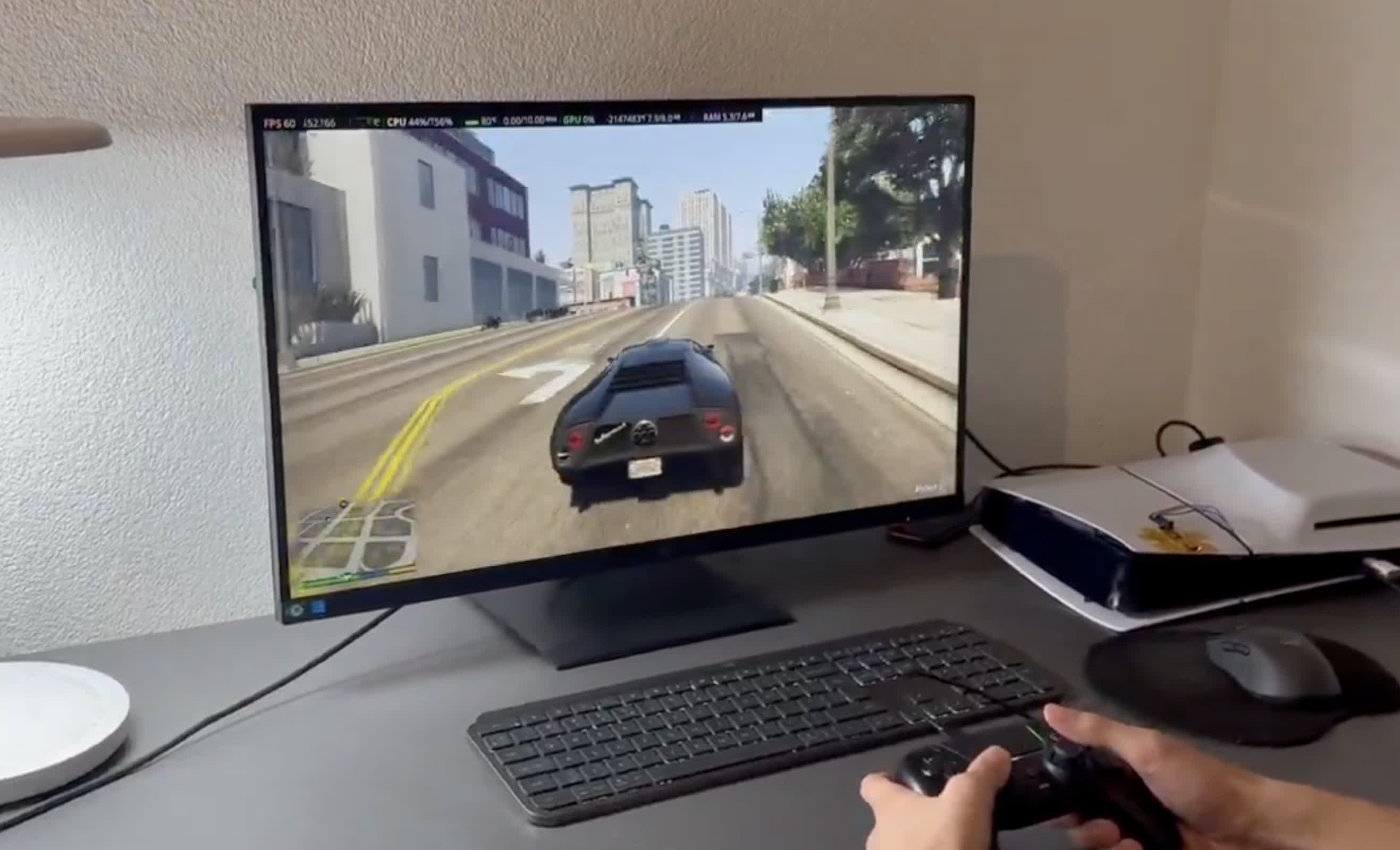
Nguyen, known online as theflow0, has turned a retail PlayStation 5 into a Linux gaming box powerful enough to run Grand Theft Auto V Enhanced with ray tracing at 1440p and 60 frames per second.
In his demo, the console outputs 4K HDMI video, handles audio correctly, and supports all USB ports, putting it much closer to a usable desktop PC than a fragile proof-of-concept. Nguyen says his current configuration runs the CPU at 3.2 GHz and the GPU at 2.0 GHz, which keeps the system stable while still exposing the hardware's capabilities under Linux.
4K HDMI Video + Audio
– Andy Nguyen (@theflow0) March 6, 2026
All USB ports
Currently running at 3.2 GHz CPU & 2.0 GHz GPU. It can be boosted to 3.5 GHz CPU and 2.23 Ghz GPU, but my PS5 slim model overheats too quickly.
Nguyen's build is anchored by a full exploit chain that uses a tool called Byepervisor to undermine Sony's security and gain the low-level control needed to load his own kernel. From there, he can bypass the stock PlayStation operating system and boot a custom Linux environment tailored to the console's AMD-based architecture.
Sony's console is built on a custom AMD SoC, closely related to components the company has shipped for PCs and even specialized boards. AMD even sold a cryptomining card, the BC-250, built around a cut-down version of the PS5's APU. According to Nguyen, that board can be converted into a full PC without requiring any unusual tricks.
Trivia: The PlayStation 5 is powered by a GPU roughly equal to which PC graphics card?
After gaining control of the system, Nguyen's focus shifted to the graphics stack. Instead of relying on undocumented hacks, he worked with the open-source Mesa project and submitted a merge request adding explicit support for the PlayStation 5 GPU.
By teaching Mesa how to talk to the console's graphics pipeline, the system can expose modern capabilities such as ray tracing and high-refresh output through standard Linux userspace tools. That is what allows the machine to run GTA V Enhanced at high resolution and decent frame rates, making it feel like an actual PC gaming rig rather than a hacked-together demo.
Clock speeds and thermals have also been part of the experiment. Nguyen tested a higher configuration that pushes the CPU to 3.5 GHz and the GPU to 2.23 GHz, revealing additional performance headroom in the silicon. In practice, however, his PS5 Slim cannot sustain those clocks for long without overheating.
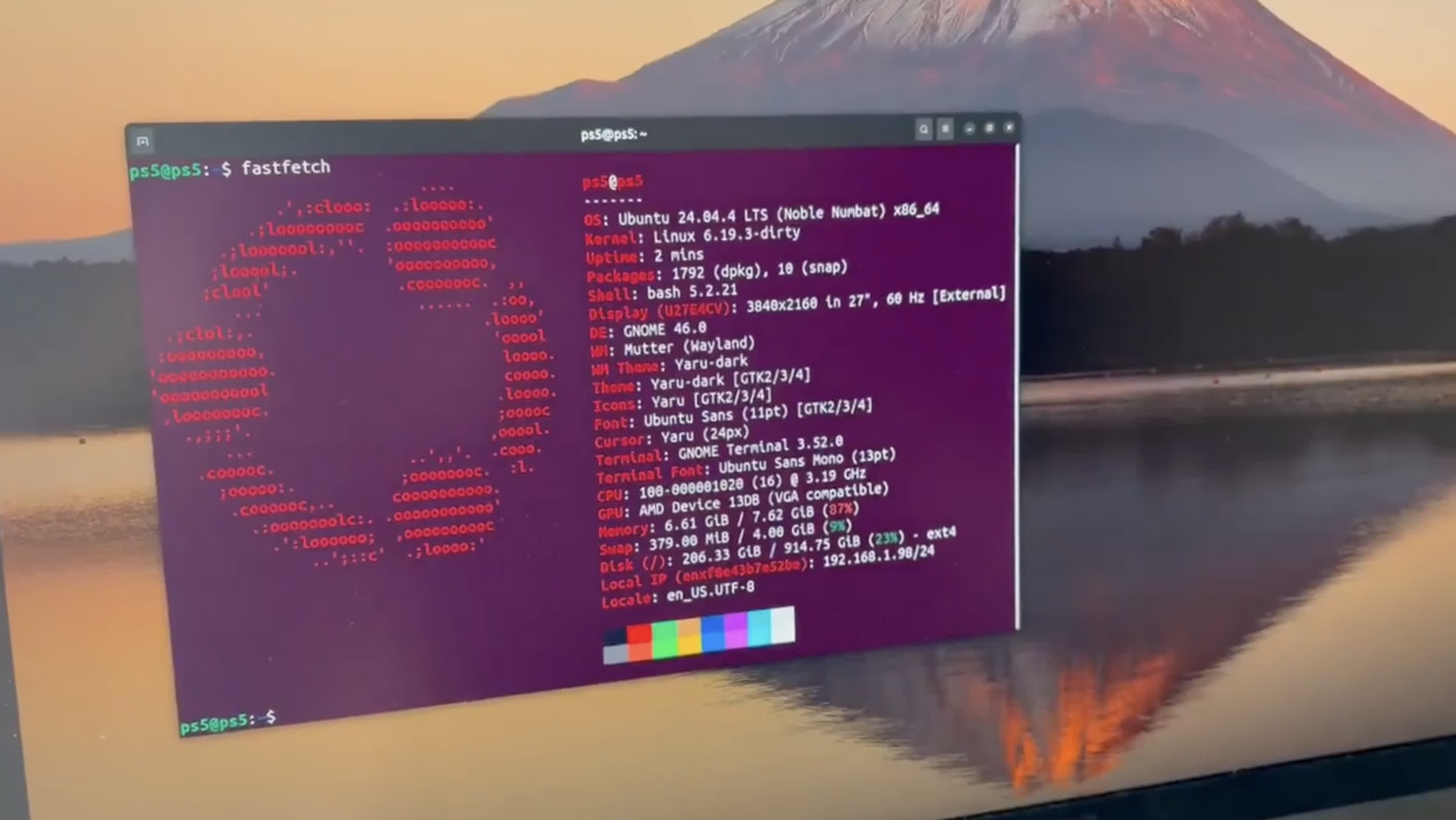
The console's cooling system was designed around Sony's stock operating profile, not sustained overclocked workloads under a different operating system. As a result, Nguyen settled on the more conservative 3.2 GHz and 2.0 GHz configuration.
Despite how polished the Linux experience appears in his videos, Nguyen's approach is not something most PS5 owners can easily reproduce. The public Byepervisor project only supports PS5 firmware in the 1.xx to 2.xx range, meaning the exploit chain works only on older, unpatched systems.
In other words, any console that has been regularly updated for online play is effectively locked out. That restriction keeps Linux on the PS5 squarely in enthusiast territory, limited to users who deliberately stayed on early firmware or who can source first-generation hardware.
Nguyen's work also arrives amid recent PS5 ROM key leaks, which have fueled speculation that the console could soon face widespread jailbreaks. He stresses that those keys alone are not a jailbreak and do not bypass Sony's protections. His Linux build still depends on carefully chained exploits to gain control of the system.
Taken together, Nguyen's work outlines a clear blueprint for turning a PS5 into a Linux machine: gain control through Byepervisor on early firmware, load a custom kernel, integrate Mesa support for the GPU, tune clocks to what the cooling system can sustain, and treat the console as a compact PC capable of modern ray-traced gaming.
It's still a niche path available to only a small number of users. But it also demonstrates, step by step, how Sony's current-gen console can be reshaped into a full Linux gaming rig when its software walls finally give way.