
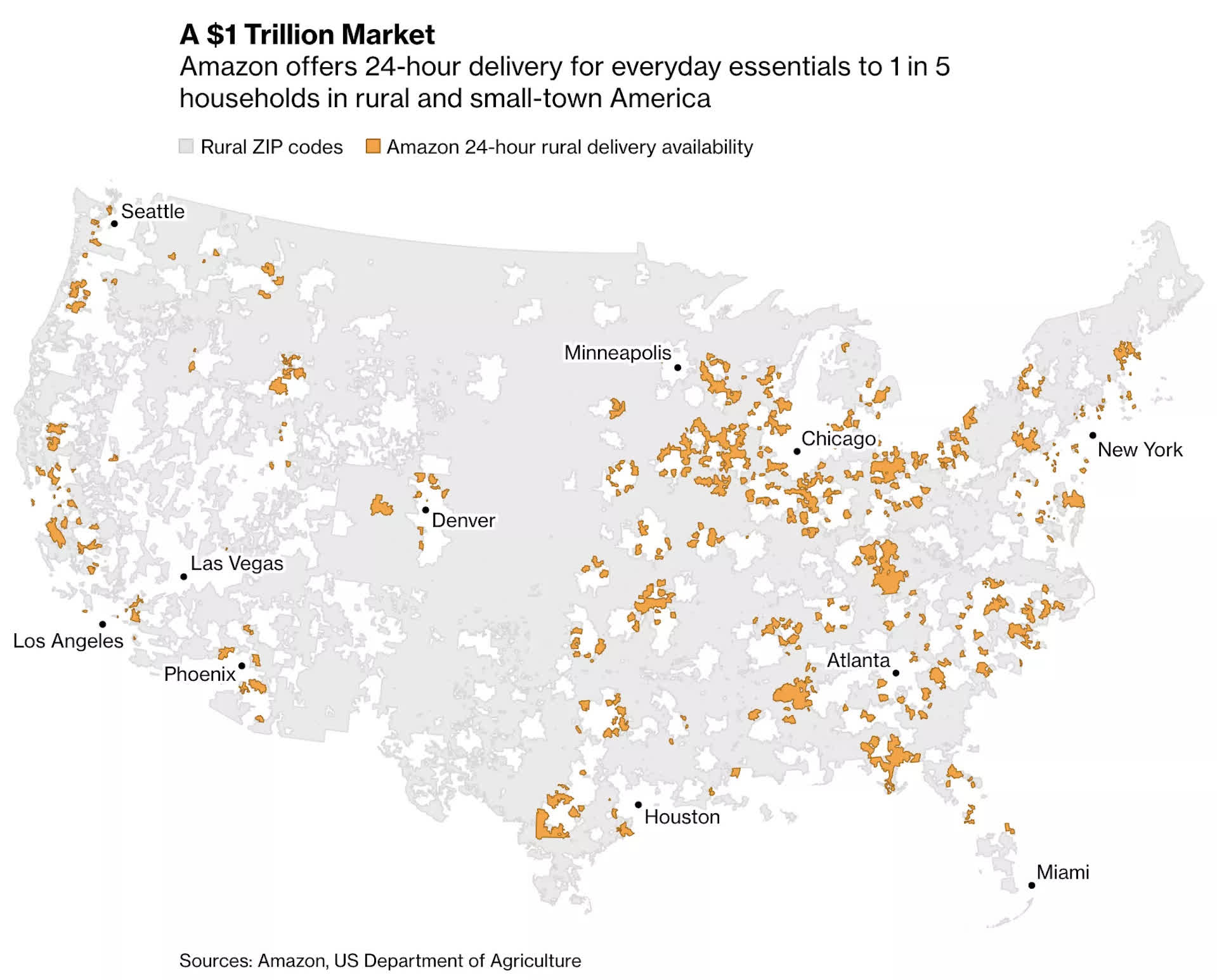
The big picture: Amazon is reshaping delivery expectations in rural America, cutting typical wait times for online orders from four to six days to as little as one to two days for a growing share of households. Following a $4 billion logistics expansion disclosed last year, rural and small-town customers now receive deliveries in under 24 hours in roughly one in five households and within 48 hours in 62% of households, according to a Bloomberg analysis of delivery times for commonly purchased items.
The stakes are high because rural residents collectively spend about $1 trillion a year on clothing, electronics, household goods, and other items – roughly 20% of US retail purchases, excluding autos and gasoline, according to Morgan Stanley.
Amazon's strategy is that faster shipping will reset expectations outside major metro areas and capture a larger share of that spending on its platform. "Rural America is often overlooked," said Sky Canaves, an analyst at eMarketer who tracks online sales, in comments to Bloomberg. "This is the opportunity Amazon is trying to seize because e-commerce growth is getting harder to come by."
The company is building a parallel logistics network in regions long dominated by the US Postal Service, UPS, and FedEx. In dozens of sparsely populated areas, Amazon is opening new delivery hubs to bring many orders within roughly a two-day window – a significant shift for communities where shoppers had grown accustomed to waiting up to a week for packages.
Amazon currently operates about 560 delivery stations across the country, roughly 160 of them in rural areas, according to Marc Wulfraat, president of supply-chain consultancy MWPVL International. At its current pace of adding 40 to 50 new delivery hubs per year, Wulfraat told The Wall Street Journal he expects Amazon to reach every US ZIP code within about four years.
Amazon already delivers more parcels overall than UPS and FedEx, both of which are scaling back their networks, including in remote areas. By filling those gaps, Amazon is on track to become the largest parcel carrier in the US, surpassing the Postal Service by 2028, according to estimates from Pitney Bowes, a shipping software company.
Amazon now handles roughly two out of every three orders itself, a sharp reversal from when it relied heavily on USPS for last-mile delivery in rural markets.
That shift has strained ties with the Postal Service following a dispute over contract terms, with the current agreement set to expire later this year. Negotiations reportedly broke down in December after USPS announced plans to auction off its parcel network, according to Amazon's account in a recent blog post.
The Postal Service is prepared to offer favorable rates in exchange for a long-term commitment, the postmaster general told Bloomberg, but added that without such a commitment, Amazon would be treated as a short-term customer and charged higher rates.
Inside Amazon, the rural expansion is framed as an extension of a logistics system first refined in dense urban markets and later expanded to regional hubs. Over the past decade, the company has moved outward from major cities to regional centers by drawing "ever-larger circles of coverage," said Holly Sullivan, Amazon's vice president for worldwide economic development, in an interview with The Wall Street Journal. Those existing hubs are now being used to accelerate delivery to rural communities and small towns.
"We would ideally like to deliver products in two days or less. So how do we make that happen? We have to invest in that," Sullivan said.
At the front lines of the strategy are not only new facilities and custom vehicles but also local businesses that sign on as delivery partners. Some small-business owners earn per-package fees – once as high as $2.50 per parcel in certain markets – for running last-mile routes in their own vehicles. Amazon says this model allows it to expand quickly into areas that are costly for traditional carriers to serve.
For shoppers, the most visible impact of the strategy may be fewer brown UPS trucks and postal carriers delivering e-commerce orders, and more local entrepreneurs arriving in minivans and pickup trucks loaded with Amazon packages.
Image credit: Bloomberg