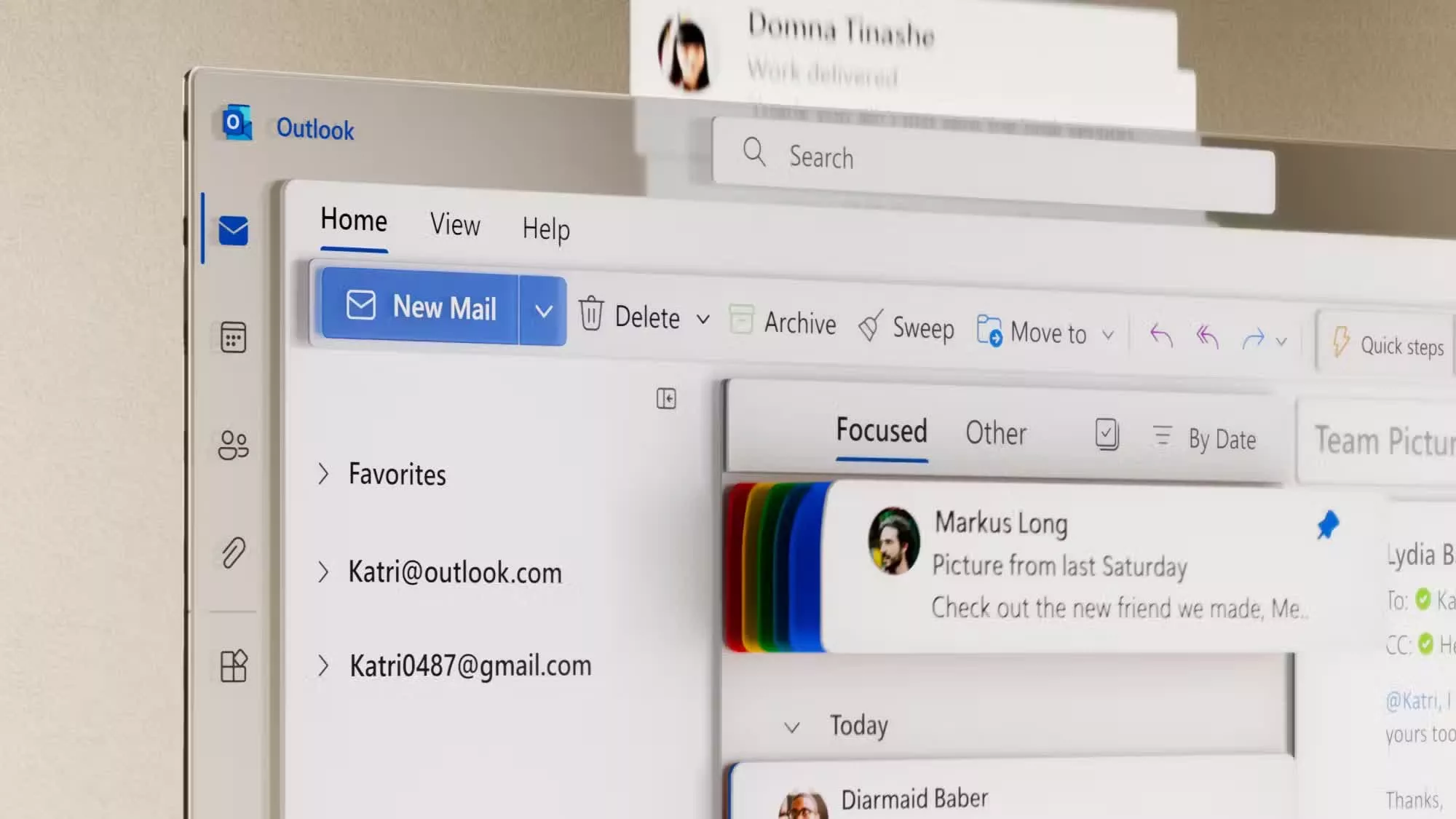
Facepalm: Even the first humans to leave Earth's orbit in more than 50 years aren't immune to the quirks of Windows software. Shortly after NASA launched the Artemis II spacecraft for its first crewed lunar mission since the 1970s, astronauts on board ran into a problem familiar to just about any office worker: they couldn't get Microsoft Outlook to start.
A clip from NASA's livestream quickly circulated on social media, capturing the moment astronauts flagged the problem. The glitch added an unexpectedly relatable note to an otherwise historic launch.
During the stream, one crewmember asks ground control to remotely troubleshoot an onboard system that appears to be running two non-functioning Outlook windows at the same time. Additional, less specific computer-related issues can also be heard in the background.
– Tom Warren (@tomwarren) April 2, 2026
The duplicate Outlook instances may point to a long-standing quirk in Windows 11, where two versions of the email client often appear side by side in the Start menu. Microsoft began preinstalling the newer Outlook experience in 2024, while still offering download links to the older version.
Outlook, like much of Microsoft's software stack, has a reputation for being finicky. The company said last year it would overhaul the email client with a stronger focus on AI, but has since eased off its aggressive push to weave AI deeper into Windows 11, pivoting instead toward performance and reliability. Whether that shift translates into meaningful improvements remains an open question.
– Aakash Gupta (@aakashgupta) March 8, 2026
Some argue the issues run deeper than bugs or UI confusion. In early March, product growth newsletter author Aakash Gupta suggested Microsoft has little incentive to fix Outlook's underlying problems because its primary customers aren't individual users, but enterprises buying bundled IT services that include Outlook, Azure, and security tools.
NASA is among those customers, and for many organizations, switching away from Microsoft's ecosystem can be prohibitively expensive, dampening pressure to improve the product. By comparison, Gmail is often viewed more favorably, in part because Google built it to scale across a massive user base, with enterprise adoption following later.
Artemis II is the first crewed lunar mission since Apollo 17 in 1972, sending four astronauts on a 10-day journey around the Moon. The mission will allow them to observe regions of the Moon's dark side that humans have never directly seen, capture high-resolution imagery, and validate systems ahead of a planned crewed landing targeted for early 2028.