
Facepalm: Multiplayer servers for the real-time strategy game Stormgate will go offline at the end of the month after the infrastructure provider that hosts them was acquired by an AI company and began winding down its gaming services. The shutdown shows how AI infrastructure expansion is now affecting not just PC hardware supply, but also the backend services that many modern games rely on.
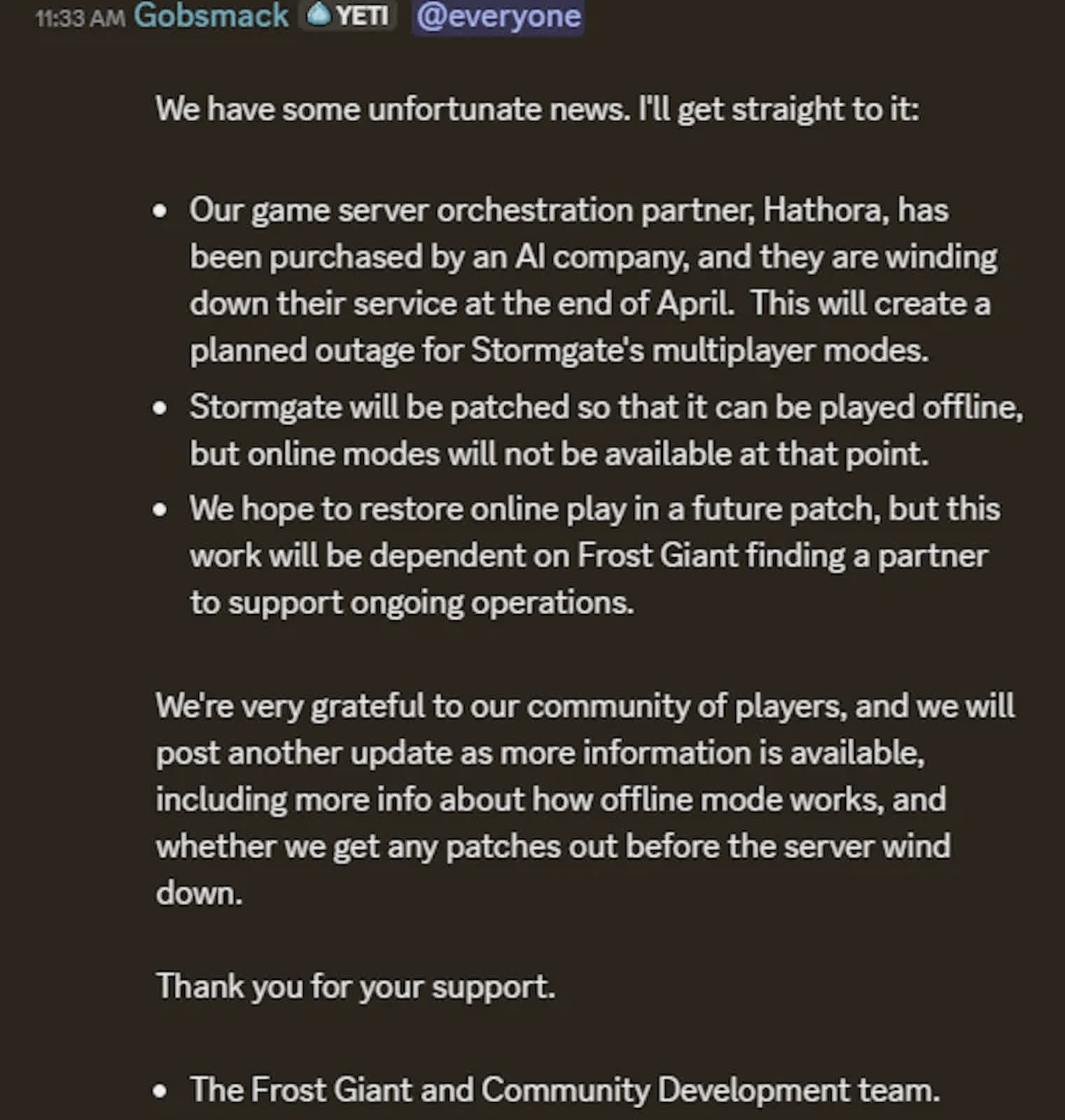
Stormgate, a free-to-play, StarCraft-style RTS developed by Frost Giant Studios, relies on a third-party "game server orchestration partner" to run its online modes. Frost Giant told players on Discord that the provider had been acquired by an AI company, forcing a planned outage that will take Stormgate's multiplayer modes offline at the end of April.
The studio said it will issue a patch so the game can continue to run offline, but "online modes will not be available at that point." The team hopes to restore online play later, but only if it can "find a partner to support ongoing operations."
That partner was Hathora, a game server platform recently acquired by Fireworks AI. Fireworks promotes its technology as "open-source AI models at blazing speed, optimized for your use case, scaled globally with the Fireworks Inference Cloud."
In practice, this means Hathora's infrastructure is being repurposed for AI inference workloads rather than real-time multiplayer. According to GamesBeat, Hathora plans to wind down its gaming infrastructure business entirely and transfer customers to another provider, Nitrado – suggesting that Stormgate is unlikely to be the only affected title. Hathora also supports other online games, including Splitgate 2.
For Frost Giant, founded by former Blizzard developers and promoted as a spiritual successor to legacy RTS franchises, the timing is challenging. The game launched to enthusiasm from a niche strategy audience but has struggled to maintain momentum; on Steam, it currently carries a mixed overall rating, with more recent user reviews skewing mostly negative. Stormgate's base game is free to play, while its full Ashes of Creation single-player campaign sells for $25.
The situation underscores a broader structural risk in modern game architecture. Over the past decade, remote-hosted servers have become standard for online multiplayer because they enable more complex, centrally managed simulations, matchmaking, live-service features, and anti-cheat systems.
That flexibility comes with dependencies: if a specialized provider is acquired, pivots to another market, or shuts down a product line, games that do not control their own stack can lose critical functionality with little notice. In this case, AI infrastructure proved lucrative enough to pull a game-focused platform out of the sector.
More broadly, many players already view AI buildouts as contributing to higher costs and reduced availability of gaming hardware, including GPUs, memory, and storage. When an AI-focused acquisition also removes access to a game's online features, it reinforces concerns that AI workloads are competing not just for the same silicon but also for the same cloud and orchestration layers that multiplayer games depend on.