
Something to look forward to: Google has announced that it will begin penalizing websites that interfere with the normal functioning of a web browser's back button. Known as back button hijacking, this behavior prevents users from navigating away from the current page or redirects them to partner sites that often serve misleading or even malicious ads for dubious products or services.
In a post on the Google Developers blog, the company said it is designating back button hijacking as a malicious practice. It added that engaging in any activity that alters the default back button behavior of web browsers will be considered an "explicit violation" of its spam policies, potentially leading to a demotion in search results.
Google has set June 15 as the deadline for non-compliant websites to remove any scripts that modify a browser's default back button behavior. This gives site owners and administrators roughly two months to comply with the new policy by removing or disabling any network code, third-party libraries, or configurations responsible for back button hijacking.
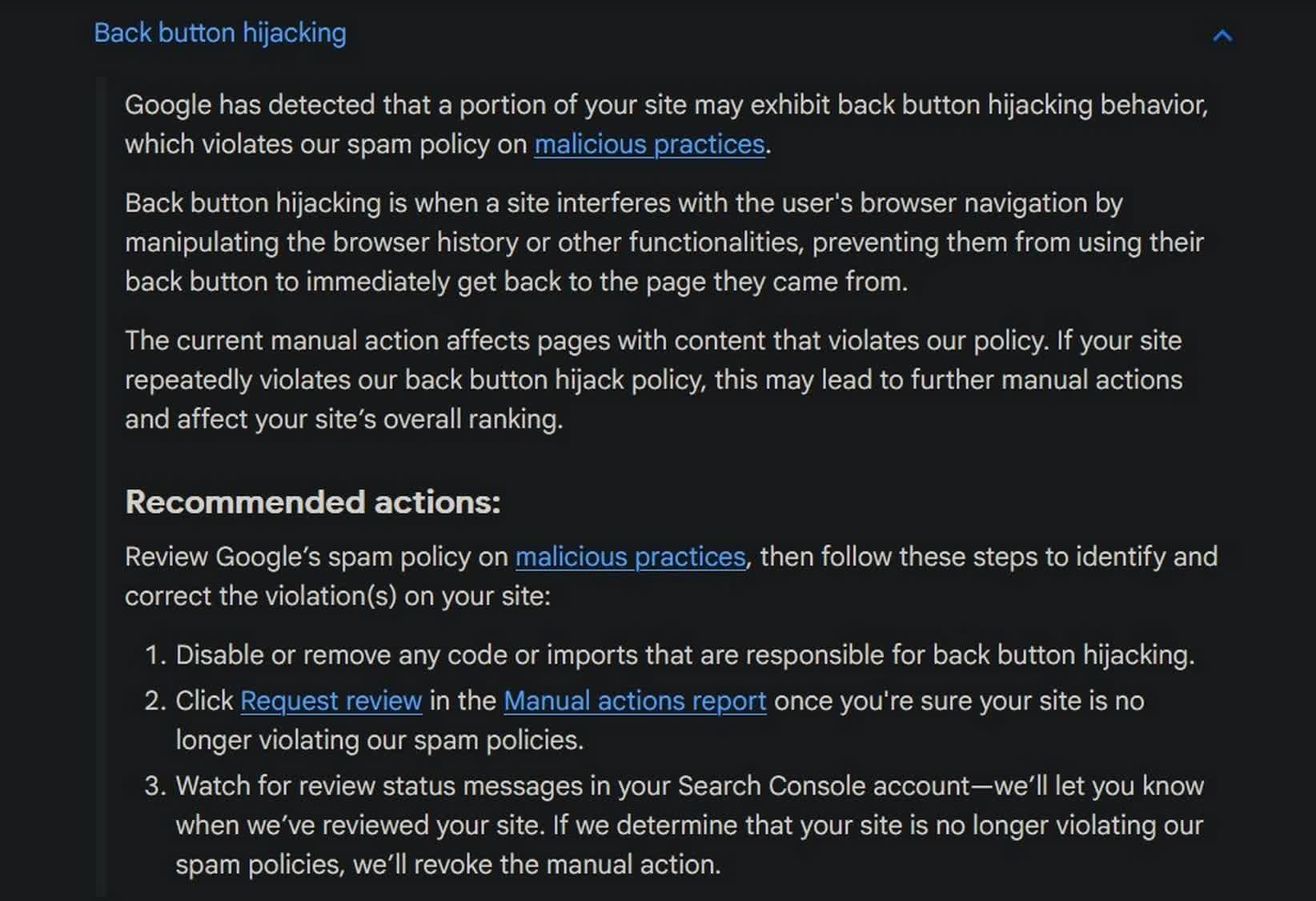
If the changes are not implemented by the deadline, offending websites may be subject to manual spam actions or automated demotions, which can negatively impact traffic. The company is also urging site owners to appeal any anti-spam actions if they have already addressed the deceptive behavior and removed all malicious code from their websites.
According to Google, instances of back button hijacking have increased significantly in recent years, degrading user experience and compromising user security and privacy. The company also noted that inserting deceptive or manipulative pages into a user's browser history has long been against its policies, but did not explain why it has taken so long to take action against back button hijacking specifically.
Over the past couple of years, Google has also taken action against other forms of deceptive behavior, including parasite SEO and expired domain abuse. The former refers to tactics where websites boost traffic by hosting content on established platforms with high domain authority, while the latter involves the misuse of expired domains with strong credibility to distribute or promote malicious content.