
Why it matters: Enterprise AI is moving past chatbots into something potentially more consequential: autonomous software agents that can carry out multi-step work across data, applications, and business processes. At Cloud Next 2026, Google made its case that this shift is accelerating, unveiling a platform to build and manage those agents at scale. The bigger question is not whether the tools are coming, but whether businesses can actually absorb the growing complexity that comes with them.
The rise of AI-powered agents inside business organizations has evolved from possibility into what increasingly looks like the next step in enterprise computing. Companies building the technologies behind those agents, including Google, have accelerated their efforts accordingly.
Last year, Google focused on early adopters with the release of its Agent Development Kit and Agent-to-Agent protocol. Then, last fall, the company unveiled Gemini Enterprise, a framework designed to help make agents practical.
Now, at Cloud Next 2026, Google has taken a bigger step forward. The company is building an enterprise platform for creating, deploying, managing, securing, and scaling agents across an organization. That is ambitious, but it also highlights one of Google's biggest challenges: making these capabilities accessible to a broader base of enterprise customers.
At the center of the announcements was Gemini Enterprise Agent Platform, an overhaul of the company's Vertex AI toolset that brings together capabilities for building, running, and securing agents. Google also expanded Gemini Enterprise itself, positioning it as an entry point for both developers and end users who want to create and use agentic applications.
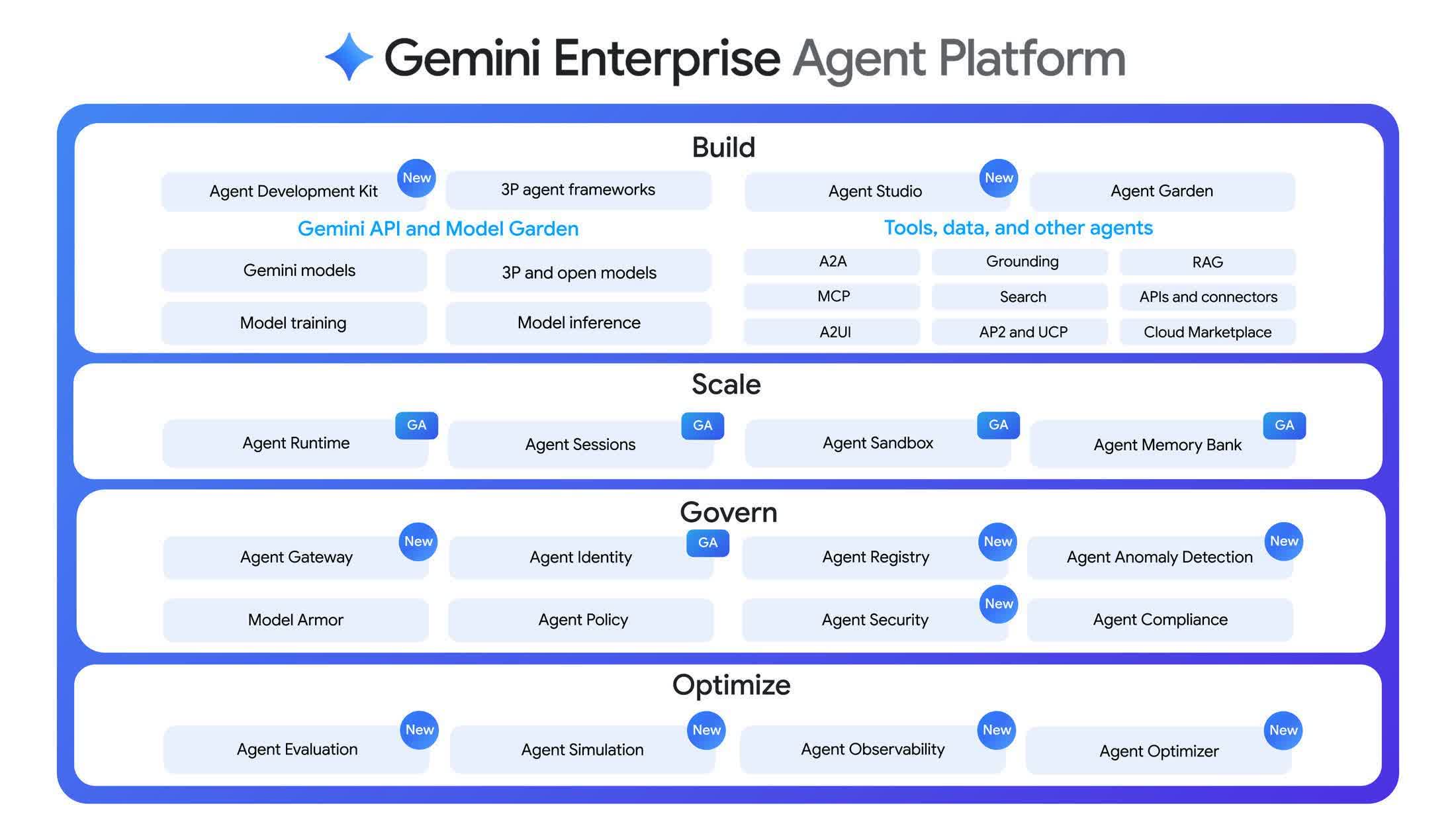
From an agent creation perspective, the company is clearly trying to broaden the audience.
Developers can use the enhanced Agent Development Kit, while business users comfortable with low-code and no-code tools can leverage a new Agent Designer. Together, these offerings are intended to make it easier to build agents that automate workflows, perform specific tasks, and support a range of business processes.
Google also created a dedicated section for agents in its Google Cloud Marketplace, where organizations can find agents built by Google alongside third-party offerings from companies such as Salesforce, ServiceNow, and Oracle. Once created or acquired, these agents can be deployed through the Gemini Enterprise application.
Of course, making agents easier to build is not enough. Before most organizations deploy them broadly, several concerns need to be addressed, especially what happens when agent usage starts to scale across an enterprise.
It is one thing for a small number of technically savvy users to create and use agents for their own work. It is another when thousands, or even millions, of agents operate across departments, applications, and workflows. At that point, governance, visibility, monitoring, and relevance become impossible to ignore.
To its credit, Google addressed several of these concerns. The company introduced Agent Identity, Agent Gateway, and Agent Monitoring capabilities to help organizations track what agents are doing, what information they access, and how they interact with systems and data.
Google also announced an Agent Simulation tool that enables developers and IT teams to test scenarios before agents are put into production. It remains to be seen how effective these capabilities will be, but the broader point stands: without governance functions like these, widespread enterprise deployment of agents is unlikely.
Google also tackled another critical challenge: context. As agents begin handling longer, more complex workflows shared across teams, they need access to the right information to interpret requests and act appropriately. At a basic level, the company is adding Memory Bank and Memory Profiles as part of an updated Agent Runtime engine to provide longer-term memory for agentic workflows.
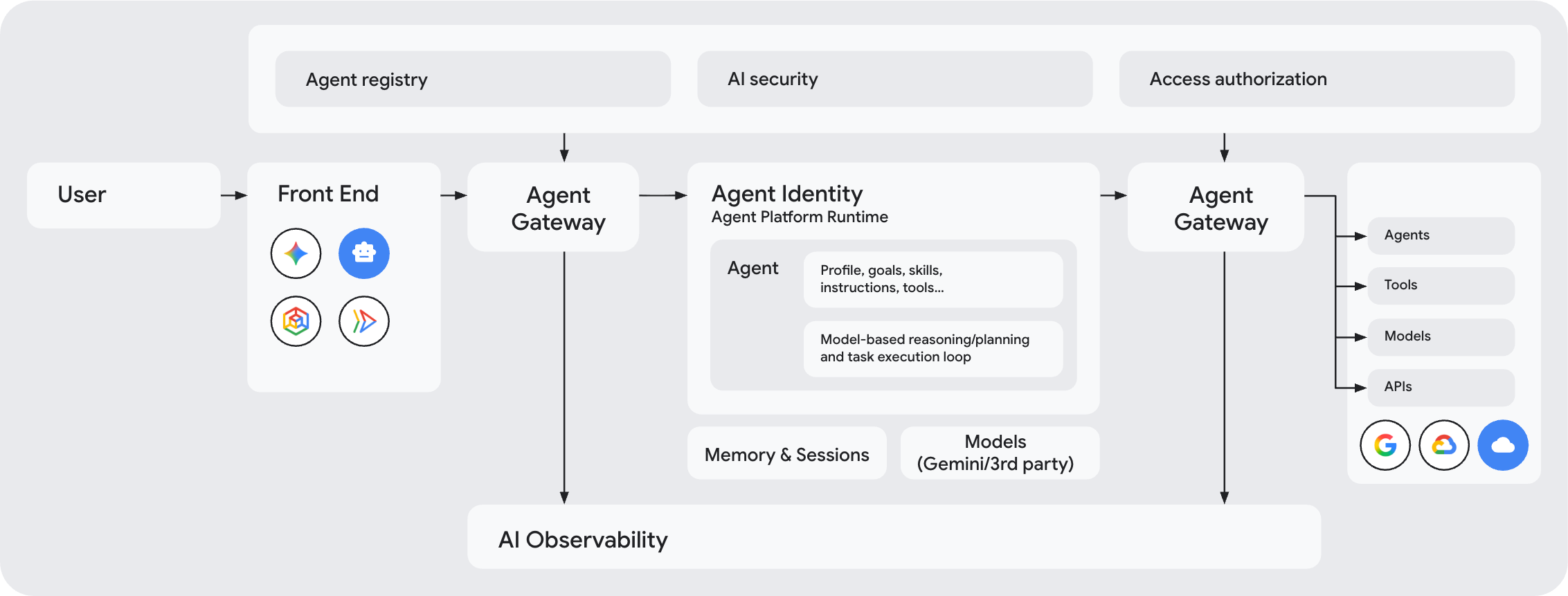
Agent Gateway and Agent Platform ecosystem
Google is also trying to solve one of enterprise AI's biggest problems: giving agents consistent, organization-wide access to relevant data. In theory, that sounds straightforward. In practice, it is difficult, particularly when enterprise data is spread across multiple environments, stored in different formats, and often locked into different clouds.
Google's new Agentic Data Cloud is designed to address those issues by integrating different data types, formats, and locations into a unified knowledge framework. Built on an AI-native cross-cloud lakehouse architecture, it allows organizations to keep data sources in place and avoid expensive data egress charges from moving data between clouds.
That matters because agents need access to the right enterprise context without forcing costly and disruptive data migrations.
Security was another major theme. Many organizations are already dealing with agent-related risks, as well as the spread of Shadow AI through browser tools and extensions. To address those issues, Google announced a telemetry tool for monitoring AI workloads created by extensions in Google Chrome Enterprise, along with a Shadow AI reporting tool for Chrome that provides visibility into browser-based AI activity.
These can operate on their own or integrate into broader SecOps environments. The message is straightforward: if agents become core to enterprise workflows, security and oversight have to be built in.
Google also introduced several agentic capabilities aimed at improving individual productivity. Within Workspace, the company has made Docs, Sheets, and Slides MCP-compatible, enabling them to participate in more sophisticated agent-driven workflows.
That underscores a broader shift in how productivity is being defined. Instead of focusing on isolated tasks, agents create the possibility of linking actions around outcomes. Workspace Intelligence serves as the contextual glue for those connections. Similarly, Canvas mode in Google Enterprise offers a different way of thinking about workflow creation.
There is still much more to come, but all these efforts represent a significant step toward a very different model of work (see "The Outcome Economy: Surviving the Agentic Blitz" for more).
Google has also integrated Gemini more deeply into Workspace. The inclusion of Gemini in Chat opens the door to scenarios where the system can analyze chat logs, determine a presentation is needed, pull in data from Sheets, and build a slide deck in a company's preferred format inside Slides.
Because of the relatively open implementation, Google can also extend some of these capabilities across documents in Microsoft Office formats. For organizations considering a move from Microsoft's tools to Workspace, that could be a notable advantage.
The company is also extending workflows beyond Workspace and into Chrome. The ability to run agentic "skills" inside the browser, enabling multistep browsing workflows.
Finally, there's some new hardware. Google announced the debut of 8th generation TPUs, including new versions optimized for training and inferencing.
Google remains one of the few companies that can design chips, build infrastructure, run a cloud platform, develop AI models, offer data tools, provide security services, and integrate all of it into user-facing applications. There's a competitive advantage in its increasingly full-stack nature of enterprise AI.

Google Cloud's fourth generation cooling distribution unit
Still, that same breadth can also create challenges. Given Google's engineering heritage, the large number of new tools and services is not surprising. But as the company continues evolving into a provider of enterprise technologies for a much broader range of organizations – many of which are far less technically sophisticated than its early adopters – it needs to do more to make these offerings easier to understand, easier to adopt, and easier to use.
There is little doubt advanced users and forward-looking organizations will find productivity gains in these tools. But if the agentic revolution is going to have broad enterprise impact, mainstream business users will need more than powerful technology.
They will need tools that are approachable, understandable, and manageable in everyday work. Cloud Next 2026 made it clear Google understands where enterprise AI is headed. The next challenge is making sure the rest of the market can get there too.
Bob O'Donnell is the founder and chief analyst of TECHnalysis Research, LLC a technology consulting firm that provides strategic consulting and market research services to the technology industry and professional financial community. You can follow him on Twitter @bobodtech