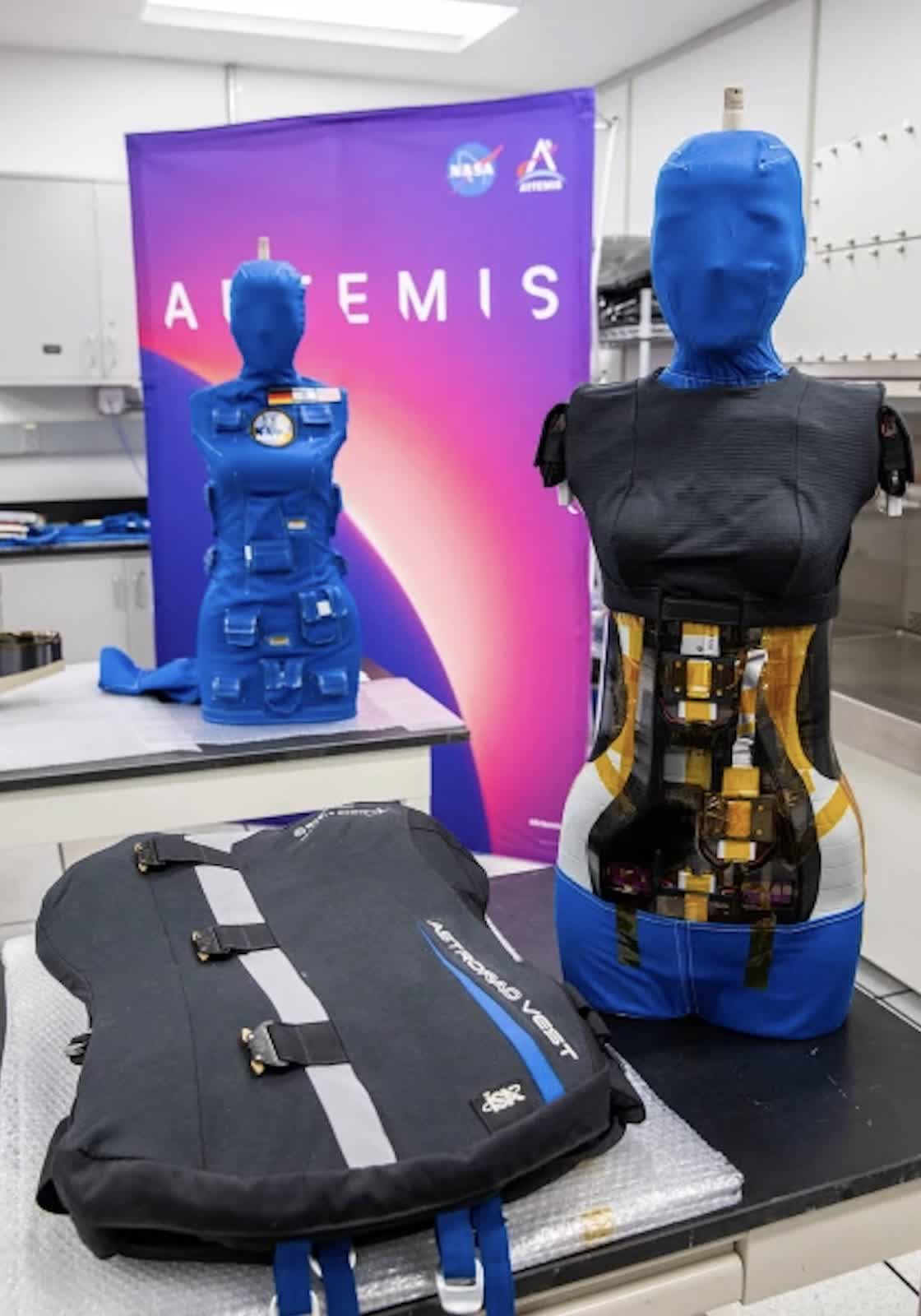
Why it matters: A vest tested during NASA's Artemis I mission could reduce astronauts' radiation exposure during major solar storms, according to a new study. The findings show how targeted shielding could support crew safety as NASA prepares for longer missions around and eventually on the moon.
The AstroRad vest flew around the moon in 2022 on Zohar, one of two female manikins aboard NASA's Orion capsule. Researchers compared Zohar's readings with those from Helga, a second manikin that wore no vest. Both contained thousands of radiation sensors.
The flight did not encounter a major solar storm. Instead, researchers used the data collected as Orion passed through the inner Van Allen radiation belt to model the vest's performance during storms similar to those seen in 1972 and 1989.
The study found that the vest could lower an astronaut's radiation dose by about 60% during a solar event like the 1972 storm, while it could reduce exposure by nearly 40% during a storm comparable to the 1989 event. Researchers said those reductions are equivalent to 193 days and 131 days, respectively, of deep-space radiation exposure.
The findings are relevant as NASA prepares for longer lunar missions. Artemis I was an uncrewed test flight, but NASA plans to send four astronauts on a lunar flyby mission in April. Future missions are expected to support longer stays on and around the moon as the agency works toward a lunar base.
Radiation is a major safety concern beyond low-Earth orbit. Astronauts closer to Earth benefit from the planet's atmosphere and magnetic field, which limit exposure. That protection falls away during missions to the moon and, eventually, Mars.
Zohar wore the 57-pound vest, developed by Israeli startup StemRad and US aerospace company Lockheed Martin. The garment is not intended for daily use. It is designed for periods of elevated solar radiation, when crews may need additional protection inside a spacecraft or shelter.
Rather than covering the entire body, the vest focuses on areas considered especially sensitive to radiation. It protects the lungs, stomach, bone marrow, breasts, and ovaries. Women are believed to face a higher risk of radiation-related cancer than men.
StemRad and Lockheed Martin previously tested a version of the vest on the International Space Station. The design was modeled after gear used by nuclear-disaster response teams. It was not included on Artemis II because that mission is expected to last 10 days and Orion has limited space, but it could be considered for later flights.
The researchers based their simulations on two past solar events. The 1972 storm occurred between the Apollo 16 and Apollo 17 moon landings. If astronauts had been traveling to or working on the moon at the time, they could have faced potentially lethal exposure. The 1989 event was linked to a power-grid collapse and the detonation of magnetic sea mines.
The team is now trying to make the vest lighter without weakening its protective properties. It is also studying whether spacecraft supplies and materials could be repurposed as radiation shielding during emergencies.
Jordan Houri, the study's lead author and a researcher at StemRad, said additional deep-space testing is not expected soon because Zohar and Helga "provided us with an exceptionally large, high-fidelity dataset."
Zohar and the vest are now on display at Kennedy Space Center in Florida.
Image credit: The AP