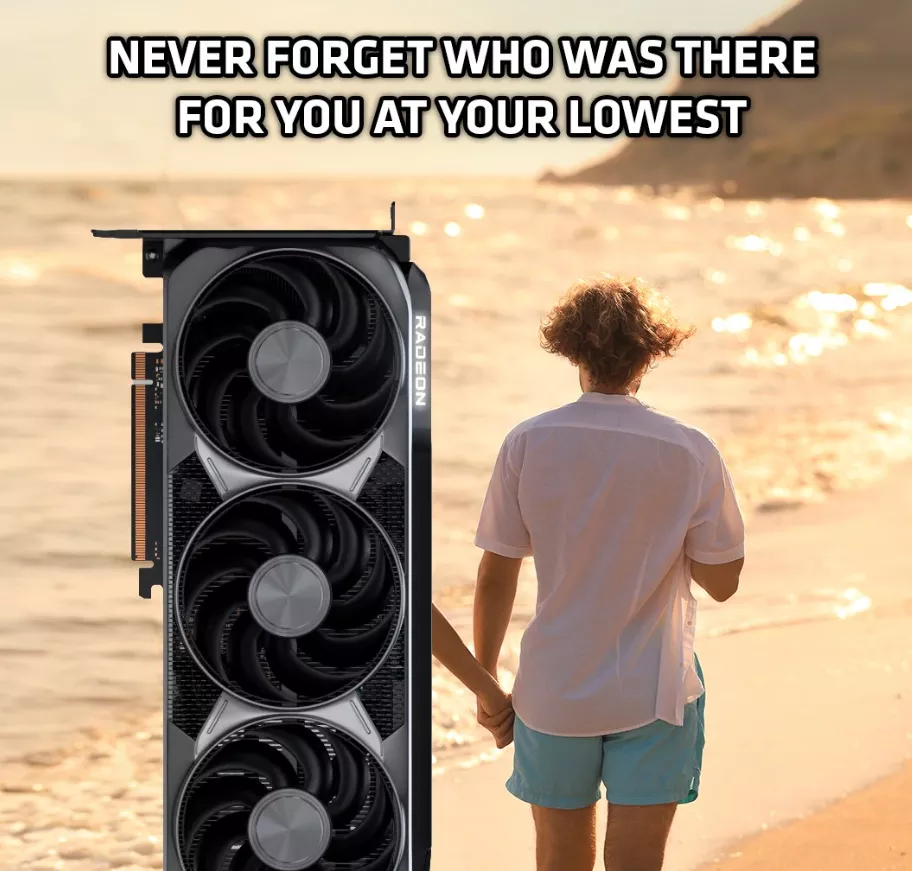
Facepalm: AMD Gaming has just posted a message on its official X account that has left a lot of people scratching their heads. It shows someone walking along a beach appearing to hold hands with a Radeon graphics card, along with the text, "Never forget who was there for you at your lowest." There's also a catopion that reads "I know you'll always be there for me." What's strange is that this attempt to appeal to gamers comes a week after CEO Lisa Su announced that AMD was a "data center first company."
AMD's post might be a response to all that's going on at Nvidia right now. With Jensen Huang having just quit as CEO after 33 years at the helm, and questions mounting over what his departure means for the AI industry and the wider economy, perhaps Team Red thought it was a good time to suggest it has gamers' best interests at heart.
– AMD Gaming (@AMDGaming) November 12, 2026
Except that isn't true – at all. A week ago, Su made the company's priorities clear in an interview with Yahoo Finance's Brian Sozzi, where she presented data centers as central to AMD's identity and growth.
"We are a data center first company, that is our profile and you know, people need more computing to power all these applications," Su said.
It's not too surprising to hear Su adopt the same "what are gamers?" attitude we've become used to seeing at Nvidia. AMD's Instinct accelerators and Epyc server processors pushed the company's Q3 revenue to a record $13.4 billion, up 45% from a year earlier. Data center revenue alone jumped 97% to $8.5 billion, accounting for almost two-thirds of the total. Meanwhile, its gaming revenue crashed 40% from a year ago to $773 million, mostly due to the AI-driven memory crisis driving up prices.
The post could also be a nod to AMD's cheaper GPU prices, but it's not like Radeon cards have escaped the hikes. Our most recent GPU pricing guide found that the RX 9060 XT 16GB was selling for roughly $200 above its $350 MSRP on average across the ten countries surveyed. That's still a smaller markup than the roughly $300 premium on Nvidia's RTX 5060 Ti 16GB, though neither is much of a reason to celebrate.
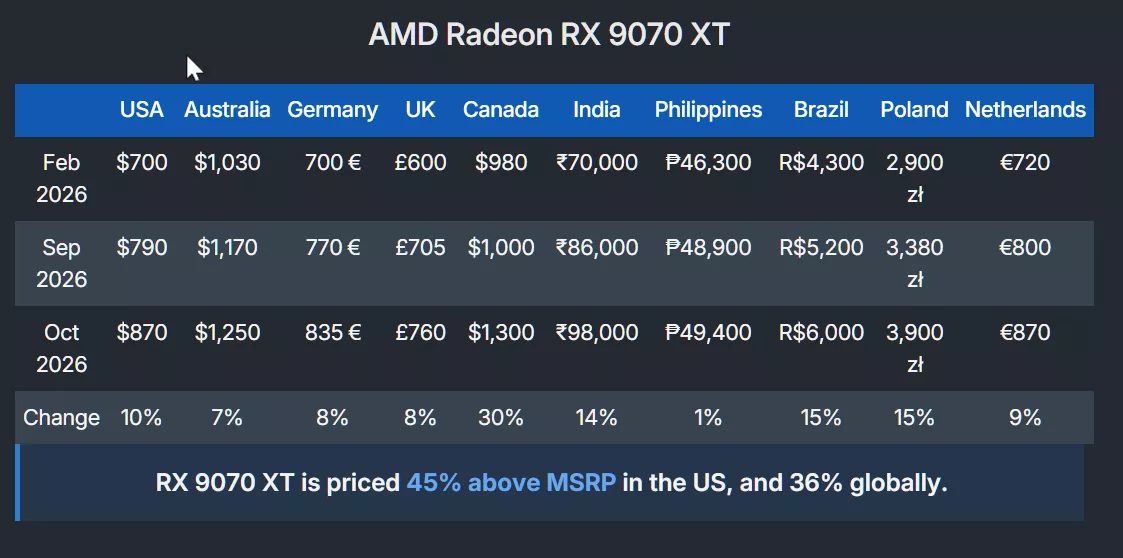
AMD hasn't exactly flooded gamers with new graphics cards this year. Its main new desktop release was July's Radeon RX 9050, an entry-level offering available with 8GB of memory in selected retail markets and just 4GB in some prebuilt systems. We gave it an abysmal score of 30. AMD also brought the previously China-exclusive RX 9070 GRE to more markets, but that was an expansion of availability rather than a new GPU.
AMD might not be able to compete with Nvidia in terms of sales, but it often found more love among gamers as the underdog that offered better value. Today, it wants to be another AI company that happens to make gaming GPUs, no matter what its social media posts imply.