
The big picture: AMD's upcoming Zen 6 CPUs have long been expected to support the company's current AM5 socket, likely closing the book on the platform before AMD moves on to AM6. Data mining has now provided the clearest evidence yet that this will be the case for the Medusa and Olympic Ridge product families.
Prominent leaker InstLatX64 recently shared screenshots of documents from AMD's website that list the company's upcoming Zen 6 processors under the AM5 platform. The information suggests that users with Zen 4 or Zen 5 CPUs will be able to upgrade to Zen 6 without purchasing a new motherboard.
AMD previously said it would support AM5 through 2027, so the news comes as no surprise. However, the company has not formally announced Zen 6, much less confirmed which socket platform it will use. Prominent tipsters have suggested multiple times over the past couple of years that AM5 would continue through Zen 6, but the latest leak is the strongest evidence to come directly from AMD.
– InstLatX64 (@InstLatX64) August 26, 2026
The site lists three Zen 6 CPU lineups, two of which support AM5. These include the desktop-exclusive chips, codenamed Olympic Ridge, and some Medusa APUs designed for AM5 and AMD's mobile FP10 socket. Meanwhile, other Medusa processors will be FP10-only.
AMD is expected to introduce Zen 6 sometime in late 2026 or early 2027. Olympic Ridge chips, presumably named Ryzen 10000, could feature up to 24 cores, more than any previous Ryzen processors, use TSMC's 2nm process, and exceed 6.5GHz. Medusa APUs are expected to appear in laptops and other low-power devices in 2027, with some reportedly using a 3nm process.
Leaked code also indicates that Zen 6 will introduce a third AMD core type. Like Intel's low-power E-cores, Team Red's new tier-3 cores will primarily handle background and idle tasks, while Zen 6 and Zen 6C cores manage heavier workloads.
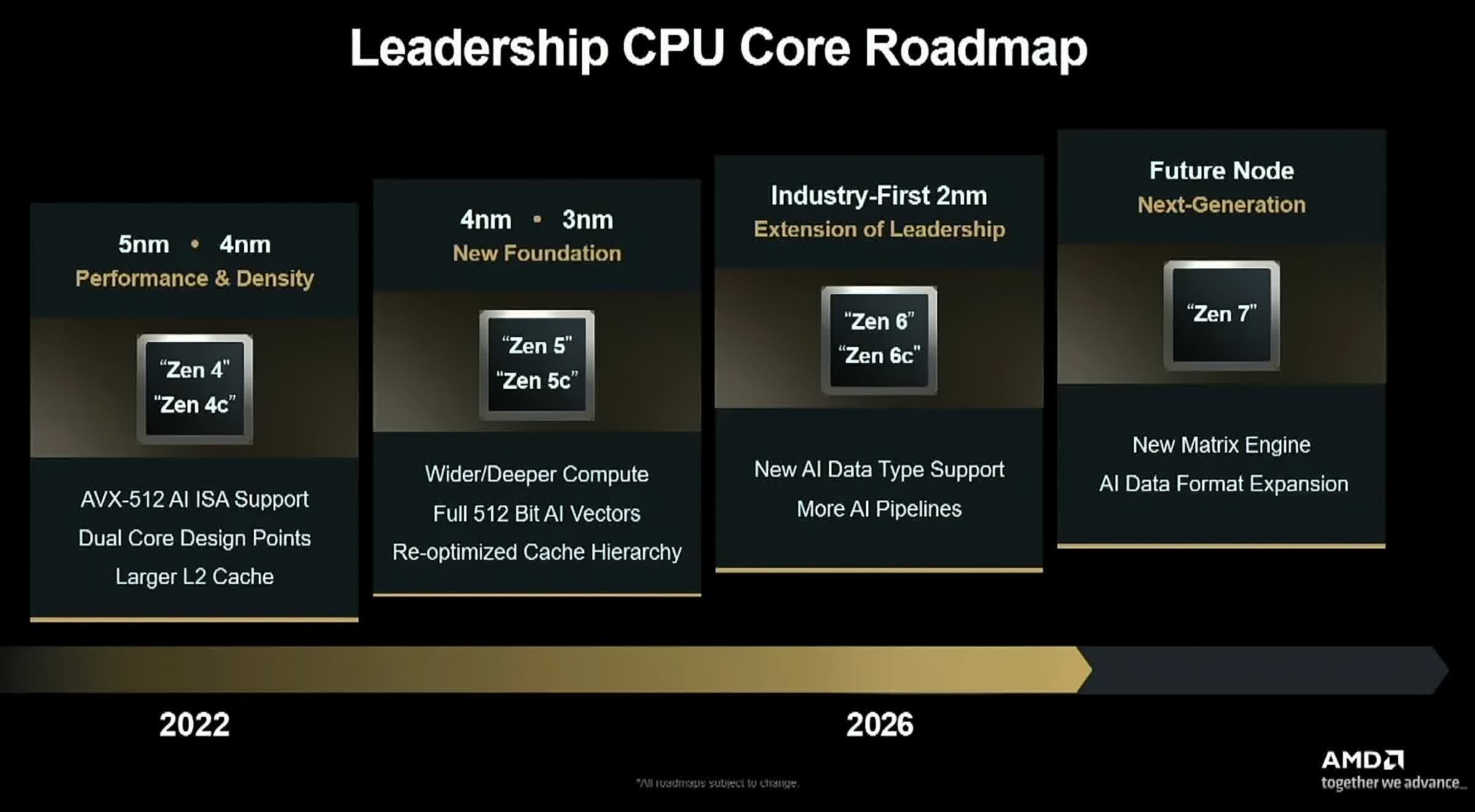
Instead of being an entirely new design, the ultra-low-power cores reuse components from five previous generations of AMD processors: Zen 6's instruction set, Zen 5's microarchitecture, Zen 4's floating-point unit, Zen 3's L2 cache, and Zen 2's L3 cache. The first clue to the existence of these cores emerged in leaked design documents for Sony's rumored upcoming PlayStation handheld, which is expected to use them alongside Zen 6C cores.
AMD patents suggest that the company will introduce the AM6 socket with Zen 7. The new platform might support PCIe 6.0 and DDR6 memory while retaining compatibility with Zen 5 coolers.