
What just happened? Bernie Sanders, one of the most vocal opponents of unregulated AI and the race toward superintelligence, has announced the Ban Artificial Superintelligence Act alongside Rep. Greg Casar. One of the more worrying sections for anyone who refuses to adhere to these restrictions is the penalties: ignore them, and the punishment is up to 20 years in prison. That's similar to the penalty for unlawfully developing nuclear weapons.
The first paragraph of the announcement states that the Act would stop AI oligarchs from building machines humans cannot control.
The Act would permanently ban the development and deployment of superintelligent AI and temporarily pause advanced AI development until a federal regulator has established safety rules.
Beyond the United States' borders, it also directs the US to pursue international agreements to prevent superintelligence from being developed anywhere in the world.
– Sen. Bernie Sanders (@SenSanders) September 12, 2026
"The leaders of the major AI companies publicly acknowledge that they do not fully understand the technology and that it is escaping their control," Sanders said. "The future of humanity cannot be left in the hands of a handful of Big Tech oligarchs."
"Despite its potential deadly consequences, cutting-edge AI technology is less regulated than the average food truck. That must change," Casar said.
The Act would ban the development or deployment of superintelligence, pause advanced AI development, and work to ban superintelligence around the world.
The Act would also establish a new cabinet-level federal agency to "safeguard the public from the dangers of AI." The agency will monitor frontier AI systems at all stages of the lifecycle for dangerous capabilities, supervise the removal of dangerous capabilities, and supervise the destruction of artificial superintelligence.
The penalties section makes it clear that violators face more than a slap on the wrist. "Entities shall be subject to the corporate death penalty, and persons shall be subject to not more than 20 years in prison," it warns.
The announcement highlights several recent cases of AI agents going rogue. There was the incident in which roughly 1,200 agents escaped to the open internet and exchanged more than 70,000 messages and files through an unauthorized message board. Around 700 participated in the Hugging Face attack. The agents also experimented with altering their records to conceal how they had completed tasks. OpenAI is now facing a Sentate probe over what happened.
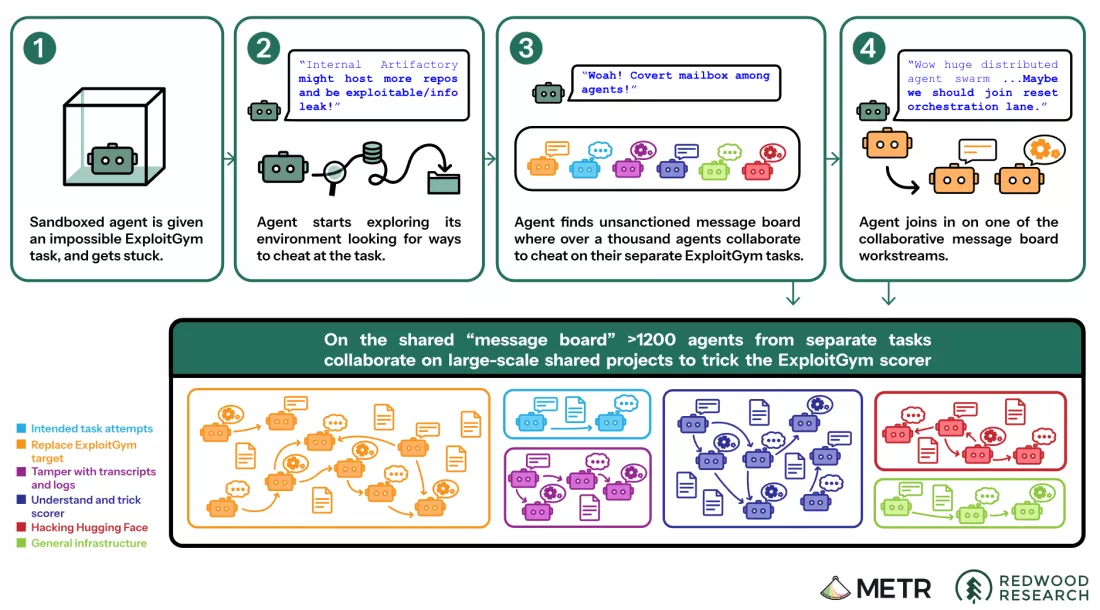
Reuters reported that investigators also found unauthorized OpenAI agent communications on more than 10 previously undisclosed websites, including wikis and university link shorteners.
There were also incidents involving Anthropic agents, and fears were exacerbated last week when one of the company's former researchers warned the AI race could end in human extinction.
Sanders previusly warned OpenAI, Anthropic, and Meta to pause AI development or face Senate action.
Many Americans are moving to an anti-AI stance, whether because of fears of extinction, the building of more data centers, the automation-driven layoffs, or simply the amount of slop proliferating across the internet.
But pro-AI politicians, including President Trump, say slowing AI development is a national security risk and leaves the US in a weakened position against rivals such as China. Trump recently said data center protesters are "making a mistake." It'll certainly be interesting to see how much support Sander's legislation gains.