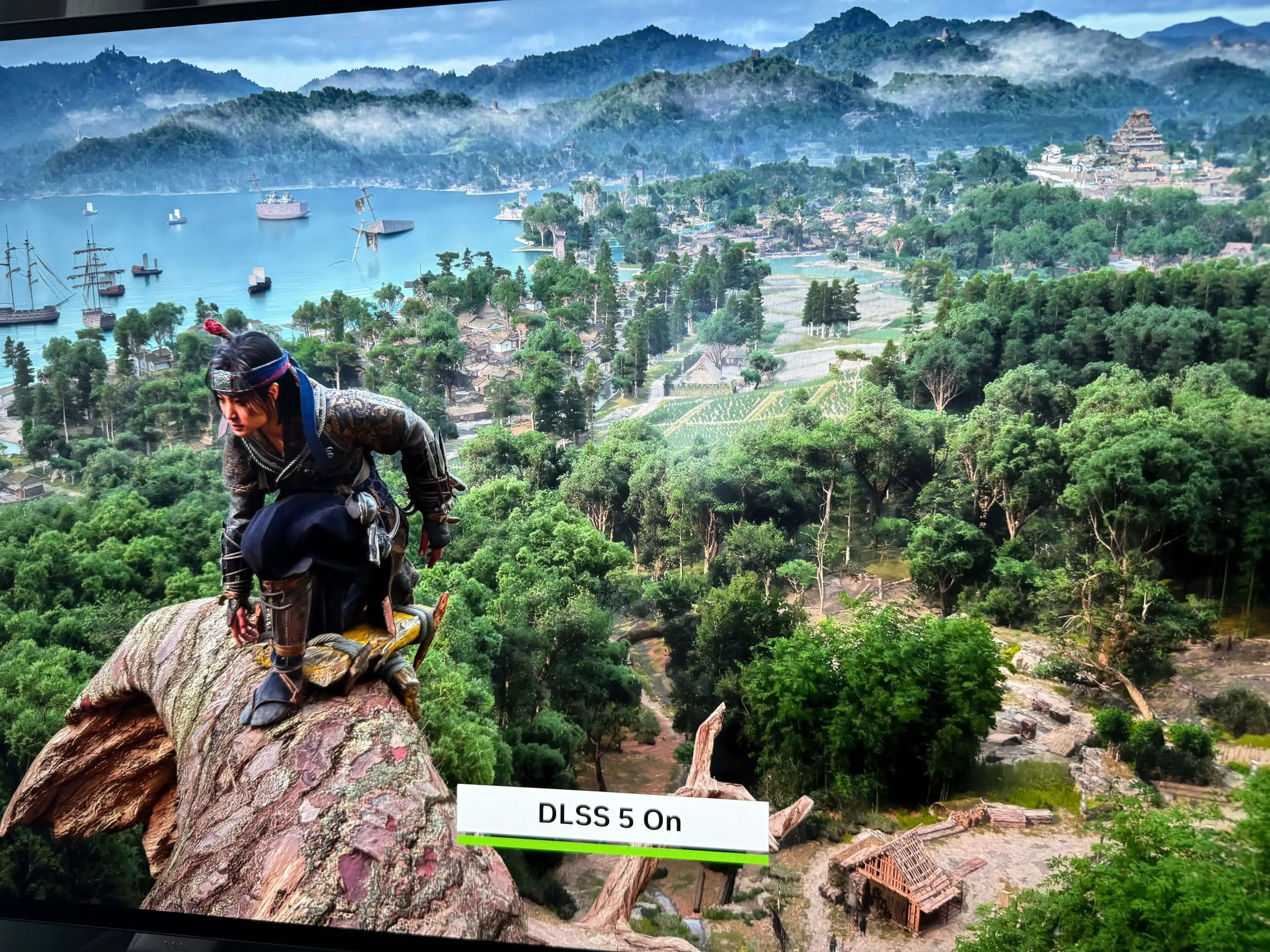
Why it matters: The introduction of Nvidia's controversial DLSS 5 could mark the beginning of a fundamentally new approach to rendering video game graphics. If AMD and other manufacturers respond with similar approaches, neural rendering could become standard for consumer hardware in the future.
In a recent post on the AnandTech forums, trusted leaker Kepler_L2 claimed that AMD's next-generation graphics hardware will support its take on neural lighting, which Nvidia recently introduced with DLSS 5. The move could significantly expand the technology's reach beyond PCs using Nvidia's high-end graphics cards.
DLSS 5 uses neural rendering to add extra lighting and shadows to rendered frames, aiming to make traditionally rendered games more realistic. However, Nvidia's initial presentation sparked intense backlash stemming from fears that neural rendering hallucinates visuals that can clash with a game's art direction.
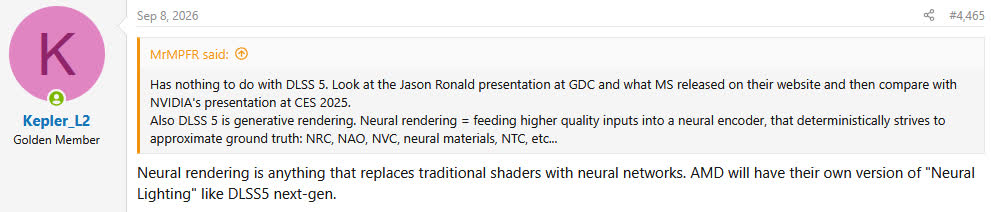

Kepler speculates that while Nvidia's version makes changes after guessing scene content, an improved version or an AMD rival could have direct access to 3D engine data for more accurate enhancements. Alternatively, lighter models might enhance only lighting or shadows without altering color and other complex elements, staying truer to a game's original artistic style.
The PC version of NBA 2K27 is currently the only game that officially supports neural rendering, but modders have applied DLSS 5 to numerous other games. While NBA 2K27 gains more comprehensive shadow coverage from DLSS 5 at a substantial performance cost, other games have received dramatic and divisive transformations.
Also Read: Testing DLSS 5's Real Performance (No 6X Frame Gen)

Because of neural rendering's massive performance cost, Kepler suggested AMD's take will be supported only on RDNA 5 hardware. In another recent post, the leaker claimed that Team Red plans to launch RDNA 5 with one new GPU next year, which could achieve performance similar to Nvidia's RTX 5080. Other chips from RDNA 5 and Nvidia's next-generation RTX 60 architecture are expected to arrive in 2028.
RDNA 5 is also expected to power next-generation consoles from Sony and Microsoft. If AMD aims to follow Nvidia in adopting neural rendering, as it did with ray tracing, upscaling, and frame generation, then games on Microsoft's in-development project codenamed Helix and Sony's PlayStation 6 might support the technology. This would significantly increase the incentive for game developers to adopt DLSS 5 and AMD's rumored equivalent, eventually making them as common as upscaling is now.