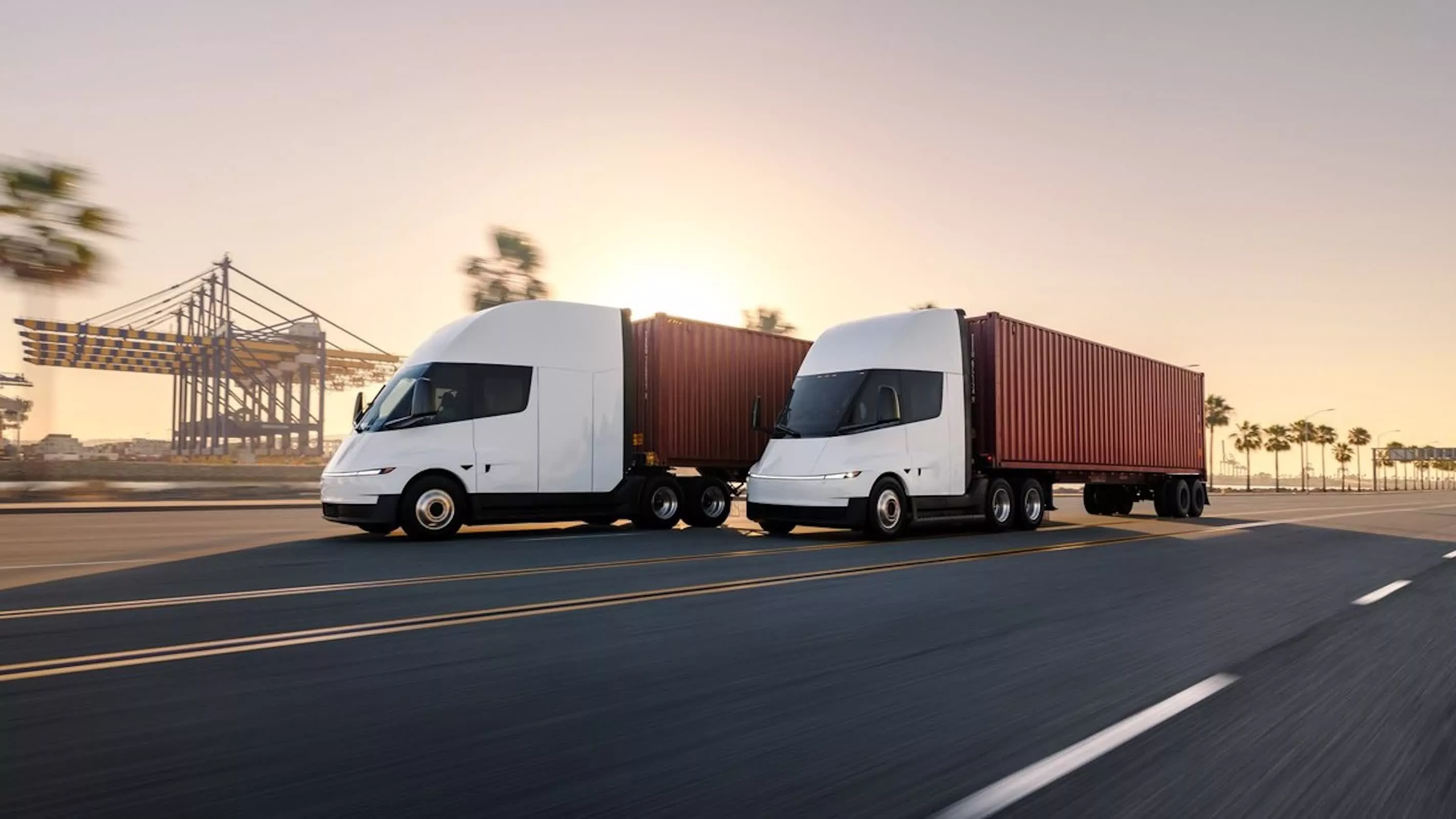
The takeaway: Tesla has begun volume production of the Semi, its battery-electric heavy truck, at a new facility next to Gigafactory Nevada. The launch marks a more serious commercial phase for the Semi after years of delays. The company says the first Semis produced at the new factory are now being delivered to customers.
The Sparks, Nevada, plant can eventually produce 50,000 trucks a year, or about 1,000 a week, according to Tesla. Before this milestone, the company delivered a small number of trucks to PepsiCo in 2022, but those vehicles were built on a pilot line.
Tesla used an event at the factory to highlight changes made to the truck's battery, powertrain, and charging system. It also named customers that include PepsiCo, US Foods, DHL, WattEV, ABF Freight, Einride, IMC Logistics, and OK Produce.
The Semi will be sold in two versions. Tesla lists the Standard Range model at 325 miles of range when hauling a full 82,000-pound gross combination weight trailer. The Long Range model is rated for 500 miles under the same conditions. Tesla executives said the Long Range truck could reach about 600 miles with a lighter load of roughly 60,000 pounds.
– Tesla Semi (@tesla_semi) September 25, 2026
Tesla has not released current prices or total reservation figures. When the company introduced the Semi in 2017, it set the starting price at $150,000 for a 300-mile version and $180,000 for a 500-mile version. Electrek reported earlier this year that Tesla was quoting some customers about $290,000 for the 500-mile truck.
The production Semi uses Tesla's 4680 battery cells rather than the 2170 cells used in earlier test vehicles. Tesla says the truck's battery pack has 822 kWh of capacity. The company says it has reduced the truck's energy consumption to about 1,700 watt-hours per mile when fully loaded, down from an original target of 2,000 Wh/mile.
Those efficiency gains are important because they allow Tesla to use a lighter battery pack while maintaining its range target. The company also said it cut nearly 1,000 pounds from the truck during development.
Tesla also reworked the drive system. The earlier design used a carbon-fiber-sleeved rotor. The production version uses a steel-caged rotor and a bar-wound stator that Tesla also uses in the Cybertruck. Tesla says the redesigned drive axle is about 80 kilograms lighter.
The company also simplified the truck's lubrication system. The hub no longer uses oil, while the motor and gearbox share a single oil supply. Tesla says that oil should last more than 250,000 miles.
The Semi now has redundant electric power steering instead of hydraulic steering. Tesla says the new system gives drivers better response and control. It also allows a tighter wheel cut, which the company says brings the Semi's turning radius close to that of a Model Y. That could matter in crowded industrial yards, city streets, and loading docks.
– Teslasti Basti (@BastianBraun121) September 11, 2026
Tesla has also carried over elements of the Cybercab's thermal-management system. The Semi uses an indirect system with pumps, compressors, and heat exchangers that manage temperatures across the cab, battery, and drive unit. Tesla says the design reduces the amount of refrigerant plumbing needed throughout the vehicle and can move heat where it is needed.
Charging remains one of the larger questions around the truck. A Semi's 822-kWh pack requires far more power to charge than a passenger EV. Tesla is building Megacharger stations that can provide as much as 1.2 megawatts per stall. At the event, Tesla showed a truck charging from 3% to 60% in about 30 minutes.
The company says it plans to have more than 30 Semi charging locations, with over 200 megawatt-capable charging posts, by the end of the year. It also expects fleet operators to install overnight charging equipment at their own facilities.
Tesla is pitching the Semi as a fleet product with remote diagnostics, mobile service, over-the-air updates, and driver profiles that can follow drivers from one truck to another. It says its current Semi fleet has recorded more than 98% uptime.
– Tesla Charging (@TeslaCharging) September 15, 2026
Some fleet operators have already placed large orders. Einride announced a 500-truck deal in August. IMC Logistics said this week that it plans to buy 50 Semis for California drayage work. A shipper coalition also selected Tesla to provide 2,500 trucks for zero-emission freight operations in California.
Tesla argues that electric trucks can cost less to operate than diesel models because they require less maintenance and are less exposed to swings in fuel prices. "You know, volatility in the oil market and the diesel market goes up and down," Tesla Vice President of Engineering Lars Moravy told The Verge. "But typically, we've seen in the history of the last 20 years, electricity is pretty flat. And wouldn't it be great to have a flat cost in your shipping rates?"