
Good news, guys. I've saved up my dollarydoos and I'm finally ready to buy a new graphics card for playing all my favorite video games. So let's go shopping, shall we?
I've got around $1,200 to spend here in Australia, roughly $850 USD, though ideally we'd like to spend a little less. Let's aim for a mid-range GeForce GPU because we've heard over on Reddit that GeForce is better than Radeon, so that's probably correct. Clearly, we're off to a very sensible start.
The GeForce RTX 5060 Ti seems like what we're after, the 16GB model of course, because we might eventually play something other than Fortnite. You never know.
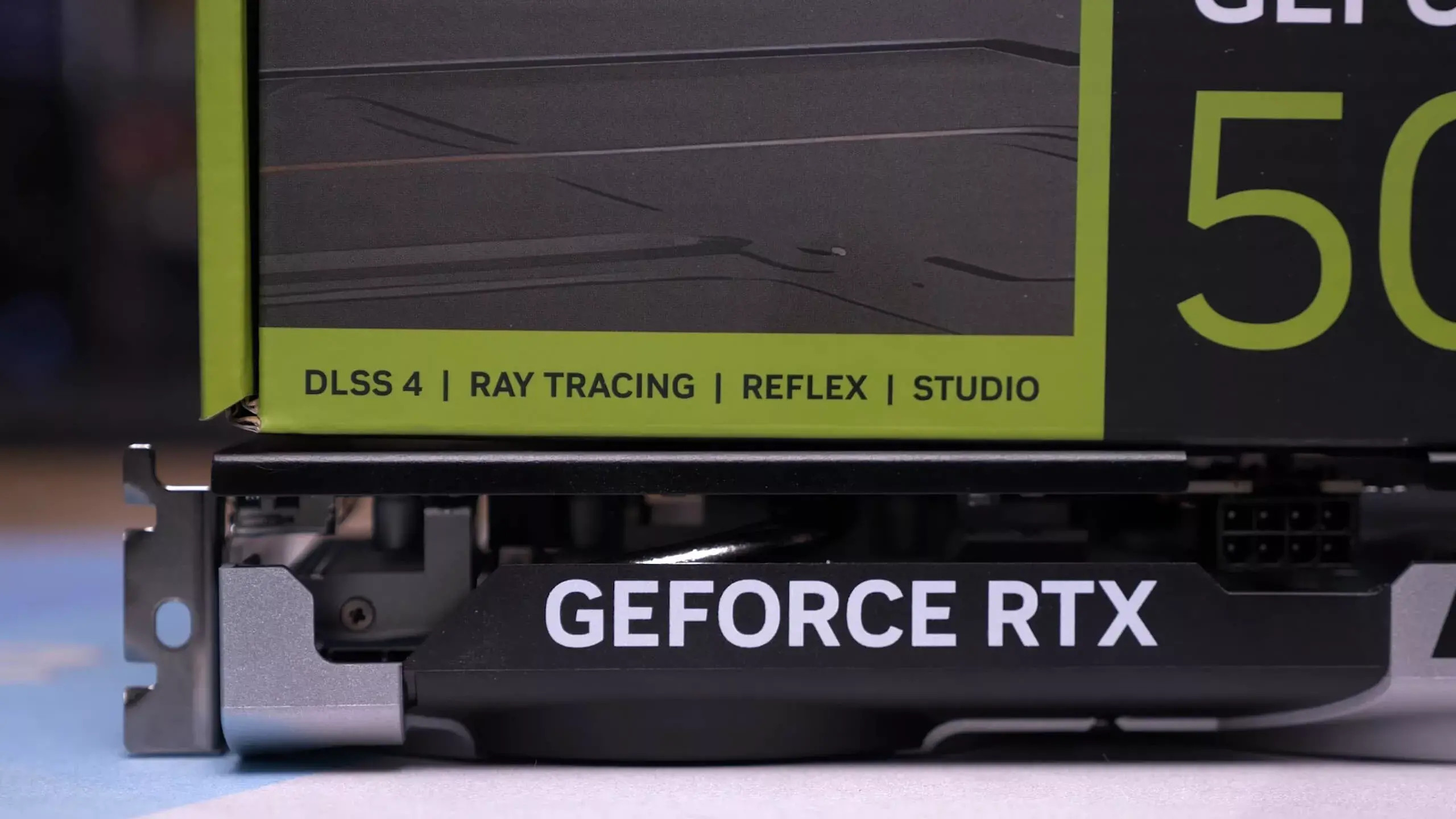
Wow, what's going on here? The last time we checked, admittedly earlier in the year, the 5060 Ti 16GB was priced around $750. Now they're starting at $1,050 and are mostly out of stock.
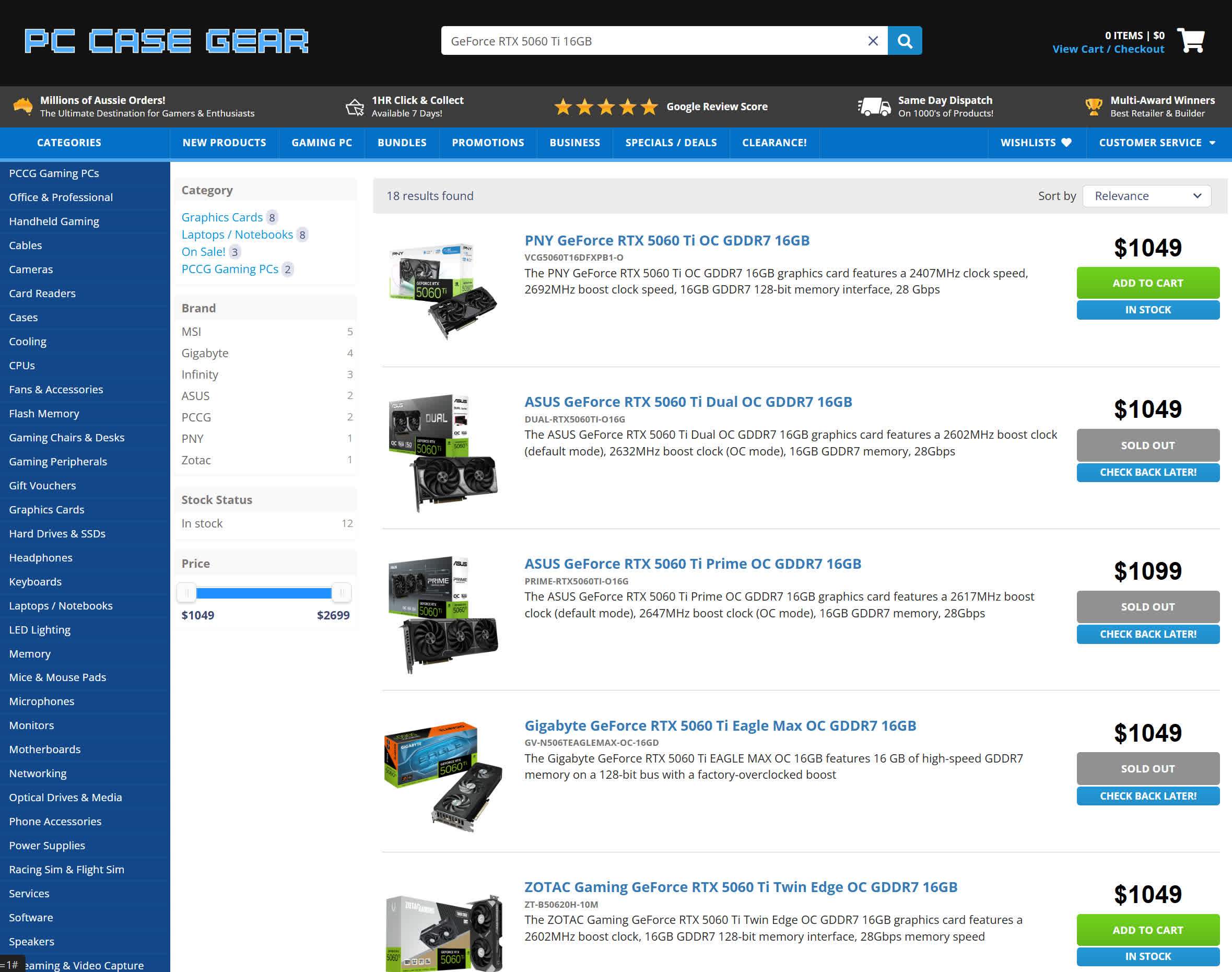
In fact, PC Case Gear has just a single model available, a PNY card for $1,049. Yikes. Bugger that, let's try Mwave. Here we go, $769. Nice. Wait, it's out of stock. Okay, $1,000, also out of stock. $1,049, finally one that's available, and it's another PNY model. Then there's the Asus Dual at $1,129. Man, it's rough out here.
Okay, so we know those Radeon GPUs aren't meant to be as good, but we're getting desperate, so let's take a look. Based on what we're seeing at local retailers, a GPU called the Radeon RX 9070 XT appears to be the direct competitor to the 5060 Ti 16GB. They're a little more expensive, but pricing is surprisingly similar, starting at $1,149 with plenty of models around $1,249. Hopefully it's not much slower than the GeForce GPU.
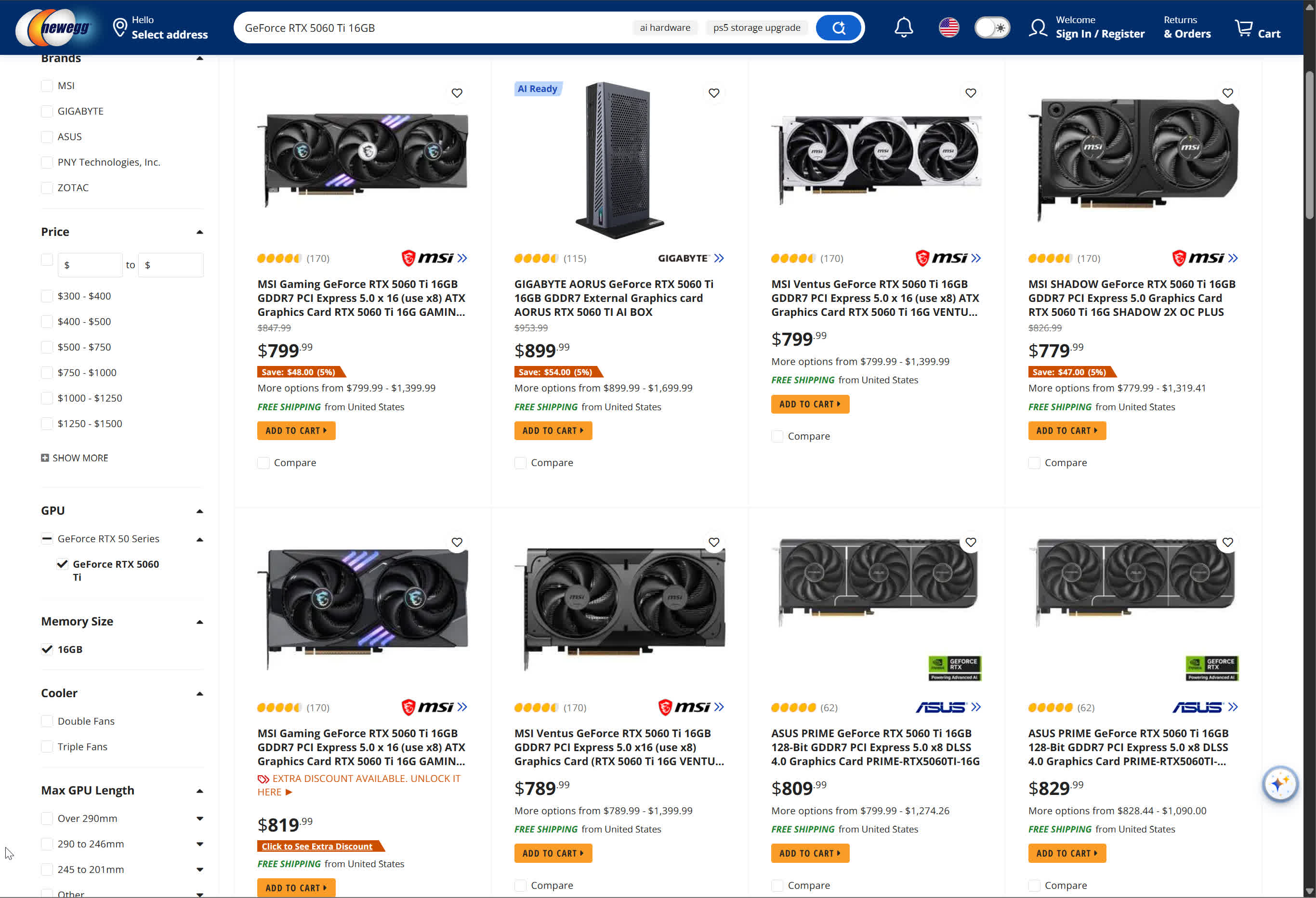
Just to make sure this isn't some bizarre Australian pricing anomaly, we also checked Newegg. There, the 5060 Ti 16GB starts at around $780, which means the 9070 XT is actually cheaper, with Radeon models starting at roughly $740. Both GPUs come with 16GB of VRAM, so we clearly need to see how they compare.
For that, we've benchmarked the Radeon RX 9070 XT and GeForce RTX 5060 Ti 16GB across 52 games to see what gamers are actually getting for roughly an $800 budget overseas or around $1,200 in Australia. Rather than walk through all 52 games individually, we'll highlight some of the more interesting results before getting to the full performance summary and cost-per-frame analysis. Let's do it...
Test System Specs
| CPU | AMD Ryzen 7 9800X3D |
| Motherboard | MSI MPG X870E Carbon WiFi [BIOS 7E49v1A4] Resizable BAR Enabled |
| Memory | G.Skill Trident Z5 RGB DDR5-6000 CL30 [CL30-38-38-96] |
| Graphics Card | Sapphire Radeon RX 9070 XT Pure Asus Prime GeForce RTX 5070 Ti 16GB |
| ATX Case | MSI Prospect 700R |
| Power Supply | Kolink Regulator Gold ATX 3.0 1200W |
| Storage | TeamGroup T-Force Cardea A440 M.2 PCIe Gen4 NVMe SSD 4TB |
| Operating System | Windows 11 25H2 |
| Display Driver | AMD Radeon Adrenalin 26.8.1 GeForce Game Ready Driver 610.88 |
Benchmarks
007 First Light
Starting with 007 First Light, we see the 9070 XT is 81% faster at 1440p using the Medium preset, with frame rates jumping from 67 fps on the RTX 5060 Ti to 121 fps on the Radeon GPU. That seems like quite a lot.
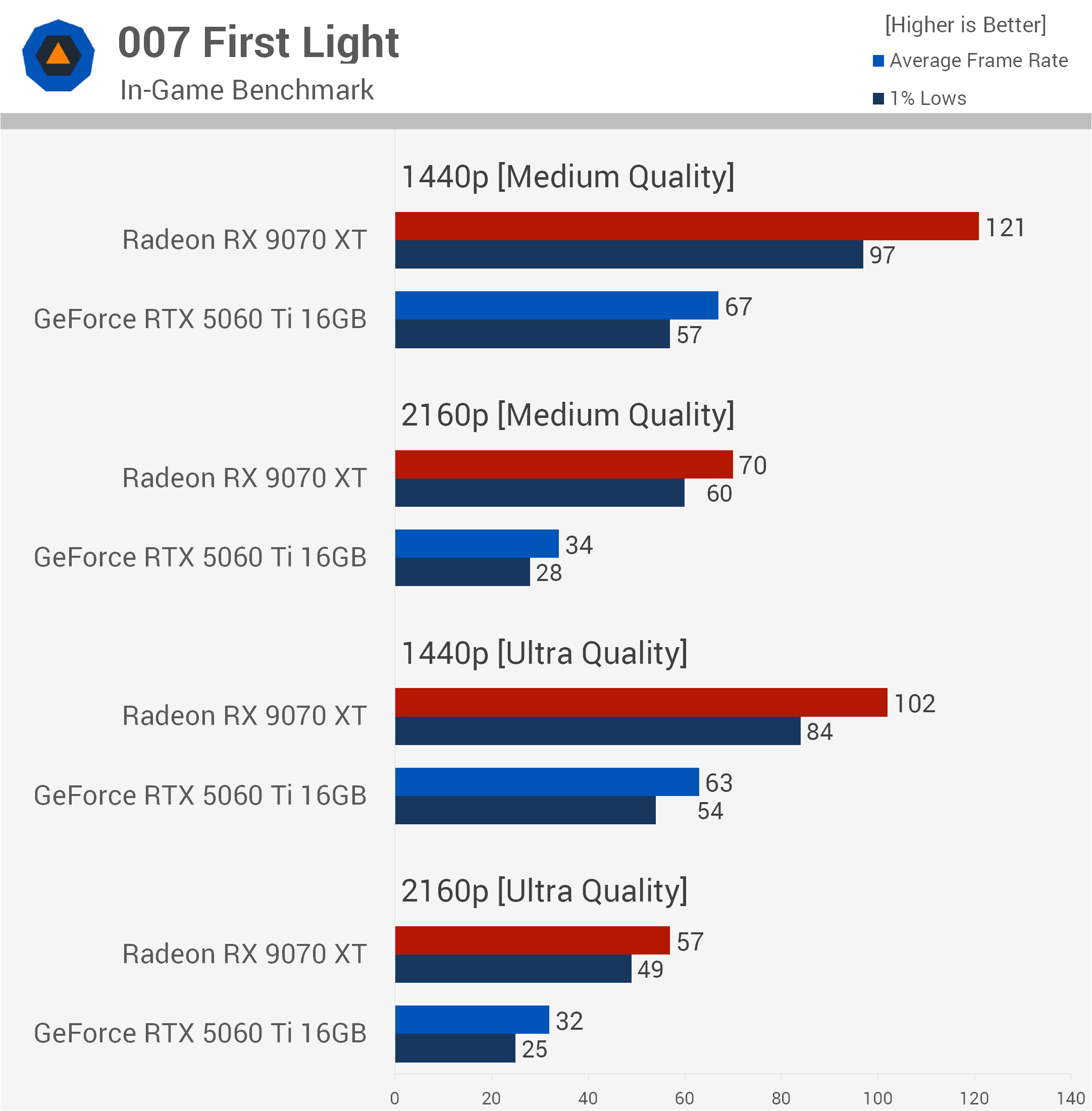
The 4K results are even worse for the GeForce GPU. Again using the Medium preset, the 9070 XT was 106% faster, taking performance from a measly 34 fps to a highly playable 70 fps.
Switching to the Ultra preset didn't help the RTX 5060 Ti all that much. The margins did come down, but even so, the 9070 XT was still 62% faster at 1440p and 78% faster at 4K. At native resolutions, the 5060 Ti is effectively limited to 1440p here, while 4K is a realistic option with the 9070 XT.
Spider-Man 2
Swinging into Spider-Man 2, the 9070 XT continues to flex on the 5060 Ti. At 1440p using the Very High preset, it averaged 130 fps compared with 81 fps on the 5060 Ti, a massive 60% performance advantage.
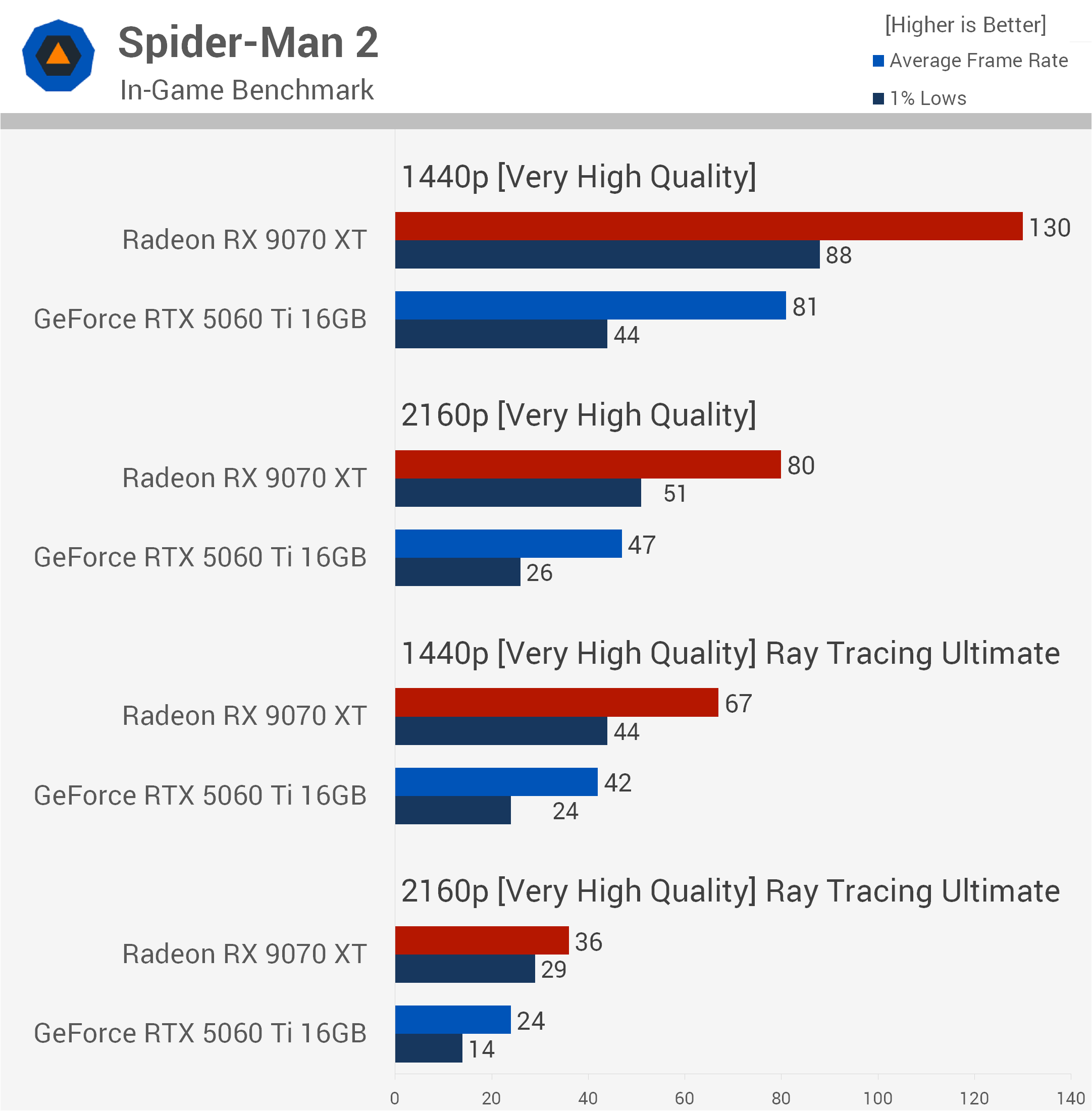
Even at 4K, the Radeon GPU remained rock-solid at 80 fps, making it 70% faster than the 5060 Ti, which managed just 47 fps.
Enabling the demanding Ray Tracing Ultimate mode brings frame rates down, but the hierarchy stays firmly in place. At 1440p, the 9070 XT delivered a playable 67 fps, making it 60% faster than the 5060 Ti's 42 fps. Then at 4K, the 9070 XT averaged 36 fps, giving it a 50% advantage over the 5060 Ti's cinematic 24 fps.
Lego Batman: Legacy of the Dark Knight
Moving over to Lego Batman, we see the bloodbath continue. At 1440p using the Medium preset, the 9070 XT pumps out 234 fps compared with 149 fps for the 5060 Ti, making the Radeon card a cool 57% faster. Bumping the resolution to 4K makes the Nvidia card's value proposition look even more embarrassing. The 9070 XT crushes it by an 88% margin, delivering a buttery-smooth 147 fps while the 5060 Ti trails far behind at just 78 fps.
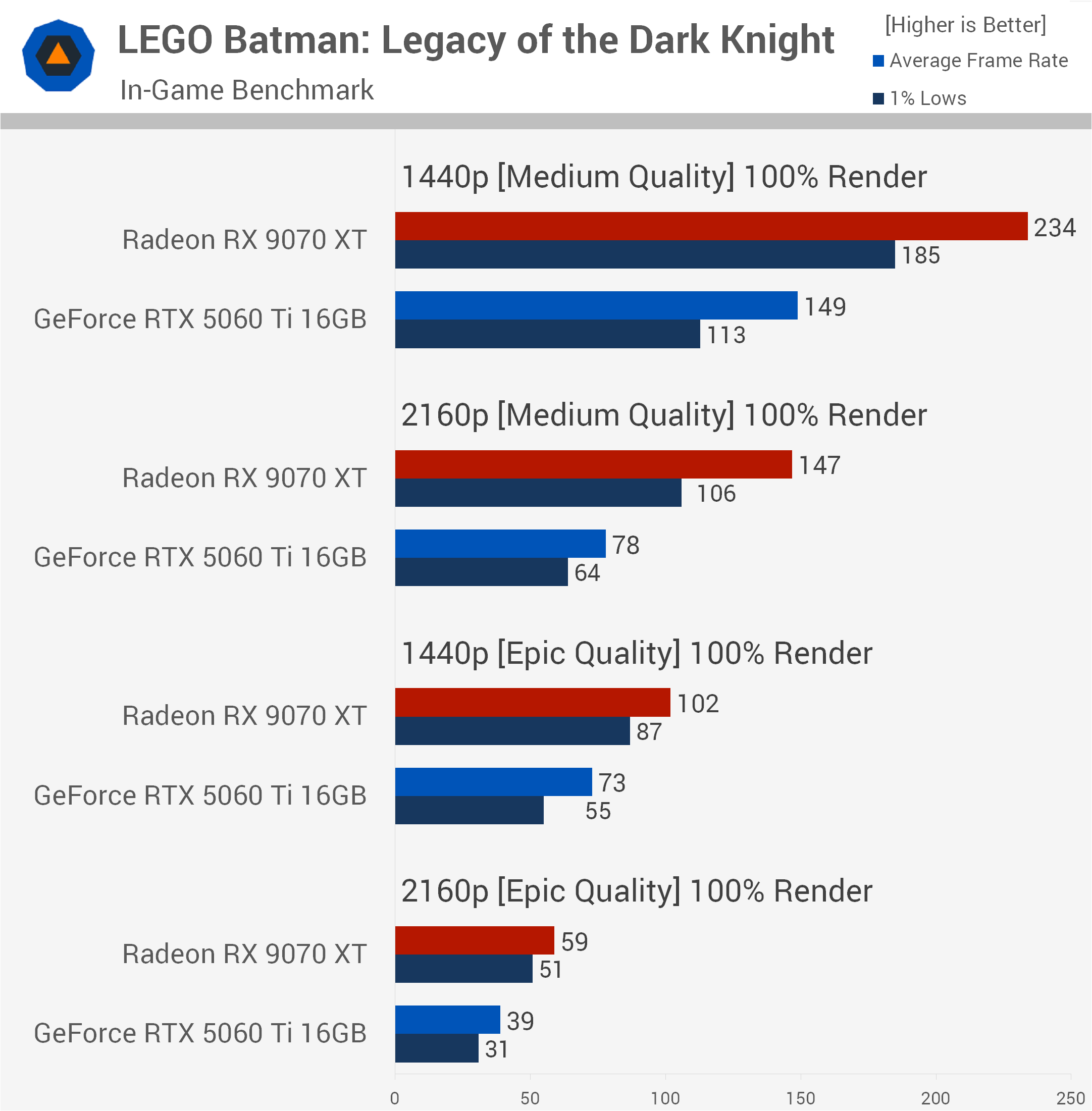
Cranking the visuals up to the Epic preset gives the RTX 5060 Ti a slight breather in terms of the performance gap, but it still gets thoroughly outclassed. At 1440p, the Radeon GPU maintains a comfortable 40% lead, hitting 102 fps versus 73 fps for the GeForce GPU.
Pushing the resolution to 4K, the 9070 XT manages to scrape by with an almost 60 fps experience, making it 51% faster than the 5060 Ti's rather pathetic 39 fps. Ultimately, while 1440p is doable on both GPUs, anyone hoping for a decent native 4K experience here will be severely disappointed by the GeForce card.
Fortnite
Fortnite gives the RTX 5060 Ti its closest showing yet, at least in lightweight competitive settings. At 1440p using Performance Mode, the 9070 XT was just 14% faster, though that gap stretched to 30% at 4K.
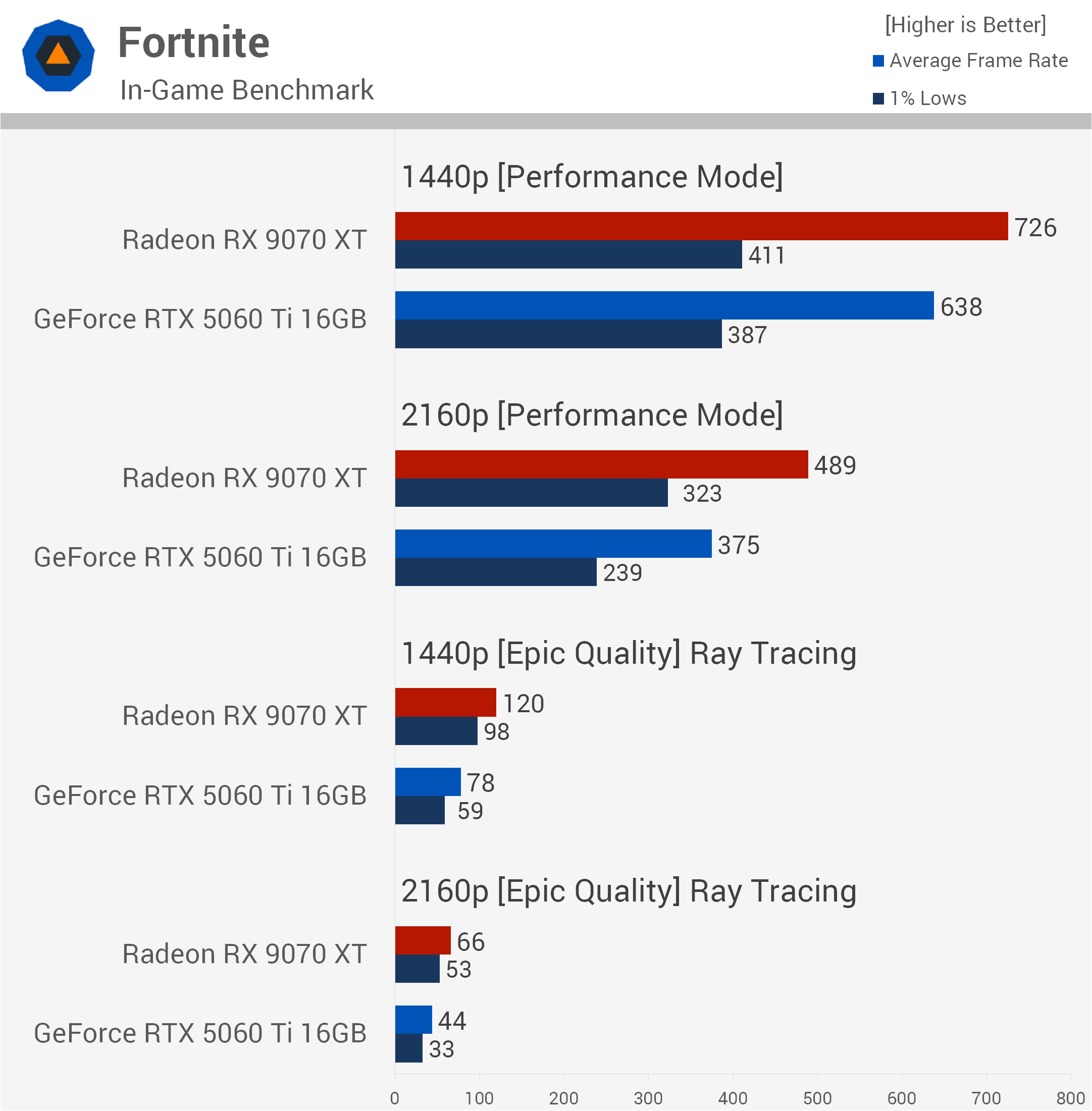
However, once Unreal Engine 5's full graphical suite is unleashed using Epic Quality settings with ray tracing enabled, normal service resumes. At 1440p, the 9070 XT rendered 120 fps, making it 54% faster than the 5060 Ti's 78 fps. Then at 4K, AMD held a flat 50% lead at 66 fps versus 44 fps.
Forza Horizon 6
In Forza Horizon 6, the rasterized and ray-traced results tell an identical story of AMD dominance. Using the Extreme preset at 1440p, the 9070 XT was 65% faster, rendering 140 fps compared with the 5060 Ti's 85 fps.
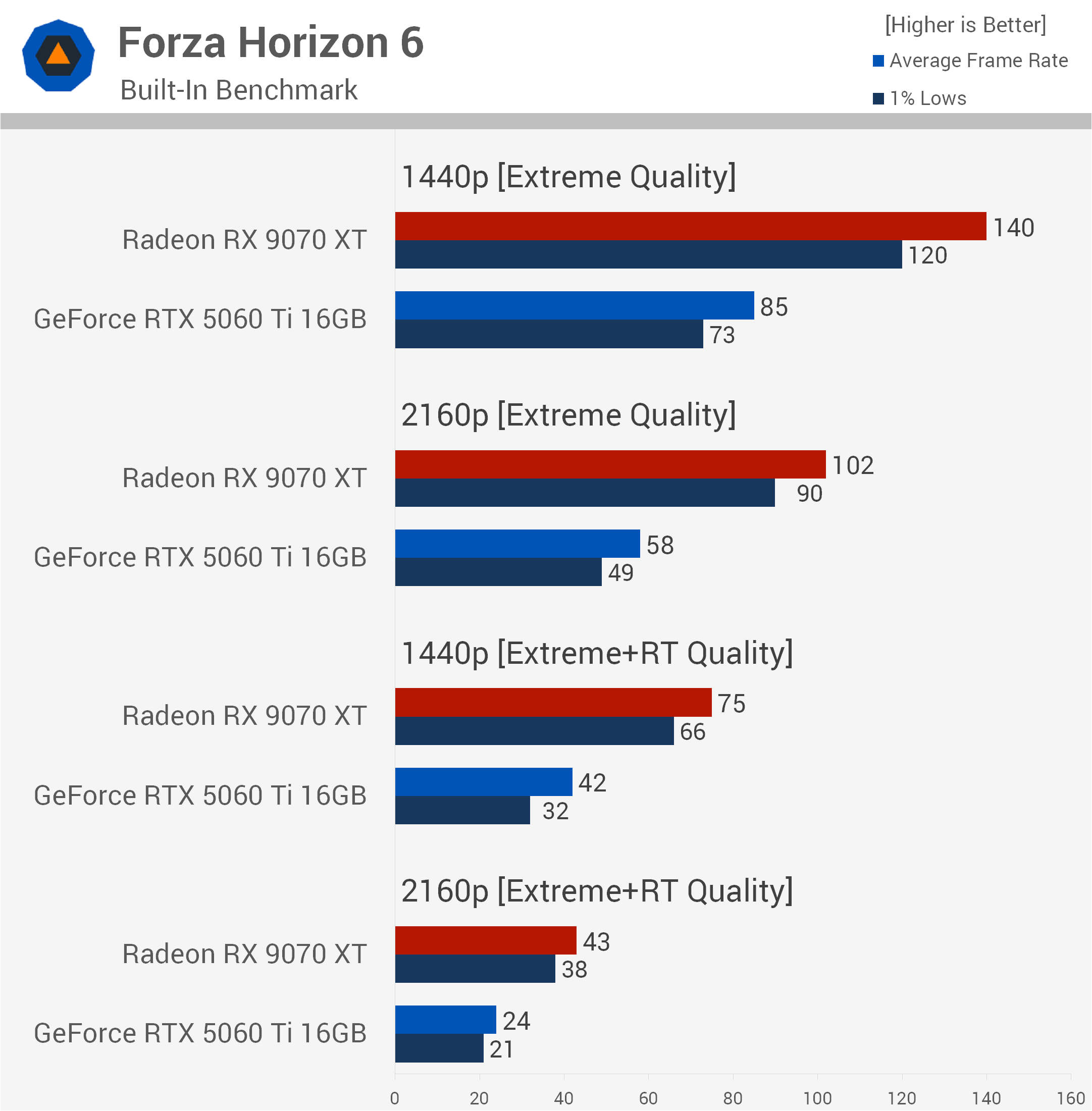
Moving to 4K, the 9070 XT breezed past the 100 fps mark, while the 5060 Ti failed to maintain 60 fps, giving the Radeon GPU a 76% advantage.
Tossing ray tracing into the mix highlights the hardware gap even further. At 1440p, the 9070 XT remained 79% ahead with 75 fps versus 42 fps. At 4K, both GPUs struggled, but the 9070 XT's 43 fps was still 79% faster than the unplayable 24 fps produced by the RTX 5060 Ti. With some upscaling support, the Radeon GPU would at least be usable here.
Crimson Desert
Next up is Crimson Desert, where the 9070 XT maintains a commanding lead. Using the Medium preset at 1440p, the Radeon GPU averaged 103 fps compared with 67 fps for the 5060 Ti, a 54% performance advantage.
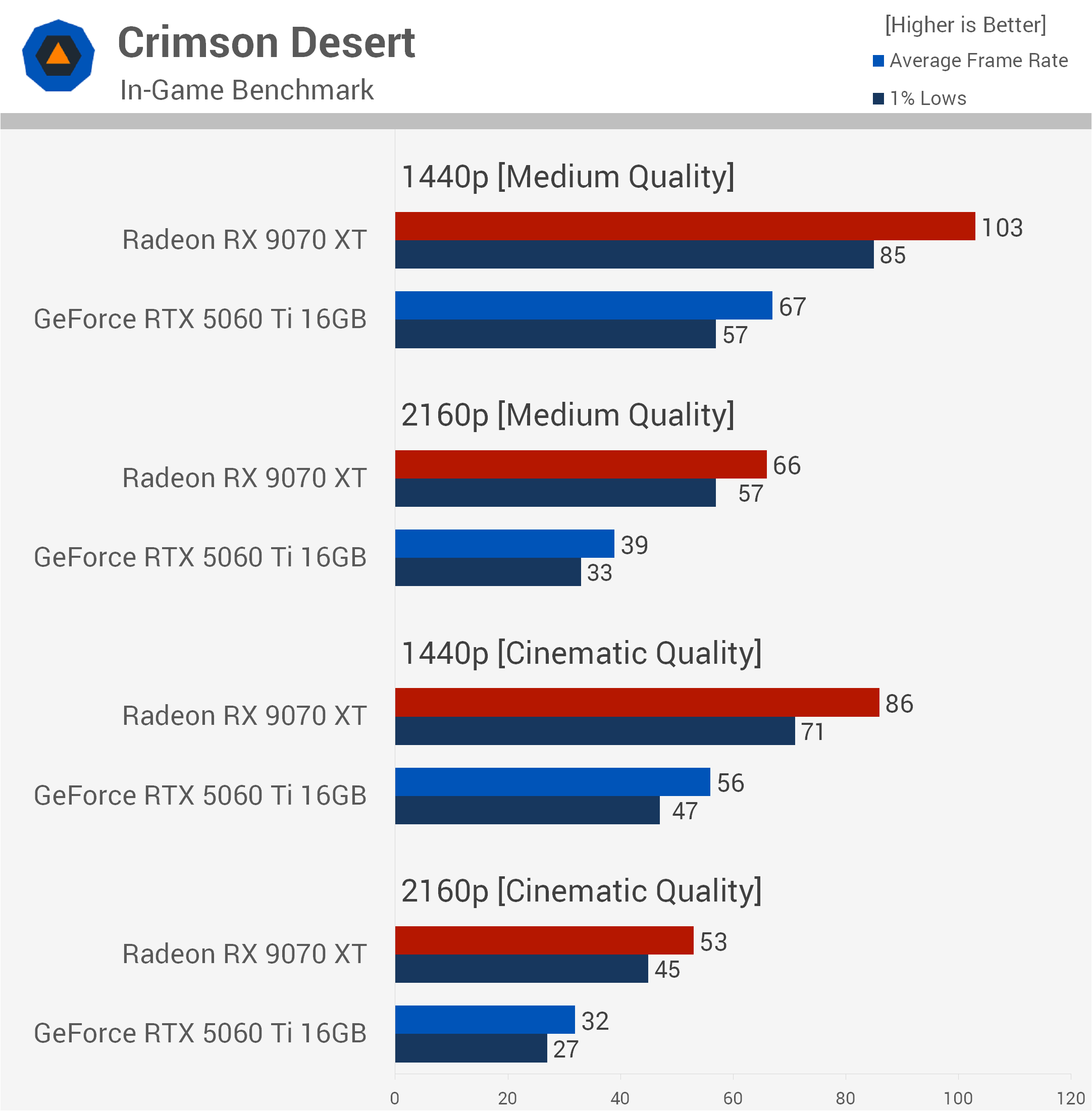
At 4K, the disparity widened considerably. The Radeon GPU cruised along at 66 fps for a 69% advantage, while the GeForce card stumbled into sub-40 fps territory at just 39 fps.
Enabling the Cinematic quality preset doesn't do Team Green any favors either. At 1440p, the 9070 XT remained 54% faster, rendering 86 fps against the 5060 Ti's 56 fps. Meanwhile, at 4K, the 9070 XT averaged a respectable 53 fps, beating the 5060 Ti's 32 fps by 66%. For a smooth visual showcase at maximum settings, the 5060 Ti clearly punches well below its inflated price point.
Ark: Survival Ascended
Unreal Engine 5 continues to take no prisoners, but the RTX 5060 Ti suffers a particularly grim fate here. At 1440p using the Medium preset, the 9070 XT delivered 70% greater performance, managing 51 fps while Nvidia's offering crawled along at just 30 fps.
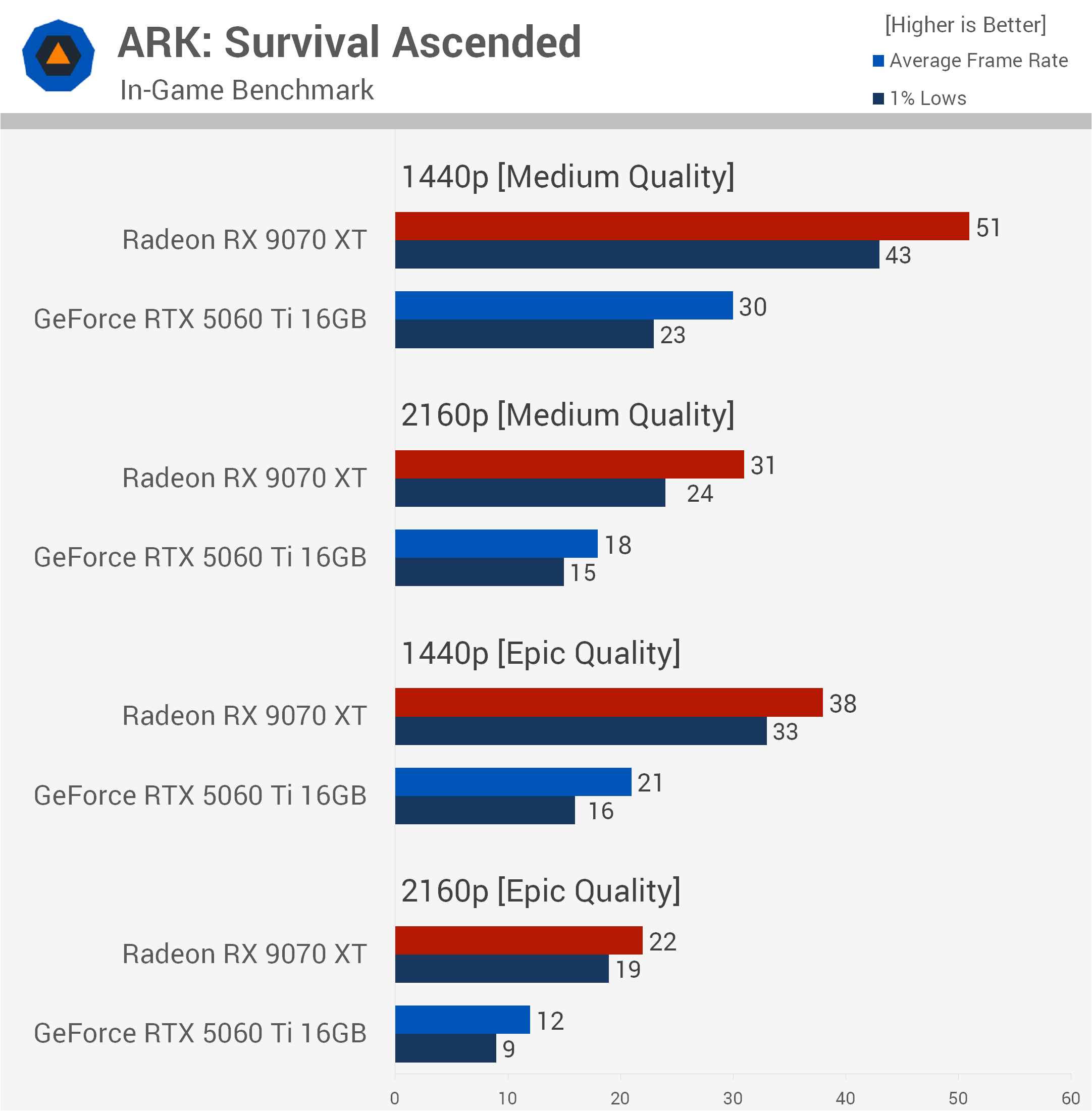
Stepping up to 4K effectively turned the RTX 5060 Ti into a slideshow at 18 fps, whereas the Radeon GPU was 72% faster at 31 fps. That's not exactly lightning quick, but it is substantially better.
Things get downright comical with the Epic preset. At 1440p, the 9070 XT was 81% faster, and at 4K the gap widened to 83%, leaving the 5060 Ti choking at a miserable 12 fps average with single-digit 1% lows. Simply put, native rendering on the 5060 Ti is essentially unplayable across the board in this title. It's so bad, in fact, that most of these results wouldn't be made workable even with Ultra Performance DLSS thrown into the mix.
Cyberpunk 2077: Phantom Liberty
In Night City, traditionally a stronghold for Nvidia hardware, particularly with ray tracing enabled, the raw tier mismatch makes for some brutal viewing. At 1440p using the Ultra preset, the 9070 XT sat comfortably at 131 fps, giving it a massive 90% lead over the 5060 Ti's 69 fps. Stepping up to 4K widened the gap further to 103%, with the Radeon GPU maintaining a playable 63 fps average while the 5060 Ti stumbled along at just 31 fps.
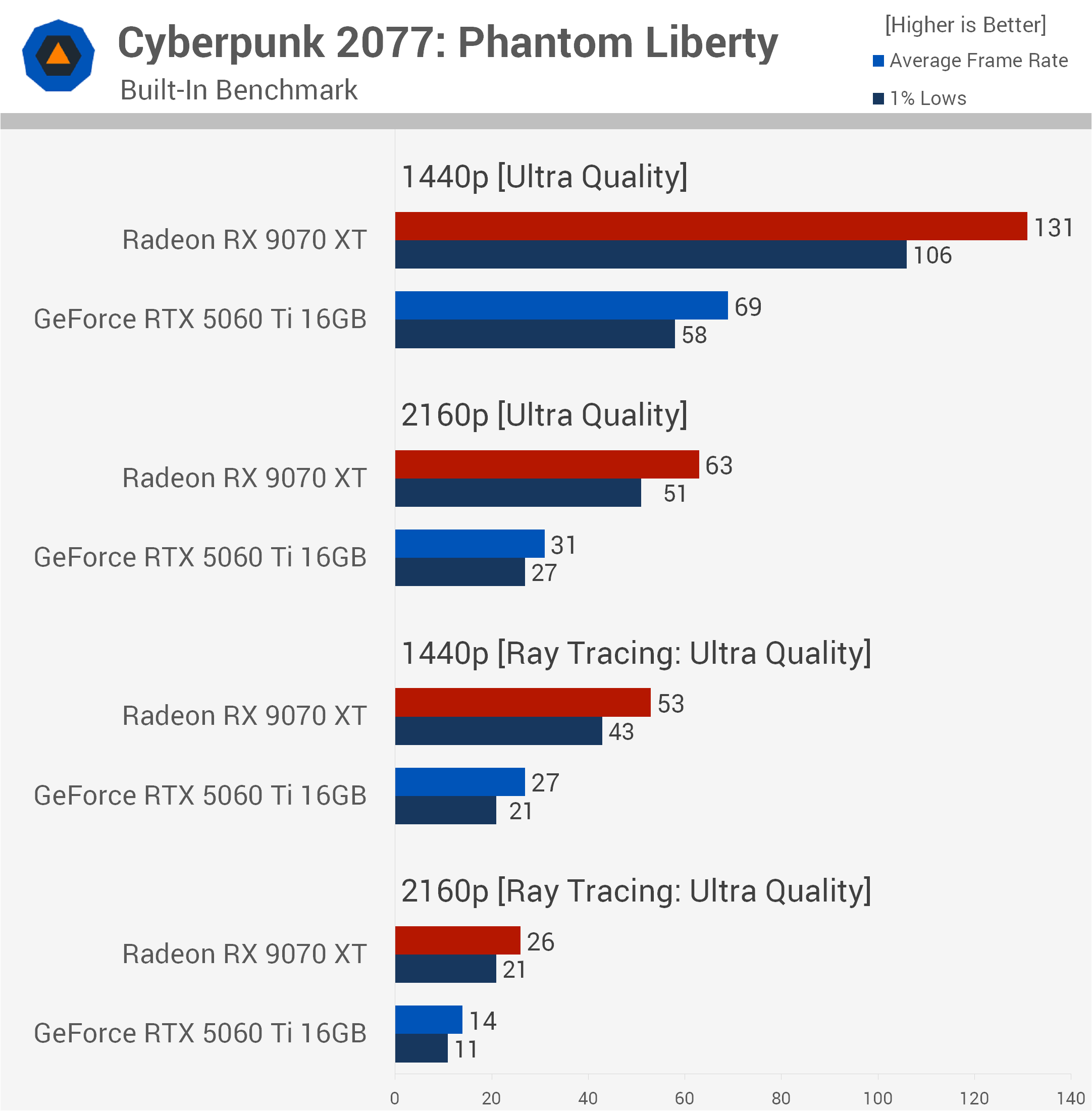
Even with Ray Tracing Ultra engaged, the 5060 Ti simply lacks the horsepower to compete. At 1440p, the 9070 XT was nearly twice as fast, with a 96% performance advantage.
Native 4K proved punishing for both, but the 9070 XT's 26 fps still placed it 86% ahead of the 5060 Ti's slideshow-like 14 fps average.
Stalker 2: Heart of Chornobyl
Venturing into the Zone at native resolution yields another heavy round of defeats for the GeForce GPU. At 1440p using the Medium preset, the 9070 XT clocked in at 122 fps, 54% faster than the 5060 Ti's 79 fps, with the Radeon GPU's 1% lows even surpassing the GeForce card's average frame rate. At 4K, the Radeon GPU delivered a 63% uplift, managing 70 fps while the 5060 Ti fell flat at 43 fps.
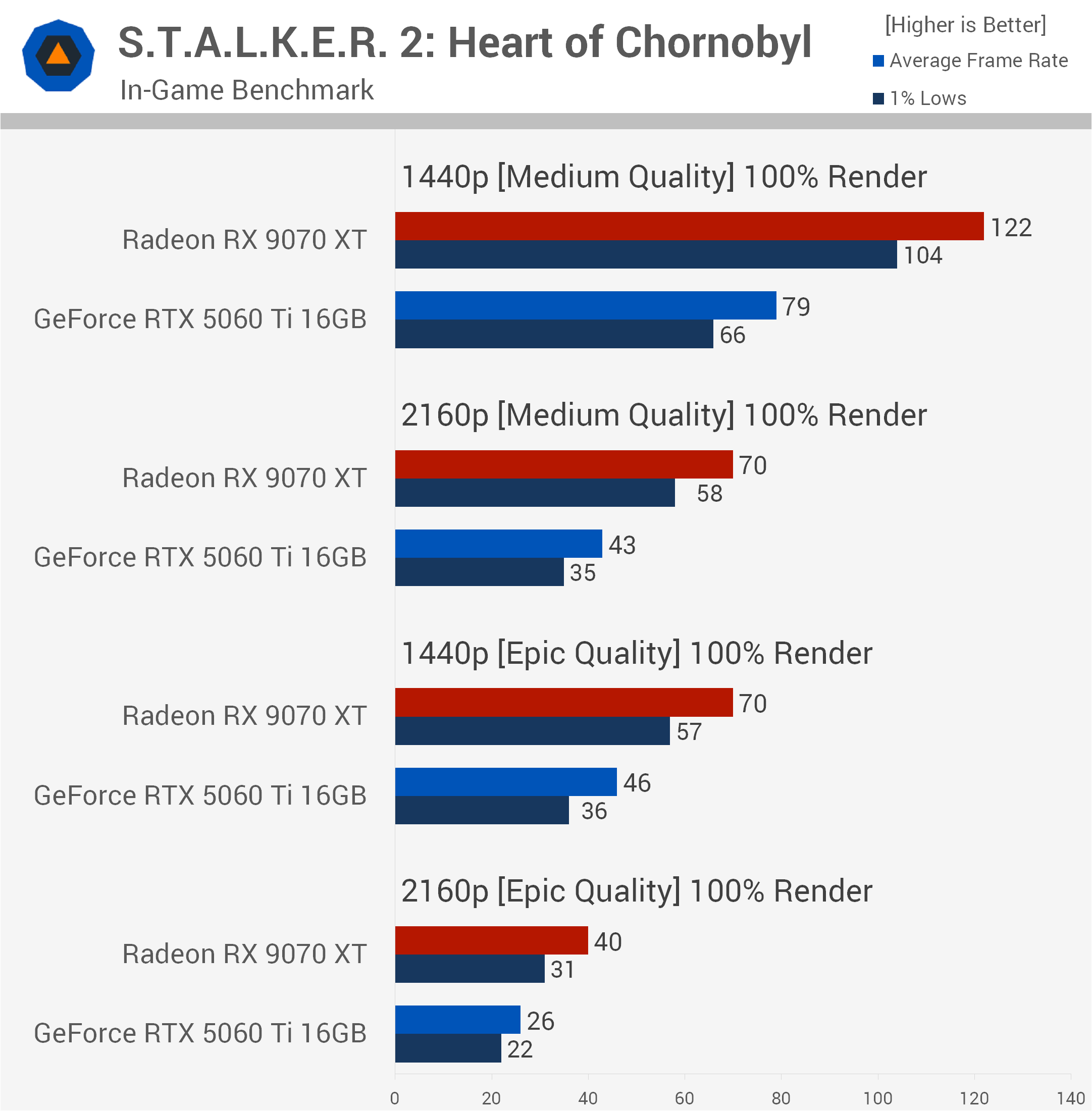
Dialing the visuals up to Epic tightens things slightly, but the hierarchy remains unchanged. At 1440p, the 9070 XT stayed 52% ahead with 70 fps versus 46 fps.
At 4K, neither GPU is delivering a high-refresh experience, but the 9070 XT's 40 fps still outpaced the 5060 Ti's 26 fps by 54%.
Pragmata
Rounding out this portion of the testing with Pragmata, the Radeon GPU continues its dominant sweep. At 1440p using the Max Quality settings, the 9070 XT rendered 138 fps, outpacing the 5060 Ti's 89 fps by 55%. Moving to 4K pushed that lead to 63%, with AMD hitting a smooth 78 fps while Nvidia struggled to break 50 fps at 48 fps.
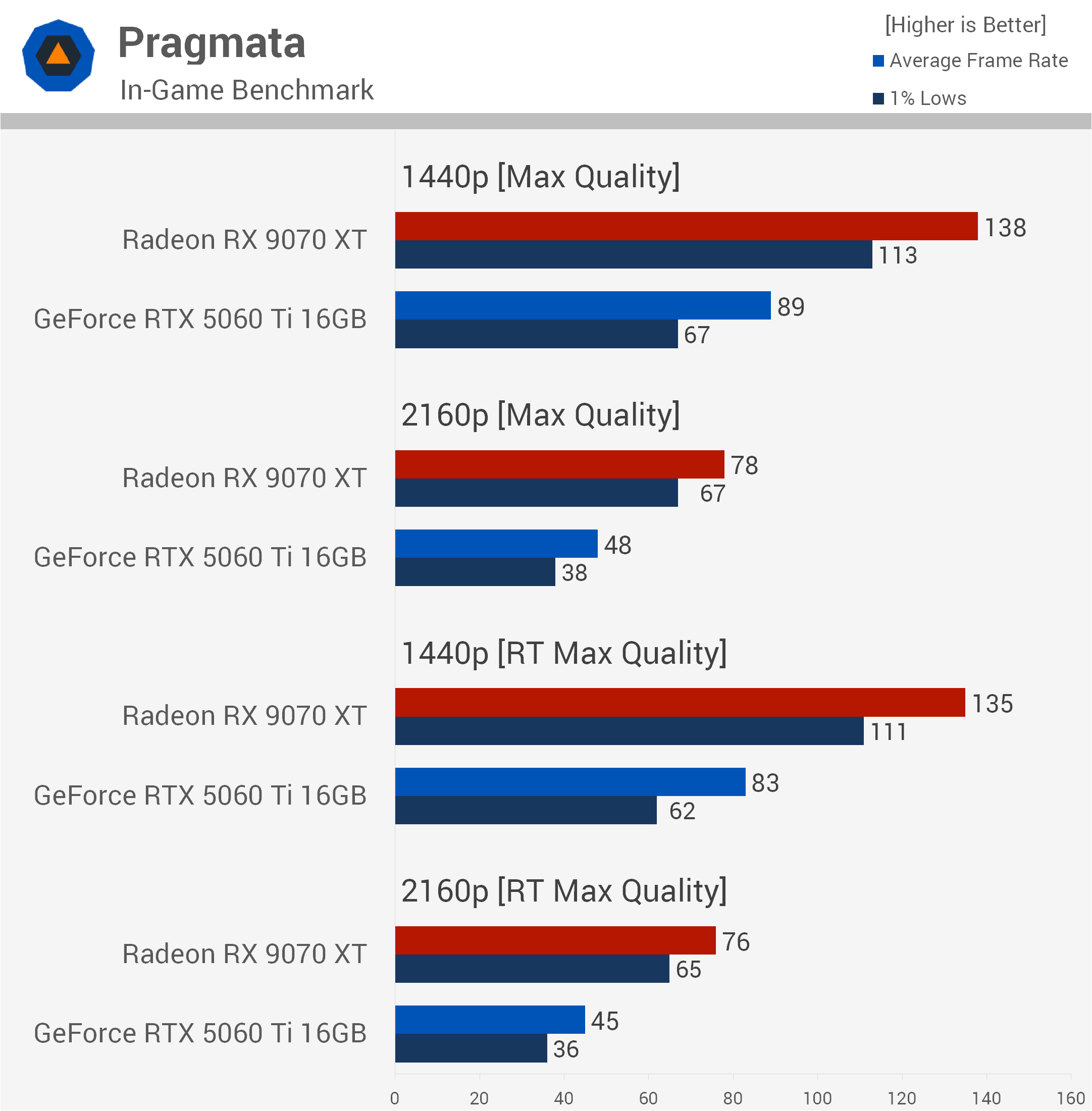
Enabling ray tracing barely slowed down the 9070 XT. At 1440p with full ray tracing, the Radeon GPU averaged 135 fps, enjoying a 63% advantage over the 5060 Ti's 83 fps.
Then at 4K, the 9070 XT averaged a solid 76 fps for a 69% margin over the 5060 Ti's 45 fps. With both GPUs selling for equivalent money, giving up more than 60% of your frame rate for the GeForce badge is a tough pill to swallow.
Arc Raiders
Finally, in Arc Raiders, we see some of the narrowest margins of the test suite, though the 9070 XT still wins in every configuration. Using Epic Quality with RT Static at 1440p, the Radeon GPU was 30% faster, extending that margin to 38% at 4K.
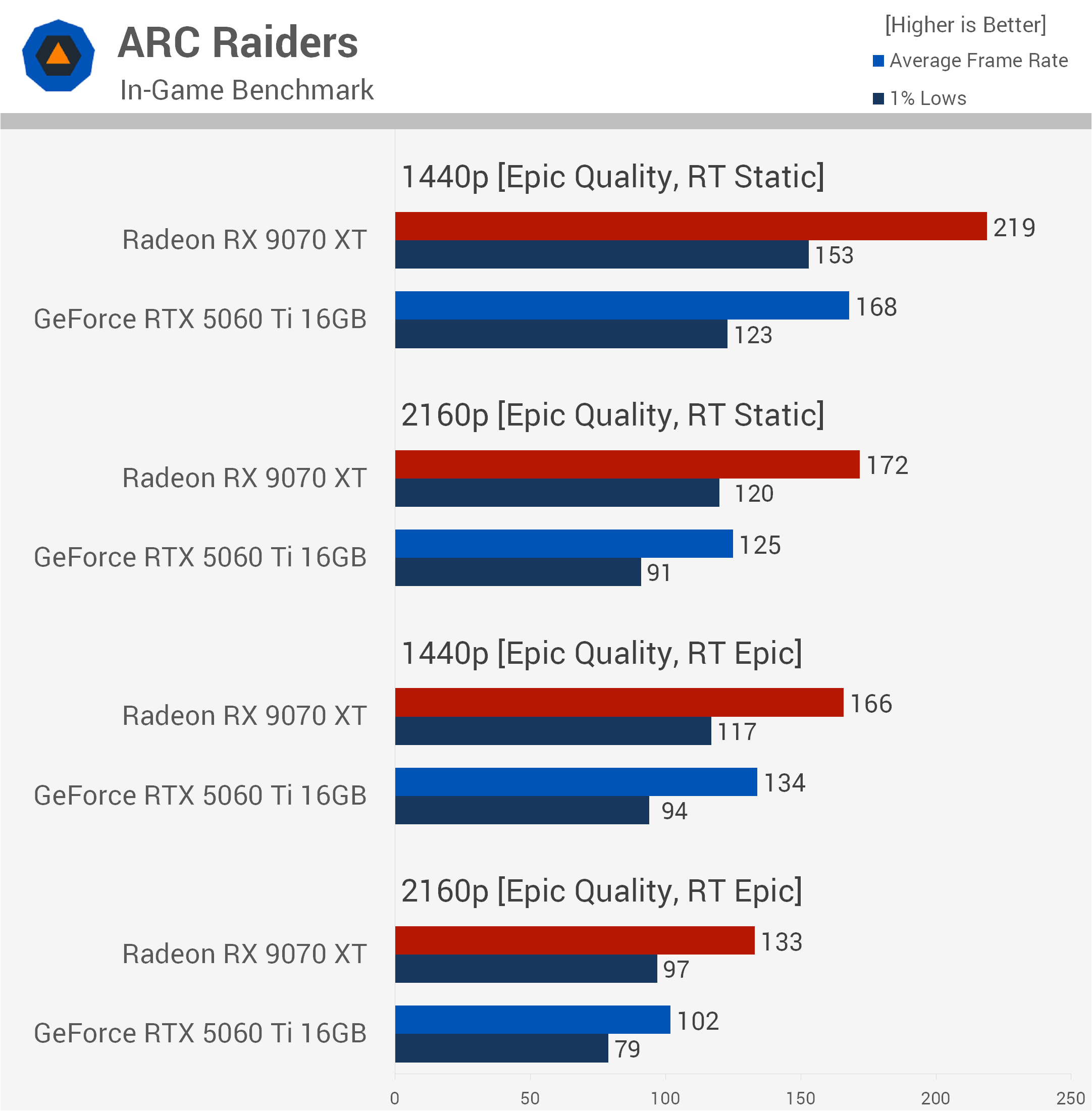
Stepping up to RT Epic at 1440p compressed the margin to its narrowest point at 24%. At 4K, the gap settled at 30%, with the 9070 XT reaching 133 fps while the 5060 Ti achieved 102 fps. Both cards provide high frame rates here, but you're still getting roughly a third more performance from the Radeon GPU for the same money.
Performance Summary: 52 Games
Looking at the massive 52-game average across mixed quality settings, the overall picture doesn't get any prettier for Nvidia. At 1440p, the Radeon RX 9070 XT pulls ahead by 62%, averaging 123 fps compared with the RTX 5060 Ti's 76 fps.
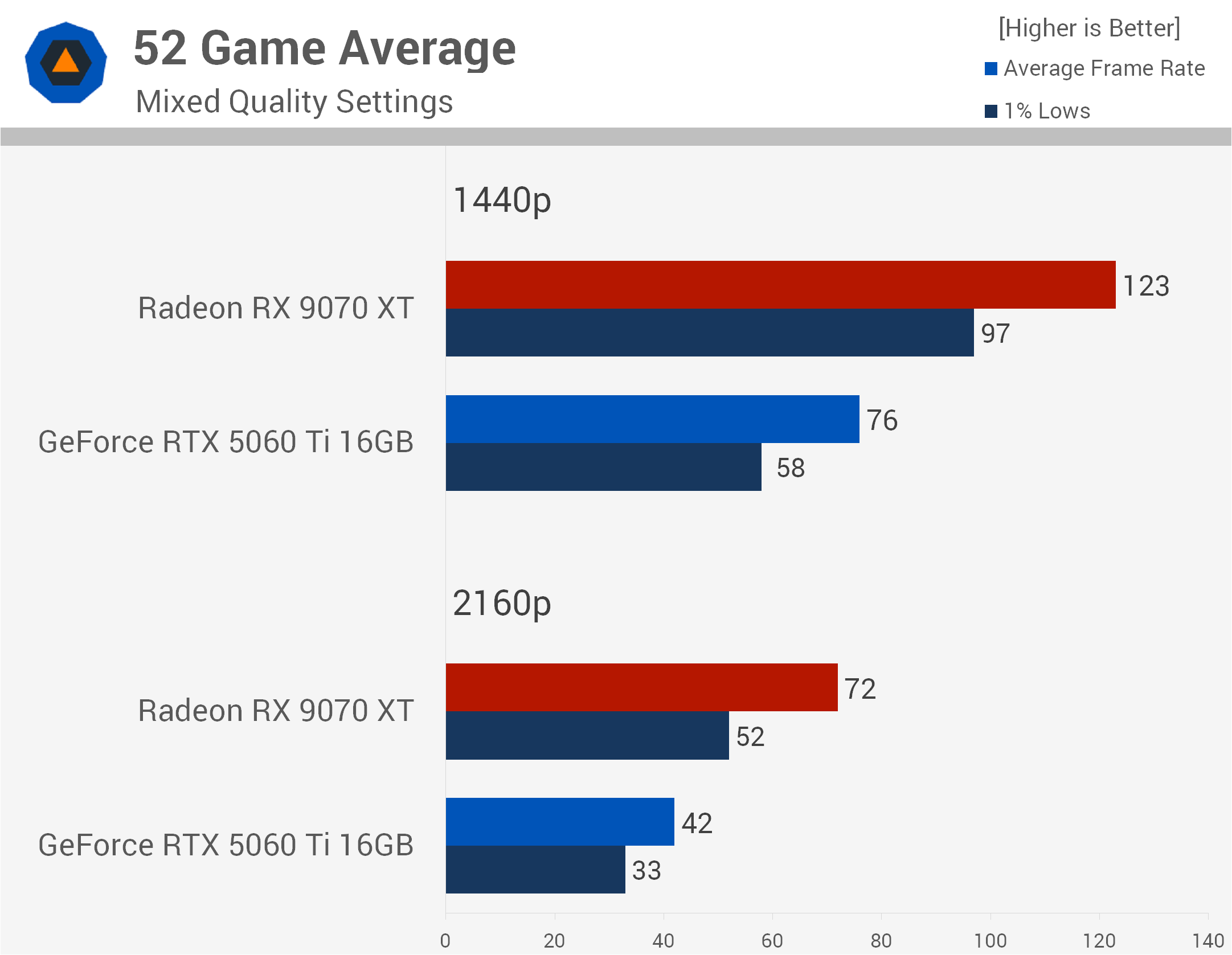
In fact, the Radeon card's 1% lows of 97 fps comfortably beat the GeForce card's average frame rate, highlighting just how wide the performance gulf really is.
Step up to 4K and the margin widens to 71% in AMD's favor. Here, the 9070 XT delivers a genuinely smooth 72 fps average, whereas the 5060 Ti is left struggling in the low 40s at just 42 fps, with its 1% lows dipping to 33 fps.
When essentially the same retail price gets you a card capable of smooth 4K gaming on one side and a GPU that's clearly better suited to 1440p on the other, the value equation for the 5060 Ti completely falls apart.
Cost Per Frame
Australian Dollars
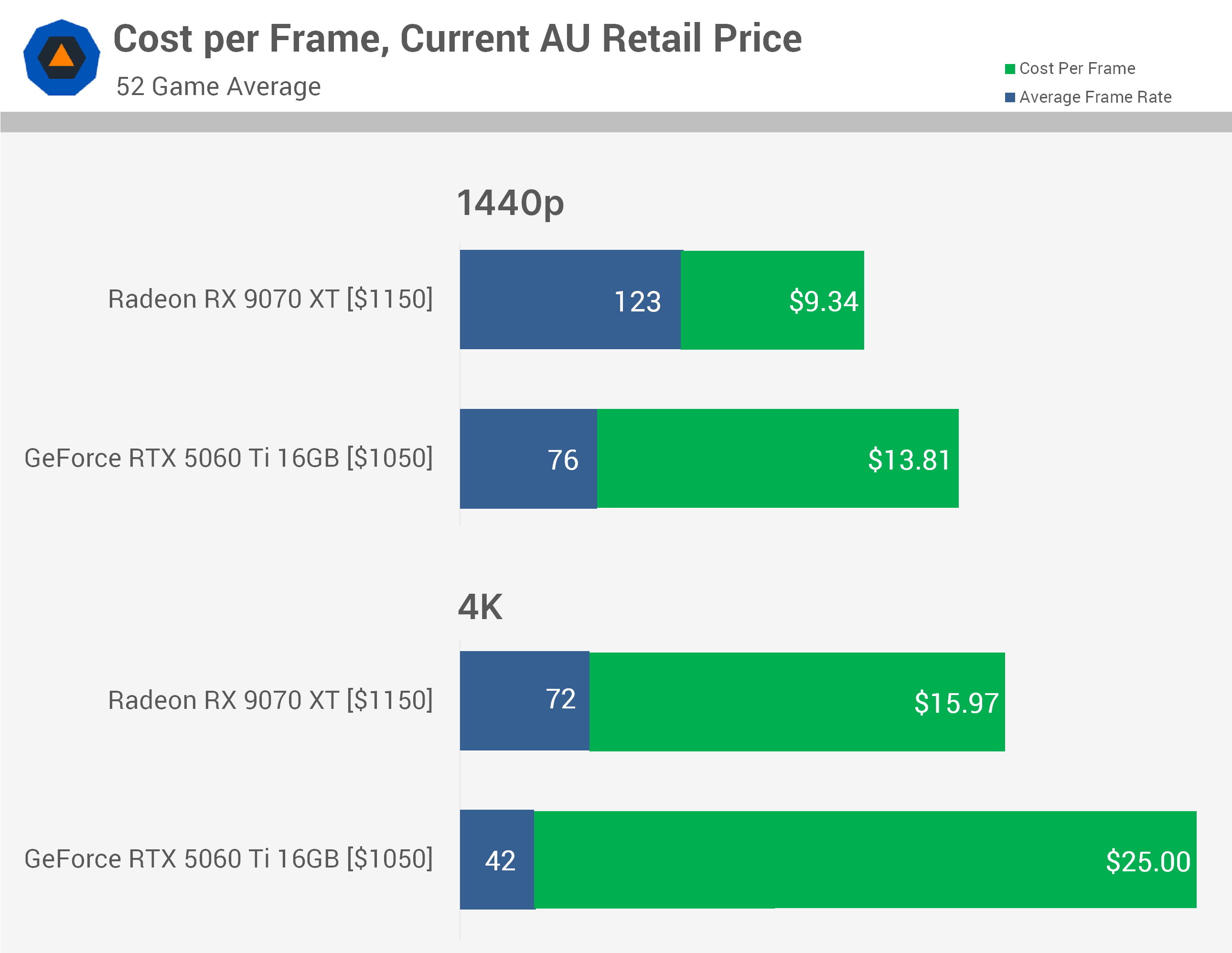
To better illustrate the value equation, here's the cost-per-frame data based on current Australian retail pricing. Despite coming in $100 cheaper, the RTX 5060 Ti 16GB still costs 48% more per frame based on our 1440p results and 57% more at 4K. That's crazy.
United States
But the situation is far worse in the United States, and we strongly suspect Australian pricing will catch up over the coming weeks, as retailers currently appear hesitant to restock RTX 5060 Ti cards at today's asking prices.
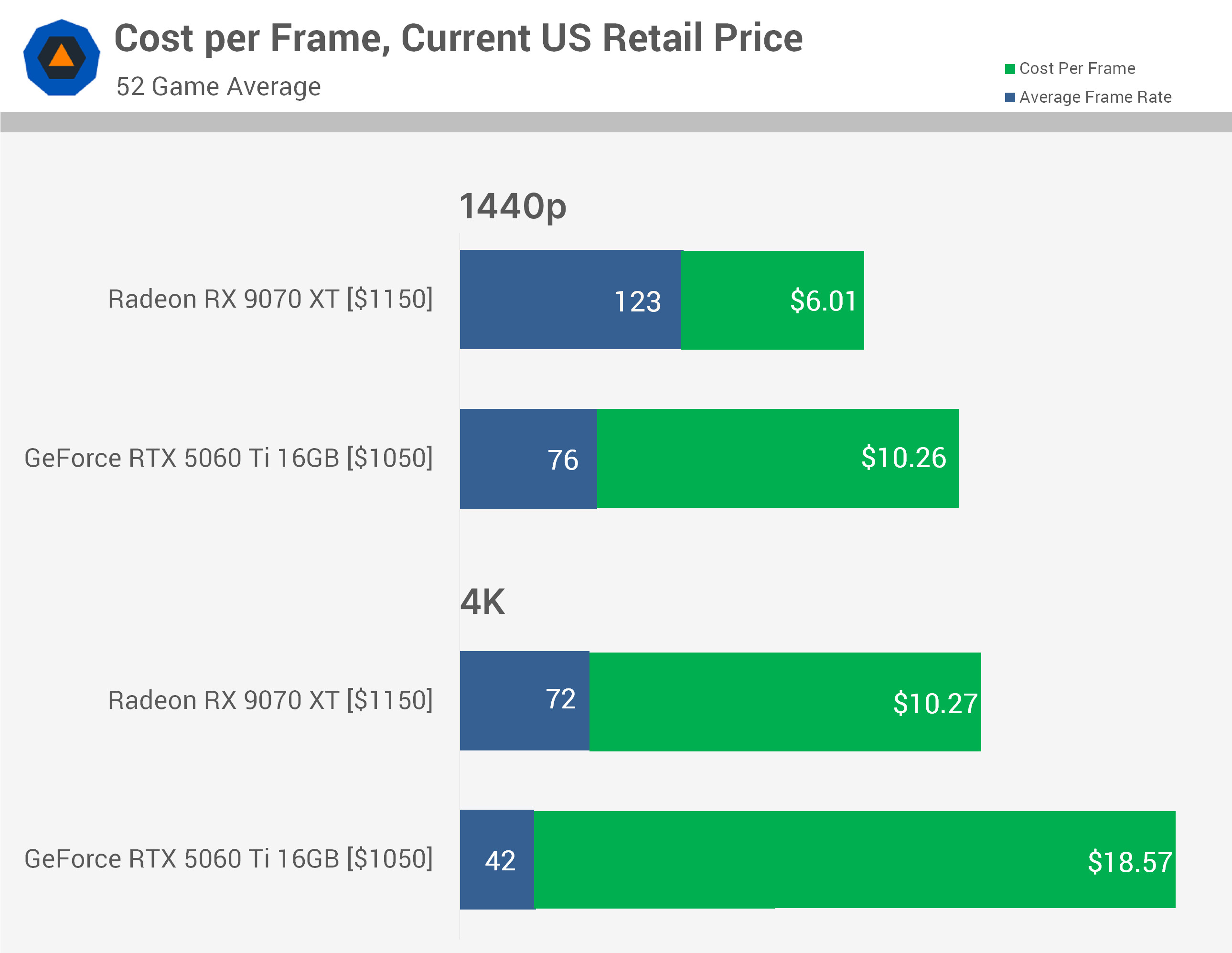
Over at Newegg, the 5060 Ti comes in 71% more expensive per frame based on our 1440p data and an insane 81% more expensive at 4K.
There's really not much more that needs to be said here.
The GeForce Tax Is Getting Ridiculous
It's hard to say when this madness will end, or even how much worse things might get. If we'd told you just a few months ago that the RTX 5060 Ti 16GB would soon cost as much as, or even more than, the Radeon RX 9070 XT, most of you probably would have laughed us out of the room. And we wouldn't blame you. It's hard to imagine, but here we are.
In part, these inflated prices are the result of the industry-wide memory shortage. The 9070 XT is now at least 23% above MSRP, though the RTX 5060 Ti 16GB is a little over 80% above its MSRP. Both feature 16GB of VRAM, but the GeForce GPU uses GDDR7 memory whereas the 9070 XT still relies on GDDR6, so there are cost differences there.
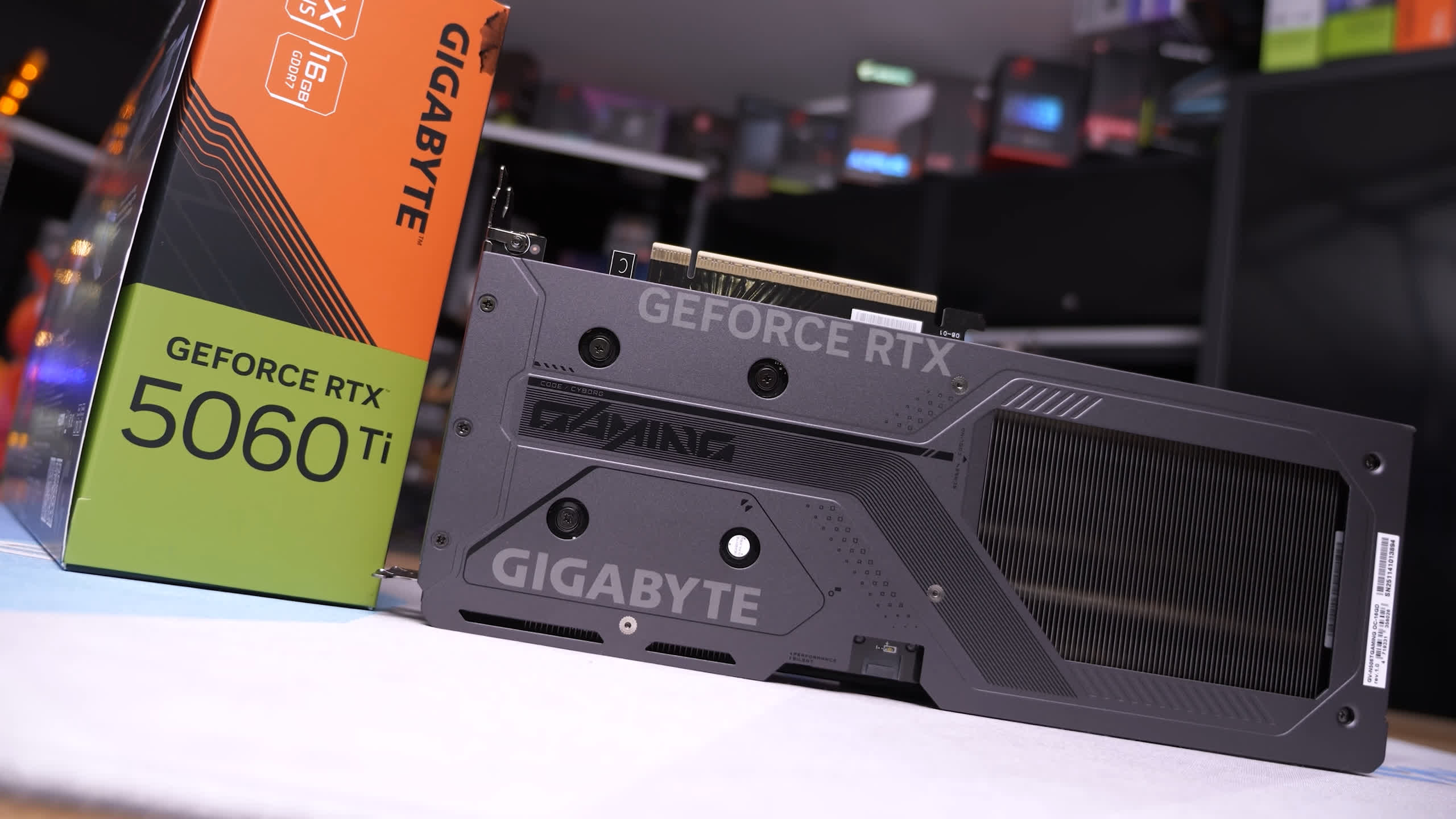
Tying into this, Nvidia recently notified board partners that it was increasing prices for its GPU and memory bundles, which was quickly followed by significant price increases for GeForce graphics cards, as we've seen with the RTX 5060 Ti 16GB. Exactly how much is the increase isn't publicly known. I have some off-the-record details, but it sounds as though they've added a bit extra on top, which would help explain how the 5060 Ti has ended up more than 80% above MSRP.
Nvidia is also able to get away with these extreme prices because of AI demand. That doesn't just mean data centers, which aren't buying GeForce gaming cards, but also users building systems for local AI workloads. Those buyers are helping soak up these hideously overpriced GeForce GPUs.
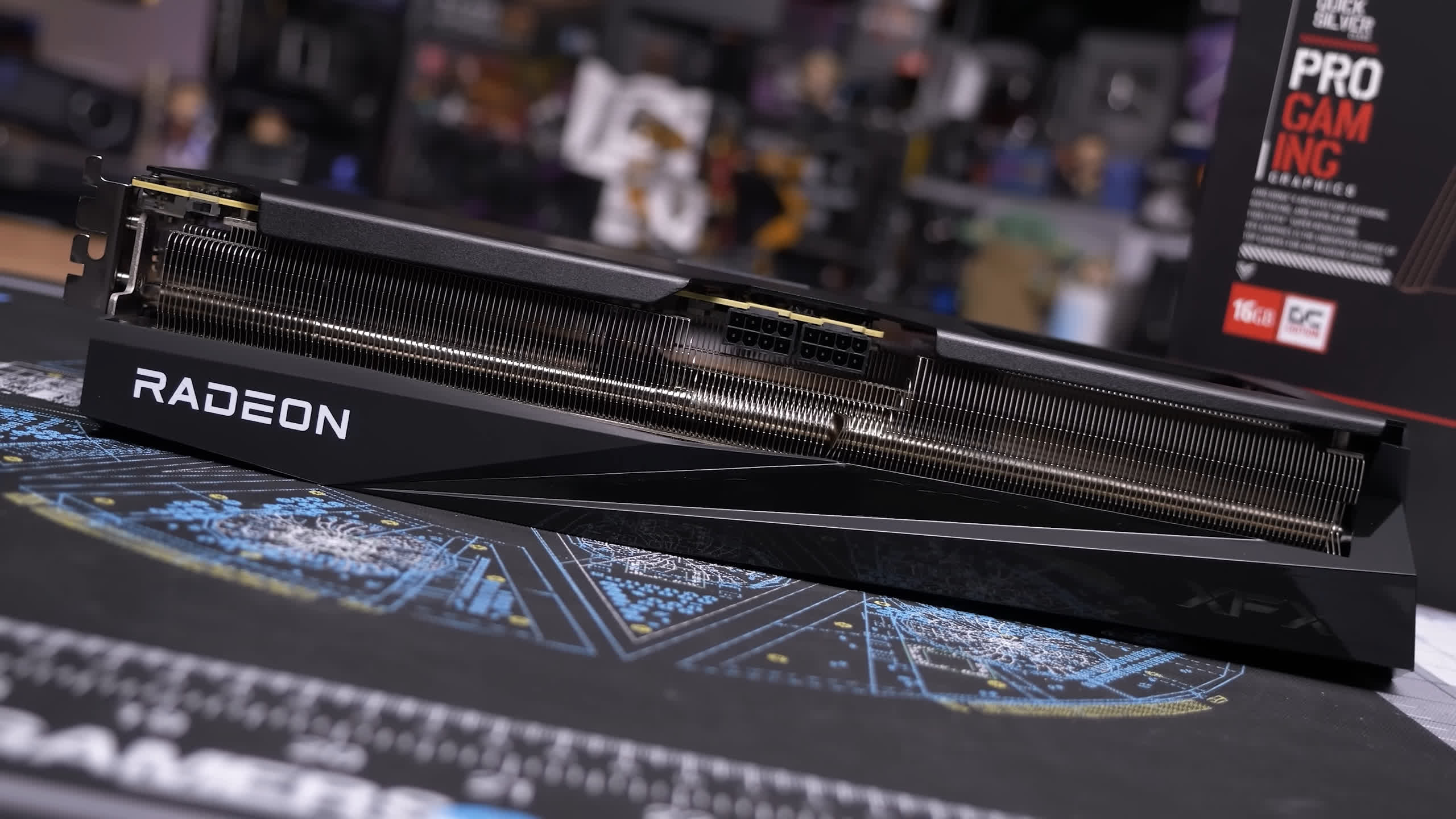
As I understand it, and please note that I am far from an expert on this AI stuff, there is significantly greater demand for the RTX 5060 Ti 16GB than the Radeon RX 9070 XT among users running AI workloads locally. As we've just seen, the RX 9070 XT is an extremely capable gaming GPU, and it actually offers more raw memory bandwidth than the RTX 5060 Ti despite using GDDR6 memory. Memory bandwidth can also be an important factor in AI workloads.
However, Nvidia remains the dominant choice for local AI builders. The disparity in demand largely comes down to software support, ecosystem maturity, and ease of use.
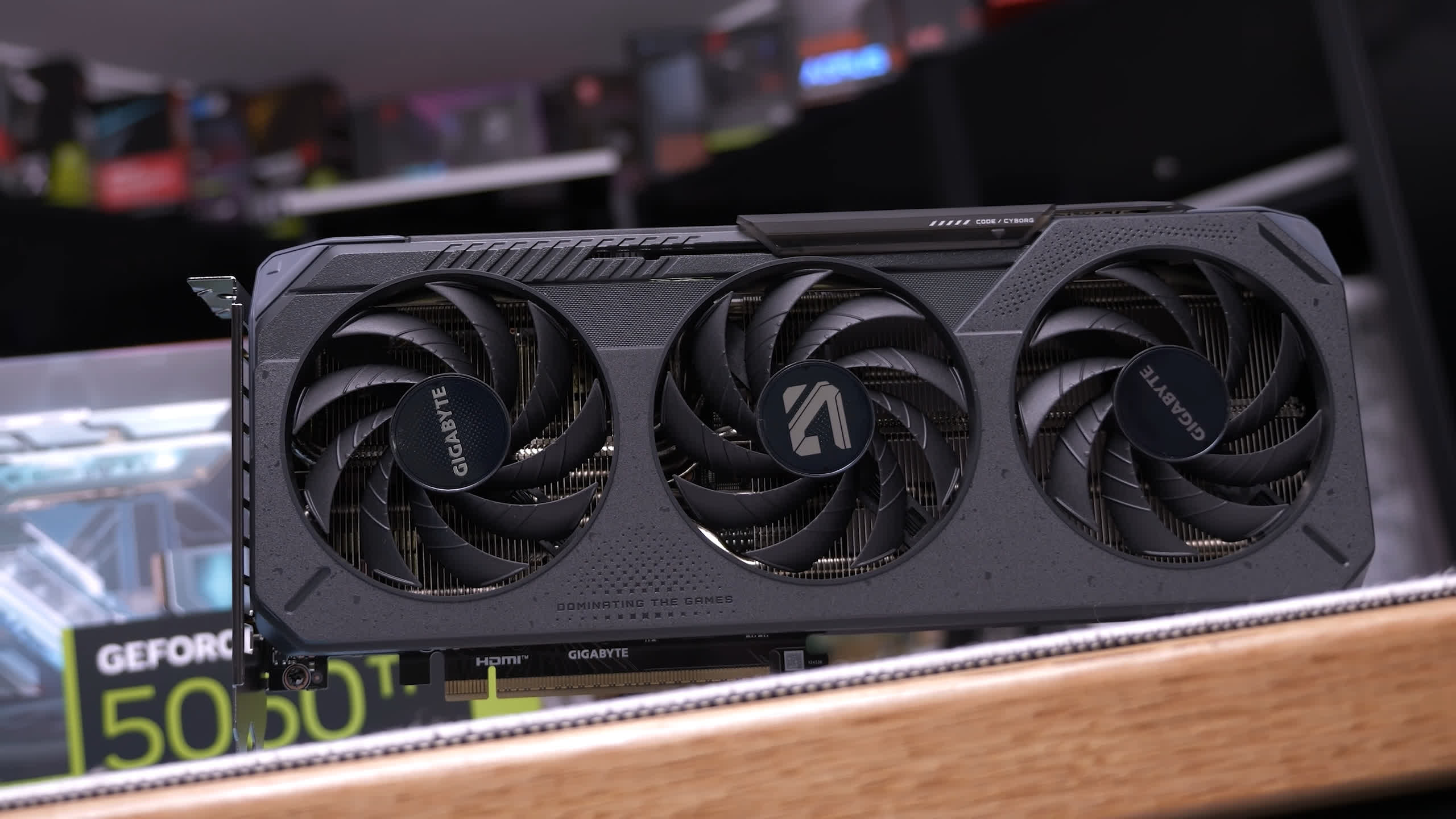
Nvidia's CUDA ecosystem remains one of the foundational software layers for modern AI development. New AI models, interfaces, fine-tuning tools, and GitHub projects are frequently developed, optimized, and tested on Nvidia hardware first. Some popular tools and inference frameworks also specifically target Nvidia GPUs.
The Radeon RX 9070 XT can be a compelling option for users willing to work within AMD's software ecosystem, particularly under Linux, where its raw performance and memory bandwidth can be put to good use. But for most local AI users, the RTX 5060 Ti remains the "safer bet" as it guarantees compatibility with upcoming AI tools, requires less troubleshooting, and dominates in image generation. For these reasons, Nvidia has been able to jack up pricing and keep selling GPUs, but in doing so fewer and fewer gamers are now going GeForce, not that Nvidia cares.
If you're building a gaming PC and want more than 8GB of VRAM, as it stands, Radeon is increasingly the only way to go. At these prices, paying the GeForce tax simply isn't worth it.