
Through the looking glass: The world's population is expected to reach roughly 8.3 billion by the middle of next month, far short of the mathematically infinite population predicted by a 1960 forecast. The failed prediction has relevance for debates over artificial intelligence. It shows how a model can track an accelerating trend for years without establishing that the trend will continue indefinitely. Forecasts of runaway technological progress face the same question: How long will the conditions behind today's growth persist?
Heinz von Foerster and his colleagues reached their prediction using a hyperbolic growth model. Unlike exponential growth, where a population increases at a constant percentage rate, hyperbolic growth assumes the rate itself rises as the population grows.
That feedback produces increasingly rapid expansion. Eventually, the model reaches a singularity, at which point the calculated population diverges to infinity in finite time. The researchers placed that point in November 2026.
Their arithmetic was not the problem. The population changes the model captured did not continue.
The forecast drew on global population estimates from approximately 1 CE through 1958. The researchers published it in Science under the title "Doomsday: Friday, 13 November, A.D. 2026." They also chose the date because it was von Foerster's birthday.
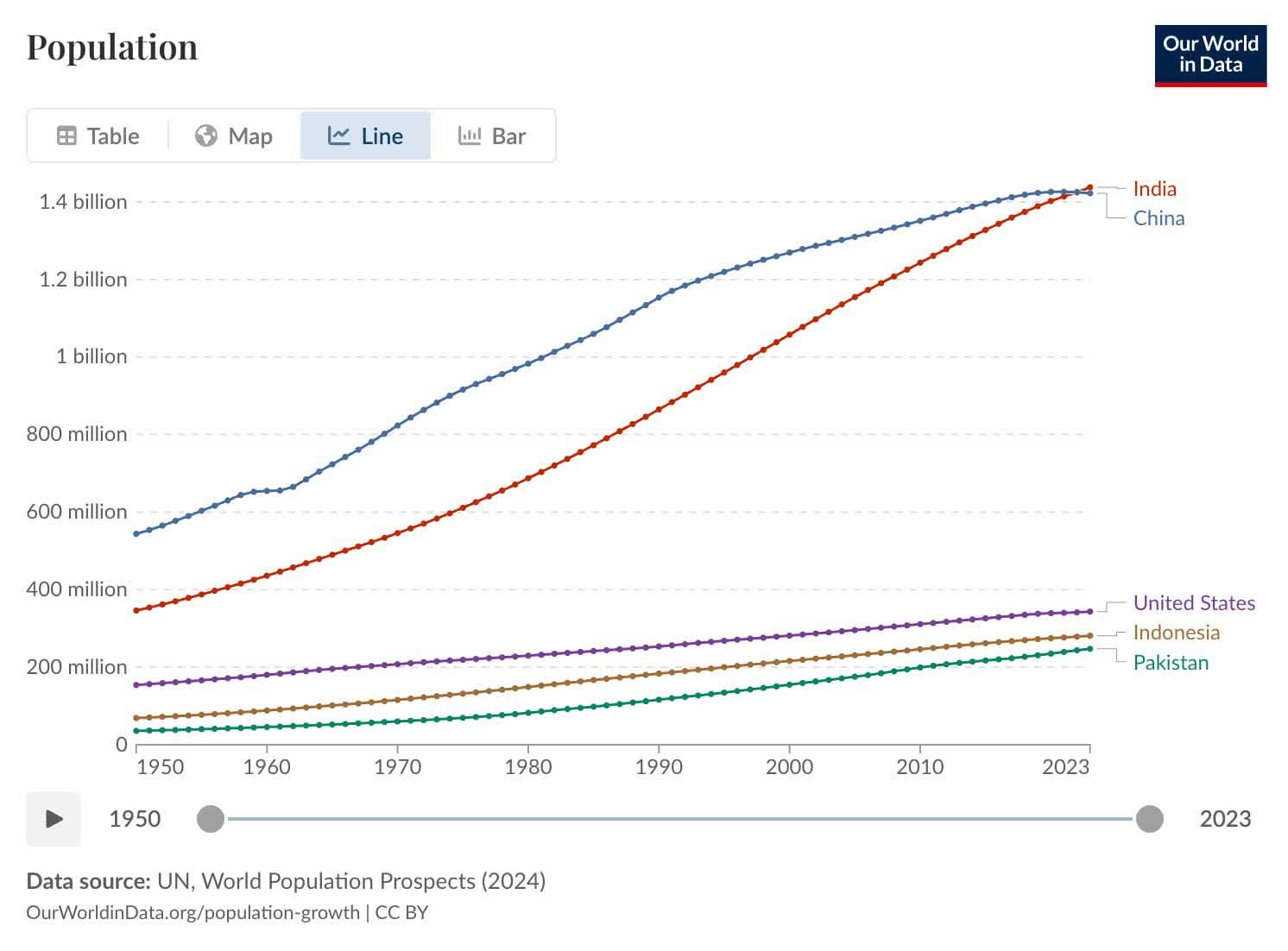
Population figures gave the model some credibility. Humanity reached about 1 billion people around 1800. That number doubled by 1925, then doubled again to 4 billion by 1975. It took less than another 50 years to reach 8 billion.
The shrinking intervals pointed to growth faster than an exponential curve. Conventional demographic forecasts repeatedly underestimated population increases in the 1960s and 1970s. The hyperbolic model performed better, tracking population changes closely until the late 1970s.
Critics nevertheless questioned its physical plausibility and criticized its failure to explicitly account for economic and technological adaptation. A close fit to population figures could not establish that people would keep reproducing under the same conditions.
The model was relatively simple and transparent. But that simplicity also left out changes that would eventually undermine its prediction.
The link between population size and growth rates began to weaken in the mid-1960s. By the 1980s, developed countries had entered a period of below-replacement fertility, while the demographic transition accelerated in the developing world.

Total population continued to rise, but larger populations no longer consistently grew faster in percentage terms. That distinction explains how the model could remain close to observed population totals for a time while losing the basis for its long-term forecast.
Economist Michael Kremer revisited hyperbolic growth in 1993. His work showed that faster-than-exponential growth could help explain broad patterns in population history extending back roughly a million years.
More recent data complicate that finding. Adding United Nations population figures through 2023 weakens the positive association between population size and growth rates. Although these newer observations cover a small share of the historical timeline, they include the largest populations and therefore have a substantial influence on the results.
The older data present another problem. Early population levels are estimates drawn from limited archaeological evidence and assumptions about technology, land use and population density.
For much of human history, population growth was extremely slow. Long stretches of stability or gradual increase were interrupted by periods of rapid growth, including the Neolithic Revolution and the modern population explosion. A single curve can obscure the differences between those periods.
Hyperbolic forecasts also depend heavily on the data used to build them. An observer in 200 BCE who extrapolated Neolithic population trends into the future would have predicted that humanity would reach its present size around the year 1000.
The choice of historical period can therefore dramatically change the forecast. A model may describe one growth phase well without explaining what happens when that phase ends.
In the late 1950s, John von Neumann discussed accelerating technological change, suggesting it might reach a point beyond which prediction becomes impossible. However, he did not provide an equation or date.
The population forecast illustrates how hard that leap is. An observed acceleration can support useful predictions without proving that growth will continue to accelerate.
The same limitation applies to forecasts based on AI scaling laws. Extending current relationships indefinitely can make explosive technological growth look inevitable. Those relationships, however, may depend on conditions specific to the period in which they were measured.
That does not rule out major advances in AI. It means that evidence of rapid progress and evidence of an approaching singularity are different things.