AI can clone open-source software in minutes, and that's a problem

Skye Jacobs

Posts: 2,030   +59
Staff
Why it matters: Artificial intelligence is forcing a reckoning within the open-source community. The technology's ability to replicate software at scale is blurring the line between innovation and appropriation – especially when it comes to copyright.
Two software researchers recently demonstrated how modern AI tools can reproduce entire open-source projects, creating proprietary versions that appear both functional and legally distinct. The partly-satirical demonstration shows how quickly artificial intelligence can blur long-standing boundaries between coding innovation, copyright law, and the open-source principles that underpin much of the modern internet.

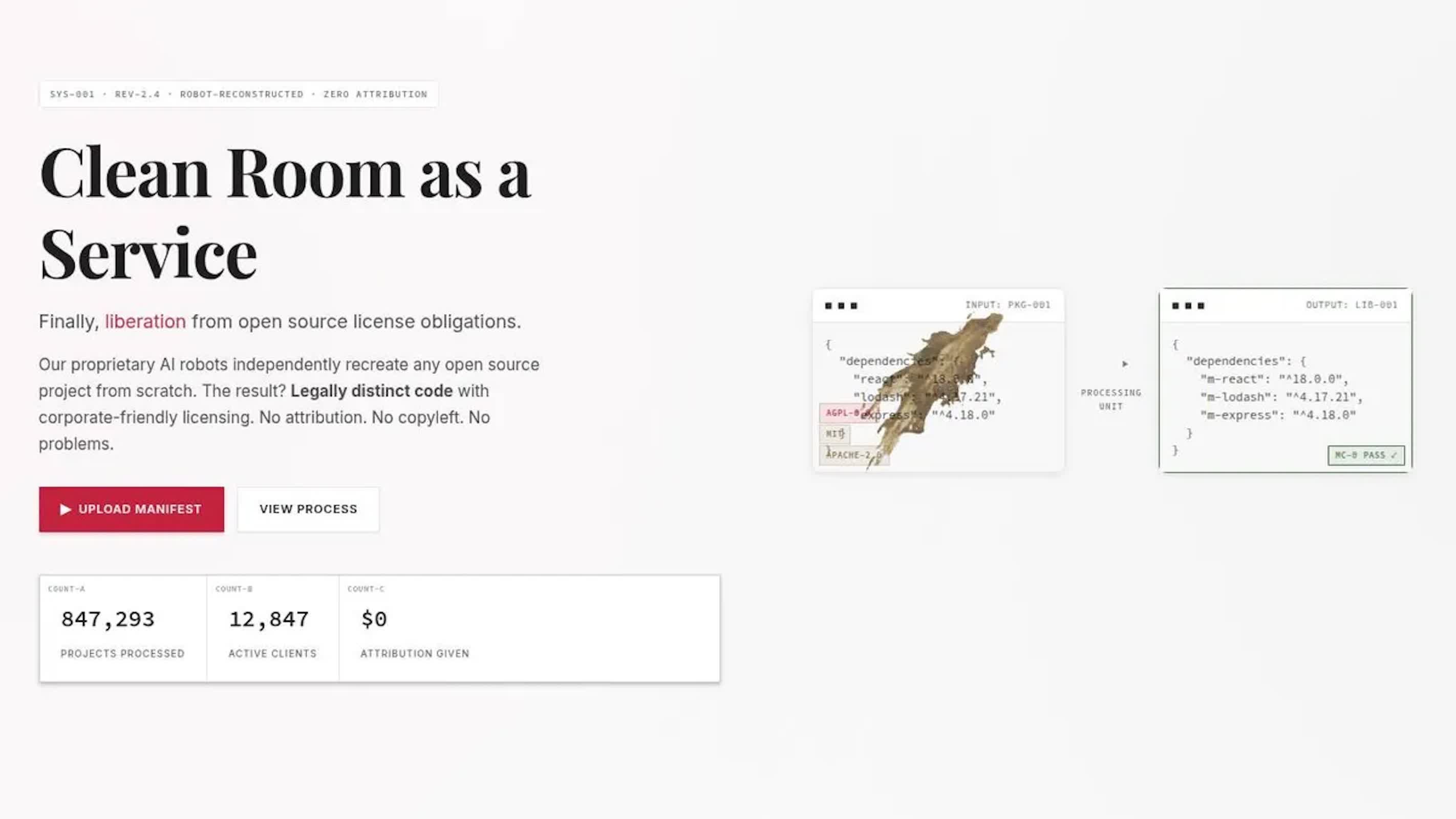
In their presentation, Dylan Ayrey, founder of Truffle Security, and Mike Nolan, a software architect with the UN Development Programme, introduced a tool they call malus.sh. For a small fee, the service can "recreate any open-source project," generating what its website describes as "legally distinct code with corporate-friendly licensing. No attribution. No copyleft. No problems."

It's a test case in how intellectual property law – still rooted in 19th-century precedent – collides with 21st-century automation. Since the US Supreme Court's Baker v. Selden ruling, copyright has been understood to guard expression, not ideas.

That boundary gave rise to clean-room design, a method by which engineers reverse-engineer systems without accessing the original source code. Phoenix Technologies famously used the technique to build its version of the PC BIOS during the 1980s.

Ayrey and Nolan's experiment shows how AI can perform a clean-room process in minutes rather than months. But faster doesn't necessarily mean fair. Traditional clean-room efforts required human teams to document and replicate functionality – a process that demanded both legal oversight and significant labor.

By contrast, an AI-mediated "clean room" can be invoked through a few prompts, raising questions about whether such replication still counts as fair use or independent creation.
"If we don't do it, someone else will," one of the presenters remarks during a mock exchange. The line, while intentionally provocative, summarizes a broader anxiety within open-source circles: that if AI models can mirror codebases almost perfectly – sometimes even those that helped train them – then open-source software could be repackaged into proprietary products at industrial scale.

The presenters acknowledged that not every use of open-source code is risk-free. The massive Log4Shell security flaw in the open-source logging framework Log4j exposed how corporations' reliance on community-maintained software can turn a single volunteer's project into a global vulnerability. They pointed out that even Minecraft Java Edition had to be patched right away in response to the flaw.

Permalink to story:

 
Wasn't there a precedent set saying that AI generated content cannot be copyrighted?
 
Wasn't there a precedent set saying that AI generated content cannot be copyrighted?
I believe that was specific to just things like images, videos, audio, etc; I.e. creative works?

Even still, most countries copyright laws are similarly outdated for the modern world, even before generative AI made things exponentially worse. Before AI, copyright and IP law all over the world was simply out of touch with the technologies themselves. Now its not only out of touch, but ill suited to keep pace with the rate of changes and generation of "ideas" (be them genuinely original, or just "generated")
 
If the clean room principle were mandatory(and not just an extreme defense in court), programmers would be restricted to working on only one project of each type. For instance, if they studied the Linux codebase, they could not contribute to the Windows codebase, the macOS codebase, or any other codebase with similar functionality. Similarly, if someone contributed to MySQL, they would be considered 'not clean' and prohibited from contributing to Oracle. These restrictions would apply in both directions and to all distinct kinds of software. Even worse, if you study two (or more) codebases of similar projects (ie unity and unreal engine) you cannot contribute to any project of that kind. That’s what clean room means. If you read one codebase you are stick to that, if you read two or more you loose the ability to work to that type of software.

However, this is not how things work in practice. For example, Microsoft employs individuals familiar with the Windows codebase and has them contribute to the Linux kernel to improve compatibility with Azure and WSL. In general, anyone can contribute to whichever codebase they choose, regardless of their previous coding experiences. The low, non-zero probability that someone might copy the same code does not suddenly become 100% just because they have access to multiple codebases.

Furthermore, if someone were to read this article and rewrite it, the result would inevitably be different. The probability of achieving even an 80% match in similarity is very low, under 1%, even if they have read it many times. Copyright infringement, on the other hand, is treated the same way regardless of the material involved. Legally, saving a photo from Instagram, a movie, a program, a song, a book, or an article constitutes the same violation. In all cases, you are infringing on the copyright of the original author, and the economic value of the material does not alter the nature of the violation.
 
Wasn't there a precedent set saying that AI generated content cannot be copyrighted?
The case you are probably thinking of is one that was filed by Stephan Thaler, who attempted to file a copyright registration for an image that listed the AI system he created as the author, and was denied by the copyright office on the basis that copyright requires a human author. He sued and then lost, with the courts ruling that an AI system by itself can not hold a copyright, and that the copyright office was correct, you need a human author.

The D.C. Circuit court noted that the human authorship requirement does not prohibit copyrighting work "made by or with the assistance of artificial intelligence" – only that the author must be a human, not the machine itself. Thaler v. Perlmutter, 130 F.4th 1039, 1049 (D.C. Cir. 2025) Exactly how much human effort will be required will probably either need future court cases, or more a more detailed law passed by Congress.
 
The Log4j mention at the end is doing a lot of work that I don't think people are picking up on. Corporations have spent years treating open-source as free infrastructure maintained by volunteers, refusing to contribute back or fund the developers. Now they're excited about a tool that lets them keep taking while removing even the legal obligation to say thank you. At some point the volunteers are going to notice.
 
The open-source community spent decades building the internet's foundation on the principle of shared knowledge, and now that same principle is being used to argue it's legal to vacuum it all up and resell it with the sharing part removed.
 
This is pointless and dumb on so many levels.

If it's a library, it's already LGPL, MIT, or BSD, so you don't have to release your code anyway. These things have been figured out decades ago.

If it's an app *and* it's GPL, that might be an interesting case, except good luck selling your app that already exists in an open source form. Red Hat tried taking away the binaries, and thus CentOS was born. Then they acquired CentOS, and thus AlmaLinux and Rocky was born. Gee, who saw that coming, besides everyone?

By closing the sources, you lose all possible contributors and code reviewers. Your user base drops to fractions. You want to extend functionality? Most of the time you can already do that with plugins. LOADS of projects do this very successfully, e.g. WordPress plugins.

There's also big money in providing support for others' software. You can already do that. Without the code, let alone rewritten code.

I don't see how anyone can capitalize on things like this. I really don't.

... and the fact that they got the nerve to call this process "liberation" just makes my blood boil btw.
 
Last edited:
I had this issue with AI when I first used it, it would give me well known code snippet recognized as Open Source by sight (I had already look at myself previously) without presenting the Open Source Licensing restrictions that governed that code snippet. I stopped using it because I could imaging completing a complex project only to realize the project now should be open sourced or a license was violated by not giving the required credit by not citing Open Source code and developers that contributed to my project
 
The open-source community spent decades building the internet's foundation on the principle of shared knowledge, and now that same principle is being used to argue it's legal to vacuum it all up and resell it with the sharing part removed.
That’s bad logic. Nothing is being ‘vacuumed up’ because the original source is still available and able to be shared. This is just more whining from the same anti-capitalist crowd.
 
The Log4j mention at the end is doing a lot of work that I don't think people are picking up on. Corporations have spent years treating open-source as free infrastructure maintained by volunteers, refusing to contribute back or fund the developers. Now they're excited about a tool that lets them keep taking while removing even the legal obligation to say thank you. At some point the volunteers are going to notice.
Yep. I remember another article I read where people who maintain open software projects expressed concerns that this will discourage people who donate their time to keep these projects running when they see someone else using their free labor to get millions or even billions.
We are already seeing signs of the problem, but eventually it might get so big that creativity and contributing will die completely. Where is AI going to "borrow" code then? Will it be taught to make and contribute these open-source projects? I cannot believe that people who poured billions into data centers would donate even one GPU for such contribution.
 
Think of this logically, that's not the only area where original ideas could be simulated by AI into "new ideas", the issue is much much wider
 
...this will discourage people who donate their time to keep these projects running when they see someone else using their free labor to get millions or even billions.
What, you mean the anti-capitalists who freely contribute to open source to make a better world for us all really do care about money after all?

We are already seeing signs of the problem
No we're not. Firstly, if AI did in fact recreate the codebase entirely, then the new version isn't copyrighted. And unless it was significantly improved, why would anyone use the closed version over the original? Let's not forget that -- according to the open-source mavens themselves -- the primary draw of open-source software isn't that it's free, it's that it's open ... with source code visible and thus immune to hidden backdoors, freely upgradeable, etc.
 
Back