Connecting the dots: Thor Ultra's distinction lies not in raw throughput but in how it operationalizes open Ethernet for the AI era. By adhering to the UEC specification, it gives data center operators a way to scale AI workloads without being locked into a single vendor's networking ecosystem. This technical positioning – combining ultra-high bandwidth, programmability, and open interoperability – makes Thor Ultra less about competing with Nvidia on speed and more about redefining how AI fabrics are designed and standardized at hyperscale.
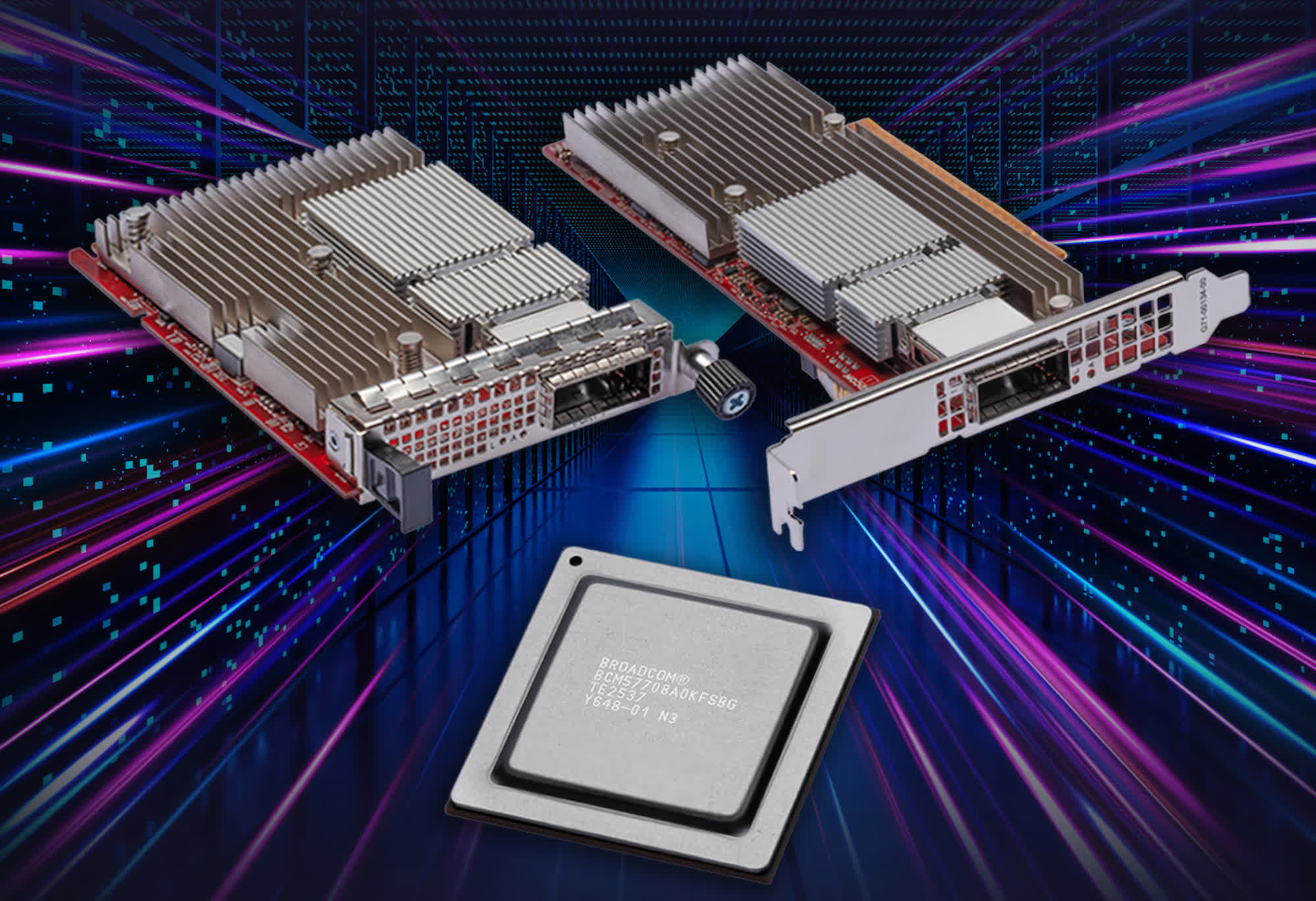
Broadcom has introduced a new networking chip called Thor Ultra, designed to compete directly with Nvidia in powering data movement across AI clusters. It is the first 800G Ethernet network interface card built to the open Ultra Ethernet Consortium specification, targeting one of the biggest bottlenecks in large language model training: high-bandwidth, low-latency interconnects at data center scale.
Thor Ultra moves beyond traditional RDMA architectures, introducing a suite of new capabilities that make Ethernet viable for trillion-parameter workloads. Its packet-level multipathing and out-of-order packet delivery features enable networks to dynamically balance load and sustain throughput across congested fabrics – tasks once dependent on costly, proprietary interconnects.
Selective retransmission mechanisms and fully programmable congestion control algorithms further improve link utilization, enabling systems to manage the unpredictable traffic patterns characteristic of distributed AI training environments.
At the hardware level, Thor Ultra's 800G line rate doubles the throughput of the previous generation and integrates 200G and 100G PAM4 SerDes options with what Broadcom claims is the industry's lowest bit error rate. The NIC supports PCIe Gen6 x16 connectivity and provides line-rate encryption and decryption via PSP offload, an architectural decision intended to free XPUs from compute-intensive security workloads that can add latency. Secure boot and firmware attestation extend the trusted computing boundary all the way to the NIC.
Although Broadcom's Tomahawk and Jericho series have long dominated intra – data center switching, Thor Ultra represents the company's clearest effort yet to redefine the NIC as a programmable extension of the AI fabric rather than a passive endpoint. The combination of a programmable congestion-control pipeline and support for packet trimming and congestion signaling with Tomahawk 5 and 6 underscores a vertically optimized (yet still open) architecture that stands in sharp contrast to Nvidia's tightly coupled, proprietary networking stack.
Broadcom takes on Nvidia with Thor Ultra, an open 800G Ethernet chip for AI clusters


