Fake Samsung 990 Pro SSD is good enough to fool your benchmarks

Daniel Sims

Posts: 2,479   +75
Staff
Cutting corners: The rising prices of RAM and storage drives due to component shortages have created an ideal environment for scammers to entice unsuspecting customers with deals that are too good to be true. As AI data center construction continues to divert DRAM and NAND production capacity, fake products are becoming harder to spot, with some even able to fool benchmark tools.
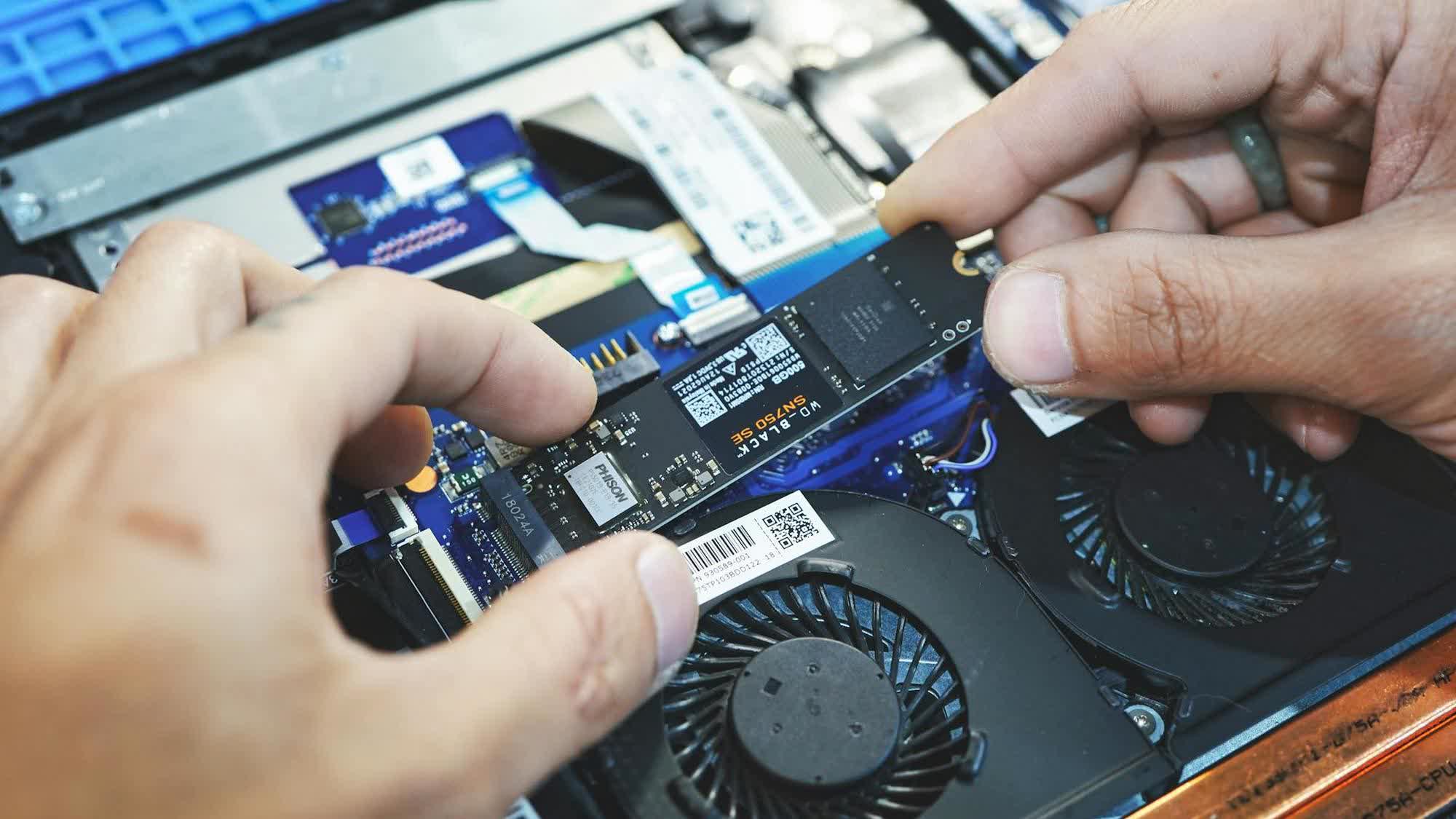
Counterfeit SSDs usually look real to the untrained eye until their performance or capacity falls far short of the device's specs. However, Japanese outlet Akiba PC Hotline recently discovered a specimen that matches the genuine article in speed and storage.

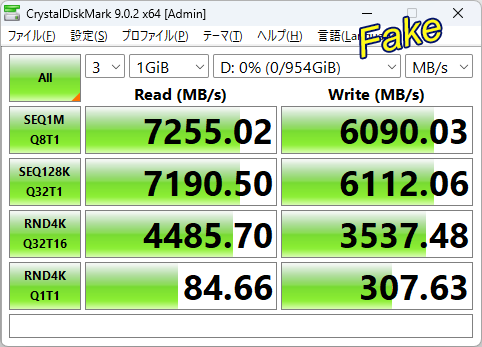
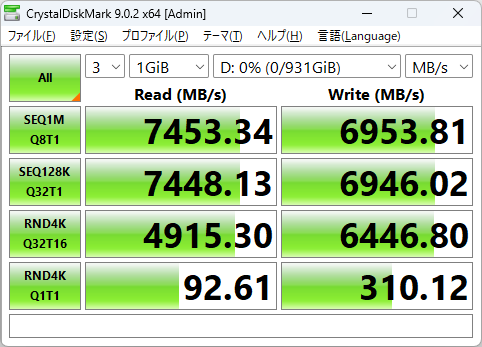
Last month, a fake Samsung 980 Pro SSD emerged that fooled Windows File Manager, Disk Management, and CrystalDiskInfo, but only transferred files at around 20 MB/s compared to the real model's 6,900 MB/s write speed. However, the fraudulent 1TB Samsung 990 Pro SSD that Akiba tested reported read and write speeds of 7,255 and 6,090 MB/s, respectively – very close to the authentic model's 7,453 and 6,953 MB/s in CrystalDiskInfo's benchmark. Furthermore, H2testw also verified that the fake drive's capacity matches the real thing.
 

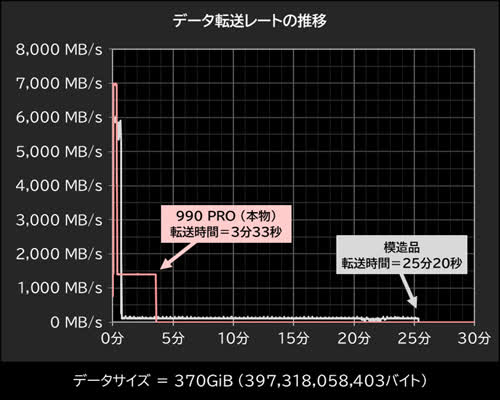
What gave the ruse away was a run through FastCopy, another tool that benchmarks transfer speeds. Here, the fake SSD took 25 minutes to move a nearly 400GB file, reaching only 261 MB/s, while the authentic 990 Pro managed it in three and a half minutes at 1,861 MB/s.

The likely reason behind the fake model's surprising performance is also one of the telltale signs of forgery when compared to a real 990 Pro – it uses a Maxio MAP1602 SSD controller instead of Samsung's proprietary controller. The "MAP1602" marking appears along the side of the drive near the gold fingers. Another giveaway is that the counterfeit model is DRAMless, while authentic 990 Pros come equipped with DDR4 SDRAM cache.

The packaging also displays minor mistakes that only become clear when customers compare it to a real Samsung box. The scam even includes an authentic-looking manual, but minor differences in the artwork emerge under close inspection.
Lastly, although authentication software such as CrystalDiskInfo and Samsung Magician does not immediately flag the drive as counterfeit, they do indicate that something is amiss. CrystalDiskInfo reports an odd serial number, "8888888888," while Samsung's app detects a "Non-Samsung" 990 Pro. Furthermore, Samsung Magician's diagnostic scan fails when attempted on the imitation drive.

The incident proves that the market has reached the point where buyers must run components purchased from sources other than the original manufacturer through a battery of performance benchmarks and authentication checks. Close examination compared with high-resolution images from manufacturer websites is also recommended.

Permalink to story:

 
I'm not dealing with counterfeits I just buy from Samsung directly. I might pay a little more but I know the only problem I am likely to have is a defective device which is a lot easier to resolve with Samsung than trying to get my money back for a counterfeit drive from a different retailer.
 
I'm not dealing with counterfeits I just buy from Samsung directly. I might pay a little more but I know the only problem I am likely to have is a defective device which is a lot easier to resolve with Samsung than trying to get my money back for a counterfeit drive from a different retailer.

not me I like amazon, because if I get a defective or fake product I can just have UPS come right back and pick it up the next day from my house, sometimes for free, you cant beat that convience.
 
not me I like amazon, because if I get a defective or fake product I can just have UPS come right back and pick it up the next day from my house, sometimes for free, you cant beat that convience.
My time is more important than that. I had a DOA LG OLED monitor that sat in my house for 2 1/2 weeks before I had time to send it back.
 
I can easily understand how a counterfeit drive can self-report a fake manufacturer and product name ... but how is it fooling a (presumed) actual benchmark performance test, if it's copying files an order of magnitude slower? Is CrystalMark just not transferring enough data to exhaust the (presumably far smaller) SLC cache on the counterfeit?
 
Last edited:
I am fortunate that I already got my new PC hardware before the price-spike. I will wait a decade before I consider any new equipment. By then this should all be over.
 
As far as I understand, there are no problems with recognition; you just need to use the proprietary software for verification.
P.S. The firmware for the WD770 has finally been updated (HMB size).
(via SanDisk Dashboard)
 
Last edited:
Rule #1: Never buy SSDs from Temu.

Rule #2: See rule 1.

If only it were that easy, all kinds of dubious sellers can fulfil orders these days via Amazon marketplace or your largest national e-goods retailer, if it has a marketplace.

I think the better rule here would be: Does the price look too good to be true? If the answer leans even slightly towards "yes", then bye, pass, no thanks, see ya, next time maybe.
 
If only it were that easy, all kinds of dubious sellers can fulfil orders these days via Amazon marketplace or your largest national e-goods retailer, if it has a marketplace.

I think the better rule here would be: Does the price look too good to be true? If the answer leans even slightly towards "yes", then bye, pass, no thanks, see ya, next time maybe.
Amazon quickly removes fake SSDs, per my experience. Temu doesn't. I trust Amazon far more than Alibaba or Temu.

Temu is the Internet equivalent of a guy in a van asking "you wanna buy a watch?".
 
Amazon quickly removes fake SSDs, per my experience. Temu doesn't. I trust Amazon far more than Alibaba or Temu.

Temu is the Internet equivalent of a guy in a van asking "you wanna buy a watch?".

Amazon does remove fake items, but far from quickly. They can last for weeks or even months. And even so, sometimes the item comes back from a different supplier.
 
Back