First reported case of a 12VHPWR connector melting on an AMD Radeon graphics card

midian182

Posts: 11,620   +175
Staff member
What just happened? It had to finally happen: someone has reported a case of a 12VHPWR connector that melted while connected to an AMD card. This sort of problem is a relatively common occurrence on Nvidia GPUs, but it's the first time we've seen it affect one of Team Red's cards.
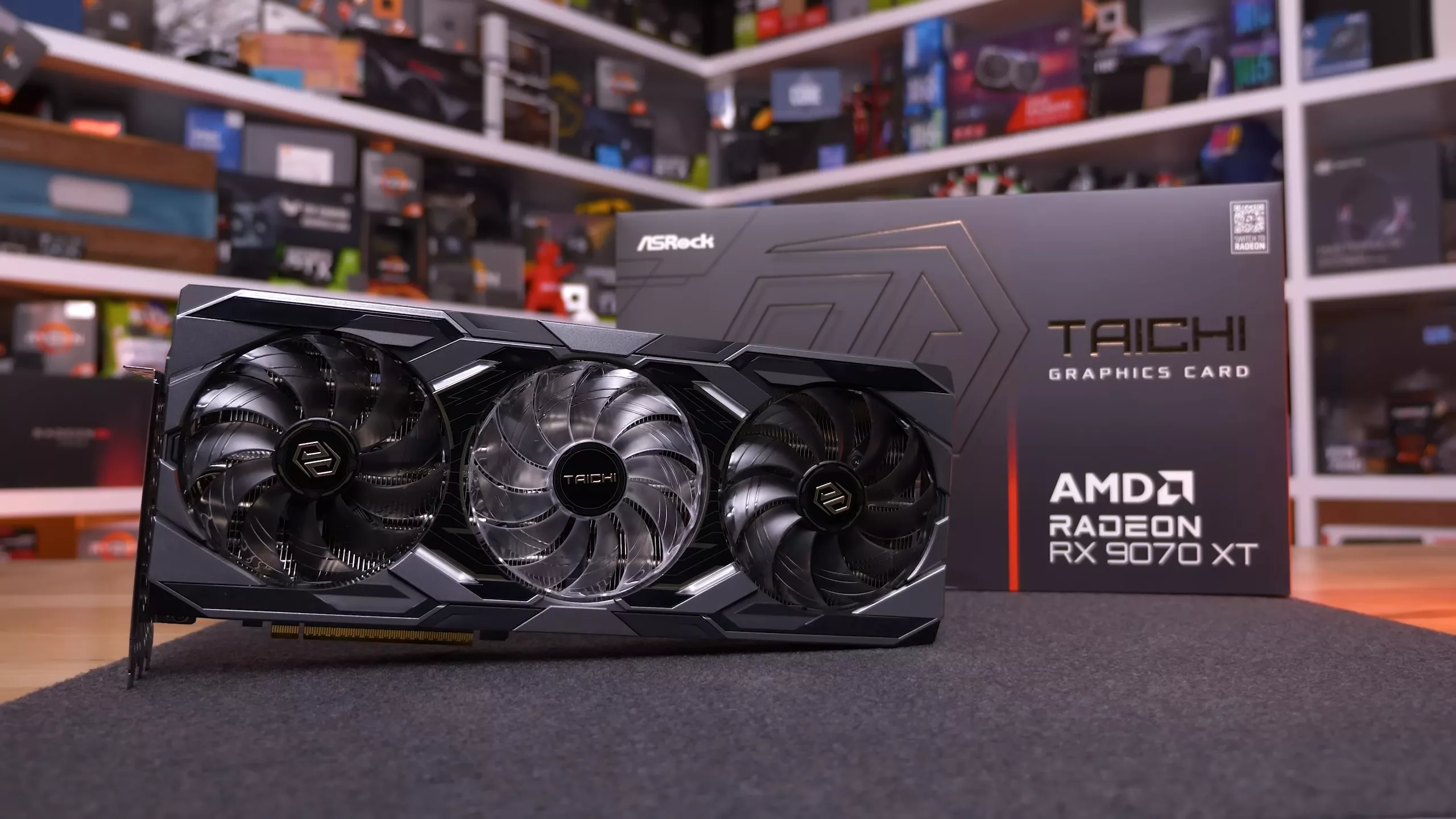
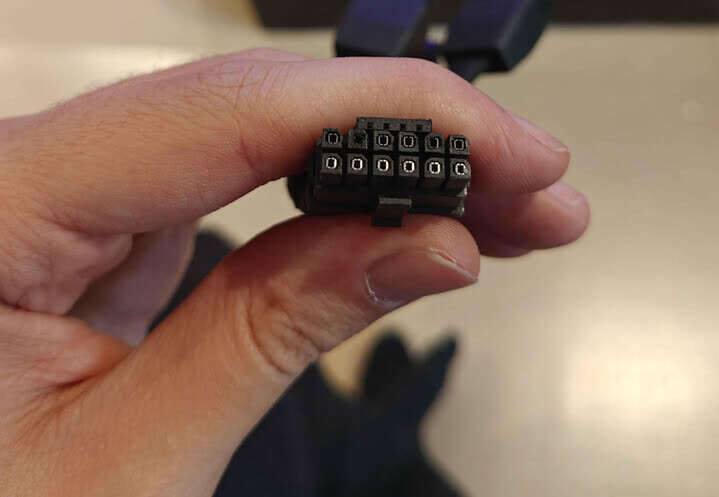
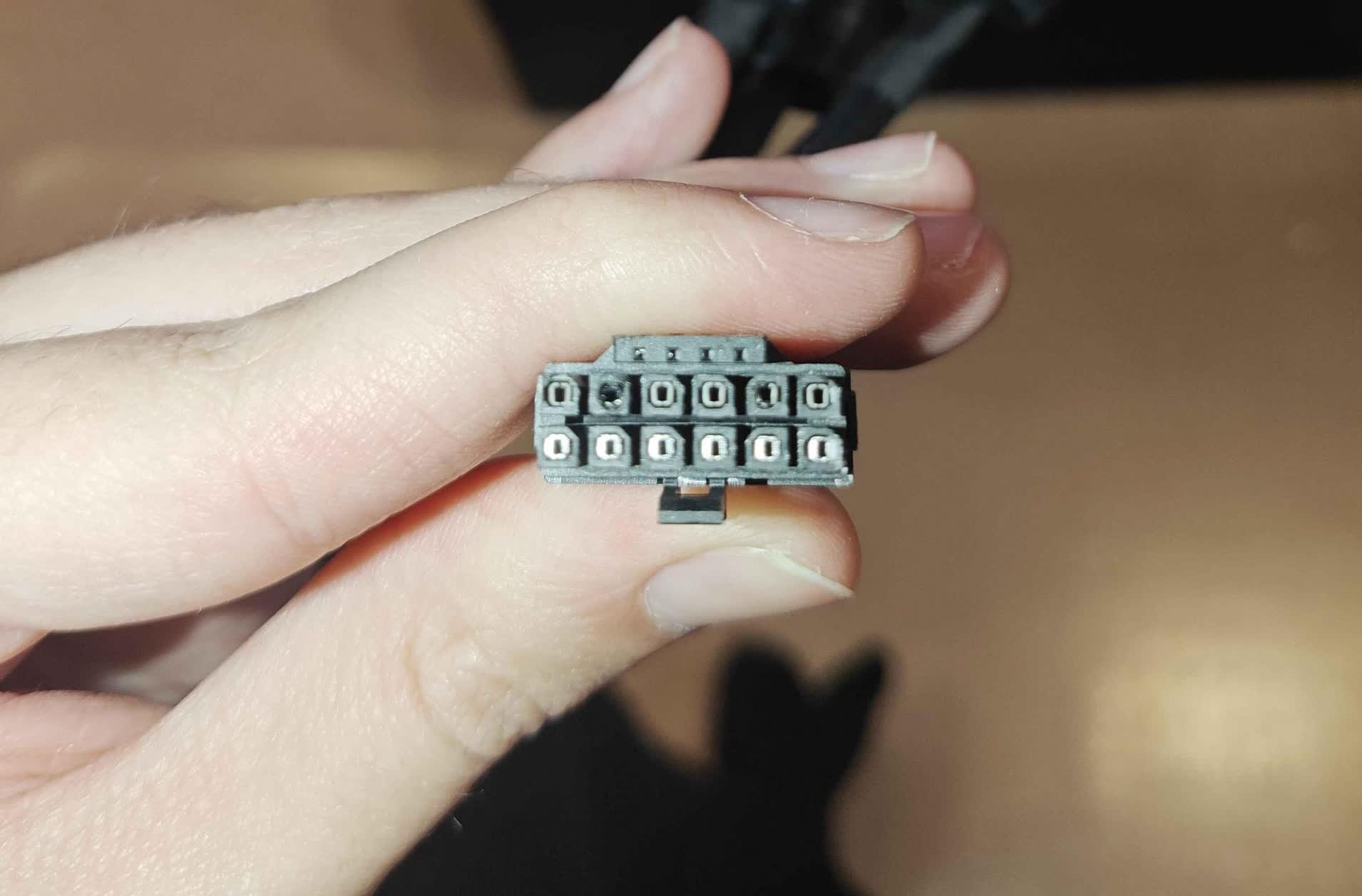
Redditor Savings_Opportunity3 writes that the pins on his 12VHPWR cable connected to his Asrock Taichi OC 9070 XT appeared darker than they should have last month. Now, the connector has melted.

AMD uses traditional 8-pin PCIe power connectors across its RX 9000 series by default – but some AIB partner models have opted for 12V-2×6, including several from Asrock, Asus, PowerColor, and Sapphire.
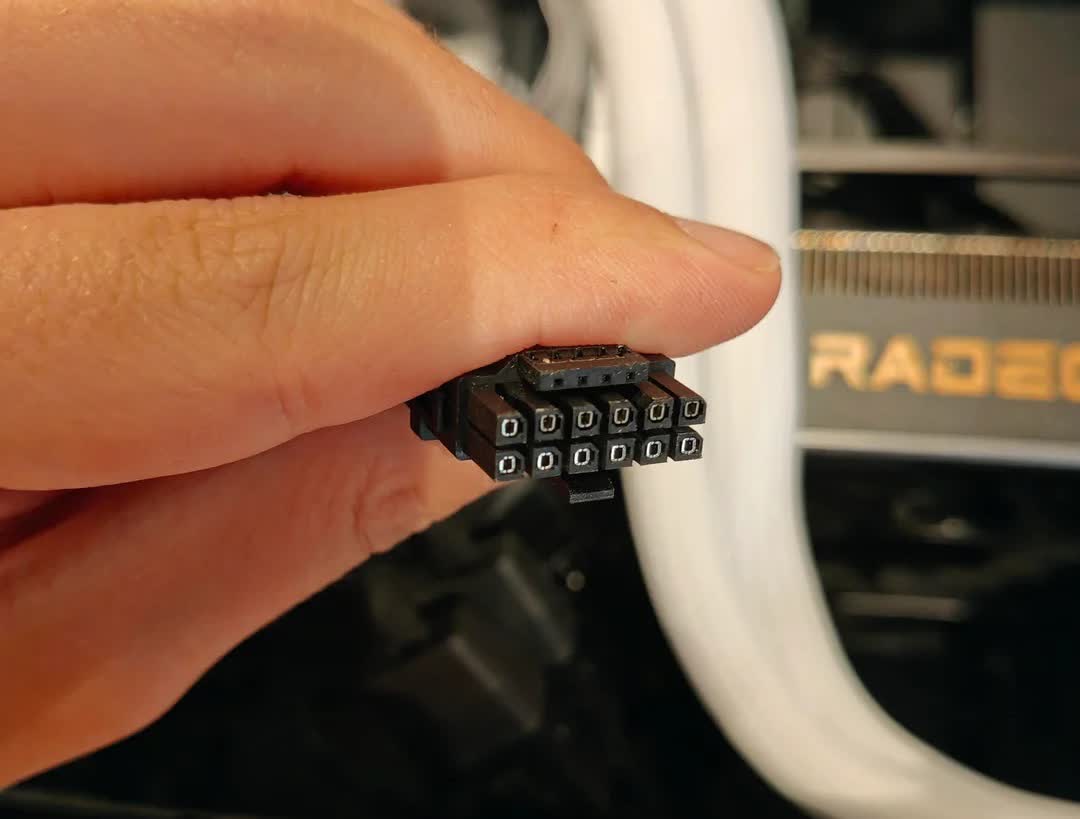
The card in question is known to be power hungry – tests show it pulling 494W under load – and Asrock recommends an 850W power supply. This flagship model swaps the two 8-pin PCIe power connectors for a single 12V High Power connector.

There are a few things to note here. The cable was connected using a 3x8-pin adapter that comes with the card itself, rather than being connected to an ATX 3.1 PSU. We've seen previous reports suggesting that these adapters are more prone to melting than direct 16-pin to 16-pin connections.
The post also states the Redditor was using a 750W PSU from a budget brand called Kolink, which is less than the recommended 850W.

Savings_Opportunity3 also states that the connector was on its 4th plug/unplug cycle, and there's no mention about how securely it was inserted into the card.
There are plenty of cases of melting connectors (sometimes alongside the cables themselves and even the card's power port), usually involving high-power-draw Nvidia cards like the RTX 4090, 5090, and 5080. The fact that this is the first – or first reported – incident on an AMD GPU has led many to suggest that this isn't Nvidia's problem alone.

Some of these incidents are blamed on user error, but one of the most recent cases, involving an RTX 5090 and Wuchang: Fallen Feathers, happened to the editor-in-chief of a gaming publication.

Permalink to story:

 
And the same connector...
Again, one card. One can easily find examples of burnt or melted 8 pins.

Do you have any data to back up the 12v being the problem, as opposed to user error? Keeping in mind that nvidia sells literally tens of millions of cards with this connector every year, including all its datacenter cards that are under far higher continuous stress then consumer hardware.
 
Again, one card. One can easily find examples of burnt or melted 8 pins.

Do you have any data to back up the 12v being the problem, as opposed to user error? Keeping in mind that nvidia sells literally tens of millions of cards with this connector every year, including all its datacenter cards that are under far higher continuous stress then consumer hardware.
Again, the OEMs had no reason to use this connector, that we know is problematic.

Now I understand, you are defending Nvidia position toward 12VHPWR implementation. Sorry, but this connector a lessons learned treasure trove for what to not do when implementing a new standard.
 
It's all about mitigation risk. I personally used the 4090 suprim liquid with a 750 watt platinum sfx psu by Corsair for more than a year with an oc and had no issue even though the recommend minimum was 850 watts. Eventually I changed to the Atx 3.0 Seasonic 1000 watts PSU. Unfortunately nothing is 100% preventive of burn risk, ( plugging it in all the way, atx 3.0 atx 3.1, higher rated and reliable manufacturer of both PSU and GPU, per pin sensing, thermal camera etc etc. ), Although I would argue the later improves your chances to mitigate risk.
It's crazy how some are experiencing this with normal use and we have Nvidia and Asus now with 5090 Matrix as well as some overclockers via shunt mods pushing for 800 to 1200 watts of power over a single cable. 🙃
 
Last edited:
16pin = 12pin infact if the connector was actually 16pin it might mitigate some of the failures but ofcourse the whole horrid plug needs a redesign full stop..just look at derbauers testing
:D
 
Last edited:
Again, the OEMs had no reason to use this connector,
Aside from the fact it is the current standard....
that we know is problematic.
How do you know it is problematic? What data do you have to back this up that doesnt also apply to the old 8 pin connector? Anyone can find pictures off of Reddit.
Now I understand, you are defending Nvidia position toward 12VHPWR implementation. Sorry, but this connector a lessons learned treasure trove for what to not do when implementing a new standard.
You are fighting ghosts. I've not seen nor heard any concrete argument as to why the 12v is any worse then the old 8 pin, or any numbers. Considering nvidia alone sells tens of millions of GPUs that use this connector per year, if it were truly faulty it should be easy to find the numbers to back that up. Yet somehow, nobody does, and simply resorts to attacking people instead.
16pin = 12pin infact if the connector was actually 16pin it might mitigate some of the failures but ofcourse the whole horrid plug needs a redesign full stop..just look at derbauers testing
:D
Having 4 extra pins will not fix the issue. The problem is not the connector itself. When run in spec, it is fine. The issue is cards are not load balancing correctly, instead they are drawing power through 1 or 2 pins, which is WAY out of spec.

Load balancing is achieved by load resistors on the board itself, something that was mandatory when you had 2 or 3 8 pins giving power. With the 12 pin, some manufacturers have cheapened out and removed these resistors, resulting in the melting issue. nVidia is absolutely guilty of this, there were only 3 resistors on the 3090 series, reduced to 2 on the 4090 and 1 on the 5090 (this is coming from derbauers video). There should be 6, one for each pin.

It is up to the device drawing power to regulate its amperage draw, not the PSU. The PSU is simply a dumb terminal that provides an avenue of amperage.
 
Considering the amount of 9070xt sold, this is a good news.
I am a firm believer though, the main reason for these burns is cables or more specifically connectors made on 10 cent each. There is not much money to make unless the makers show real "creativity" and aggressive saving on everything. Outdated equipment that requires new parts? Old software that needs to be upgraded? Cheapest components that cannot manage electric flow? There are probably more than one reasons. But it is time to make cables more reliable, even if it will come with a higher price.
 
Last edited:
Again, the OEMs had no reason to use this connector, that we know is problematic.

Now I understand, you are defending Nvidia position toward 12VHPWR implementation. Sorry, but this connector a lessons learned treasure trove for what to not do when implementing a new standard.
I would hardly call maybe a few dozen cards (generous estimate, it's probably less than a dozen) a treasure trove for what not to do. Sounds to me it is working as expected and there have been some bad individual cards/cables/PSUs like there have always been. I'm using one of those cables on a 4080 OC with a manual overclock on top. Zero issues for almost two years. I build dozens of computers every month, never had a user run into an issue with the cable.

Sounds like you're sensationalizing something that happened, like all most standard users do. I bet you think 12th and 13th Gen issues was widespread too? Turns out it wasn't, and affected drastically less than .1% of all the CPUs produced for the two top end SKUs. Not every COU from that SKU had the problem, it was purely due to silicon variability, which they were able to mitigate with a minor change to the firmware.
 
Again, one card. One can easily find examples of burnt or melted 8 pins.

Do you have any data to back up the 12v being the problem, as opposed to user error? Keeping in mind that nvidia sells literally tens of millions of cards with this connector every year, including all its datacenter cards that are under far higher continuous stress then consumer hardware.

it's well documented at this point that uneven load balancing across the pins seems to be the culprit. industry standard shunt resistors that monitor the current distribution over the cables would help with that, but for unknown reasons nvidia chose to not use them.
add to that the very poor safety factor of the 12vhpwr itself (1.1 vs 1.9 on the standard 8-pin) and you have the recipe for an overall very poor design.

more in-depth:
buildzoid:
der8auer:
 
No thanks. I prefer good old 8-pins connectors.

2 of them offer plenty of power. I would never buy a card that would need much more.
 
After years on this forum I've come to the conclusion that a certain poster that I won't name (but it's pretty obvious who) is a common troll. And as the saying goes, "don't feed the trolls"...
 
I bought a 4070 instead of my usual 80 series purchase for this very reason. It's a flawed standard even if it's mostly due to user error. A product that is prone to user error is poorly designed. Period...
 
AMD never implemented this, the reference model is hosting the standard power PCIe connectors, the OEMs did for the performance crown. Now they have the unreliability crown instead... blame Sapphire and Asrock instead of blaming AMD.
There is no reference model this generation as AMD did not release one.
But yes the blame lies with Sapphire and AsRock using an unnecessary connector on a ~400W (max power with +10% power limit) card.
as opposed to user error?
Ah yes. Suddenly users simply forgot how to plug in power connectors. It's electrically bad design coupled with low fault tolerance and user unfriendly design that has lead to all the issues. Unlike 8pin it doesn't even have a click sound when the plug is firmly in the socket.
including all its datacenter cards that are under far higher continuous stress then consumer hardware.
Data center cards have the plug at the back of the card, not middle. This means less stress on the cable and better airflow. Also data centers are much better cooled than consumer boxes. Also no one has really delved into this, but data center cards may do somewhat proper rail isolation on the PCB like 3090 did.
Aside from the fact it is the current standard....
So is 8pin. Unless no one informed us that 8pin is legacy EOL.
How do you know it is problematic? What data do you have to back this up that doesnt also apply to the old 8 pin connector? Anyone can find pictures off of Reddit.
Videos from far more knowledgeable people on this matter are not proof enough?
Stacks of failed cards from repair shops is not enough?
You are fighting ghosts. I've not seen nor heard any concrete argument as to why the 12v is any worse then the old 8 pin, or any numbers.
Then you haven't looked.
Considering nvidia alone sells tens of millions of GPUs that use this connector per year, if it were truly faulty it should be easy to find the numbers to back that up. Yet somehow, nobody does, and simply resorts to attacking people instead.
Attacking who?
I would hardly call maybe a few dozen cards (generous estimate, it's probably less than a dozen) a treasure trove for what not to do.
The number of reported faults is in the hundreds at least. Not dozens.
Considering that not everyone posts on the internet it could be thousands in reality.
I bet you think 12th and 13th Gen issues was widespread too? Turns out it wasn't, and affected drastically less than .1% of all the CPUs produced for the two top end SKUs. Not every COU from that SKU had the problem, it was purely due to silicon variability, which they were able to mitigate with a minor change to the firmware.
13th and 14th gen. 12th gen was fine.
Looking at Amazon reviews for 13th and 14th gen affected SKU's it's way more than your claimed .1%
You think same game developers would have displayed a warning message to their gamers if this was really a .1% issue?
You think a known browser developer would have disabled bug reports due massive influx of errors from those systems during a heat wave if this was a .1% issue?
 
Back