Intel addresses Arrow Lake's launch woes, promises fixes for gaming performance issues

Skye Jacobs

Posts: 1,979   +58
Staff
A hot potato: The coming weeks will be crucial for Intel as they work to address Arrow Lake's issues and restore faith in their latest processor lineup. Meanwhile, potential buyers may want to wait for the promised fixes and subsequent third-party testing before investing in these new chips.

In a recent YouTube interview with HotHardware, Intel VP and GM of Client AI and Technical Marketing Robert Hallock tackled the challenging launch of the company's new Arrow Lake processors. The Core Ultra 200S series, as they're officially known, has faced scrutiny since its October debut. Hallock confirmed that the launch did not go as planned, with unexpected performance issues emerging, particularly in gaming workloads.

The primary culprit behind Arrow Lake's underwhelming launch is optimization problems rather than fundamental hardware flaws. Hallock said that certain combinations of BIOS and operating system settings created issues that hampered performance. This issue resulted in bizarre and inconsistent benchmark results across various workloads.

One of the most striking examples of these issues was abnormally high memory latency. In one instance, a reviewer recorded latency as high as 180 nanoseconds - more than double the expected 70-80 nanoseconds for Arrow Lake. However, Hallock clarified that this specific memory latency problem was not the root cause of the gaming performance regression compared to the previous Raptor Lake generation.

The gaming performance of Arrow Lake has been particularly disappointing. In some cases, the flagship Core Ultra 9 285K has lagged behind its predecessor, the Core i9-14900K, and competing chips from AMD. This lackluster showing in gaming workloads is unusual, as it's traditionally been a strong point for Intel processors.
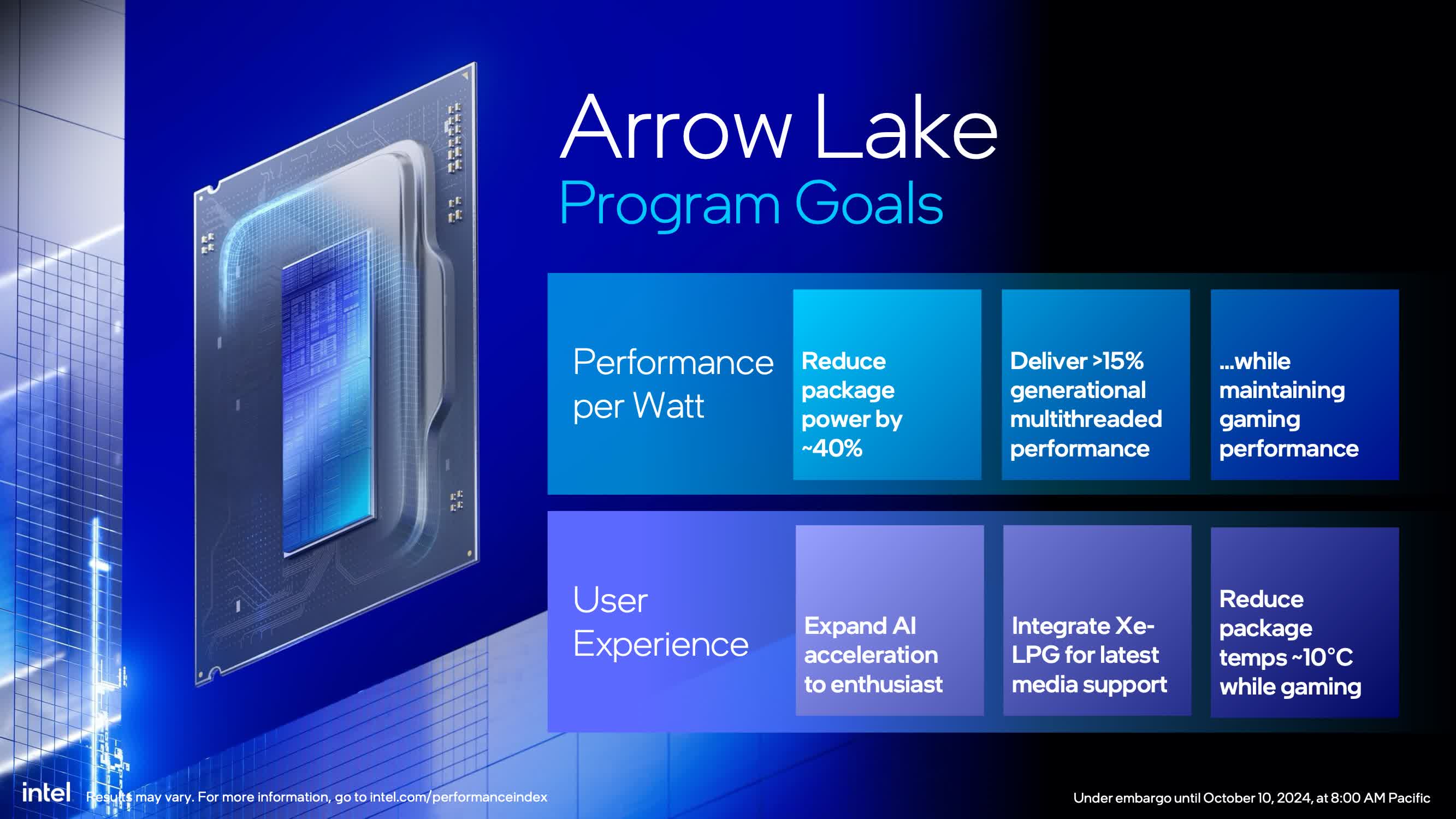
Hallock also noted a significant disconnect between the performance observed by third-party reviewers and Intel's internal testing results. Intel has launched an internal investigation to identify and address the underlying causes of these optimization issues.

At the same time, it is working on a series of fixes for Arrow Lake. Hallock said he was hopeful that at least a couple of these fixes would be ready by the end of November or early December at the latest.

The acknowledgment of these problems and the promise of swift action are positive signs from Intel. However, the Core Ultra 200S series launch has been one of Intel's most troubled in recent memory. The company faces an uphill battle to regain consumer confidence and improve the performance of these new chips, especially in the crucial gaming market.

Permalink to story:

 
Frankly, I'm betting Intel cut back a lot of their internal testing of their CPUs in recent years; that's the only real way to explain why multiple generations of their products have had issues like this.

That's how you make money right? Intel is amazing, they don't need testing. QA is overrated. Just bring out new products as fast as possible, people will buy Intel anyway.
 
None of this makes any sense, barring Microsoft pushing a surprise Windows update at the last second with significant performance impacts. But afaik no one is alleging that happened.

Otherwise, CPU reviewers seem to have largely settled into consistent testing approaches. This was not a surprise quiz. Intel knew what the questions would be and I have trouble believing not a single person there ran some of these same tests.

I suppose one answer I'd find easier to believe is that in the total scale of things, Intel did not prioritize what the TechSpots and GamerNexuses of the world would think. And its probably true that the majority of CPUs sold (which come embedded in premade systems) go to people who did not read and were not guided by those reviews. But as true as that may be the bad press sure ain't helping anything.
 
Arrow lame uses lunar lake core architecture which is intended for 30 watts laptop, far below typical 100+ watt desktop cpu, to compete apple silicon.

Gaming laptop sales number are higher than desktop.
Regular laptops sales are even higher.
Arrow lake low sales won't hurt much
 
Arrow lame uses lunar lake core architecture which is intended for 30 watts laptop, far below typical 100+ watt desktop cpu, to compete apple silicon.

Gaming laptop sales number are higher than desktop.
Regular laptops sales are even higher.
Arrow lake low sales won't hurt much
Arrow Lake is what the enterprise/server Xeon market depends on. Low sales will massively hurt Intel. They were already bleeding marketshare to Epyc, this will only make it worse.
 
Arrow Lake is what the enterprise/server Xeon market depends on. Low sales will massively hurt Intel. They were already bleeding marketshare to Epyc, this will only make it worse.
Gaming workloads don't mean anything to the datacenter, but power efficiency does. That is why both intel and amd current generation of processors do not focus on improving gaming performance which, TBH, doesn't need improvement.
 
Do companies actually test anything before releasing anymore?
Well, they claim they did and like AMD seem to be blaming reviewers indirectly, for getting it wrong, as they said their own benchmarks were much better. LOL The era of blame shifting is now in full swing.
 
RIP Wintel
This is a real problem when Nvidia enters the race next year. The lucrative markets are data centers and mobile CPUs, that are gradually switching to ARM based SOC, and that threatens Intel the most as the market leader currently.
 
Back