Jeff Bezos isn't worried about the AI bubble: "the good ideas will pay for all of the losers"

Julio Franco

Posts: 9,318   +2,252
Staff member
Sounding off: Concerns over an AI bubble have intensified as OpenAI, Anthropic, Google, Microsoft, and Amazon collectively pour hundreds of billions into data centers, chips, and model development. But Jeff Bezos believes that even if the boom collapses financially, the long-term technological gains could still justify the frenzy. His comments arrive at a moment when OpenAI alone is reportedly valued at $852 billion and looking to IPO, underscoring just how unprecedented the AI spending race has become.

Amazon founder Jeff Bezos dismissed fears of an impending AI bubble during a recent CNBC interview, arguing that periods of speculative excess often accelerate technological progress rather than derail it. "Even if it does turn out to be a bubble, you shouldn't worry about it because the bubble is driving investment and a lot of the investment is going to turn out to be very healthy," Bezos told CNBC's Andrew Ross Sorkin on Squawk Box.

The remarks come when there's mounting debate over whether the current AI boom is sustainable. Hyperscalers including Amazon, Microsoft, and Google are expected to collectively spend more than $700 billion on AI infrastructure this year alone, while startups continue to raise enormous funding rounds at valuations that would have seemed implausible just a few years ago.

ChatGPT-maker OpenAI announced $122 billion in committed capital tied to a valuation of $852 billion a few weeks ago, making it one of the most valuable private companies in the world, and now with an impending IPO. At the same time, investors and analysts have increasingly questioned whether the industry's spending levels can generate returns quickly enough to justify the scale of investment.

Bezos appeared largely unconcerned by the possibility that many AI companies or projects could fail.

He acknowledged that the current environment has resulted in "every experiment" getting funded, including weak or unrealistic ideas, because investors have not yet learned how to reliably distinguish promising AI ventures from bad ones.

But Bezos believes that inefficiency is a normal part of major industrial transitions. "It's because investors at this moment haven't learned yet how to discriminate between good ideas and bad ideas, and that's OK, because the good ideas will pay for all of the losers," Bezos said.
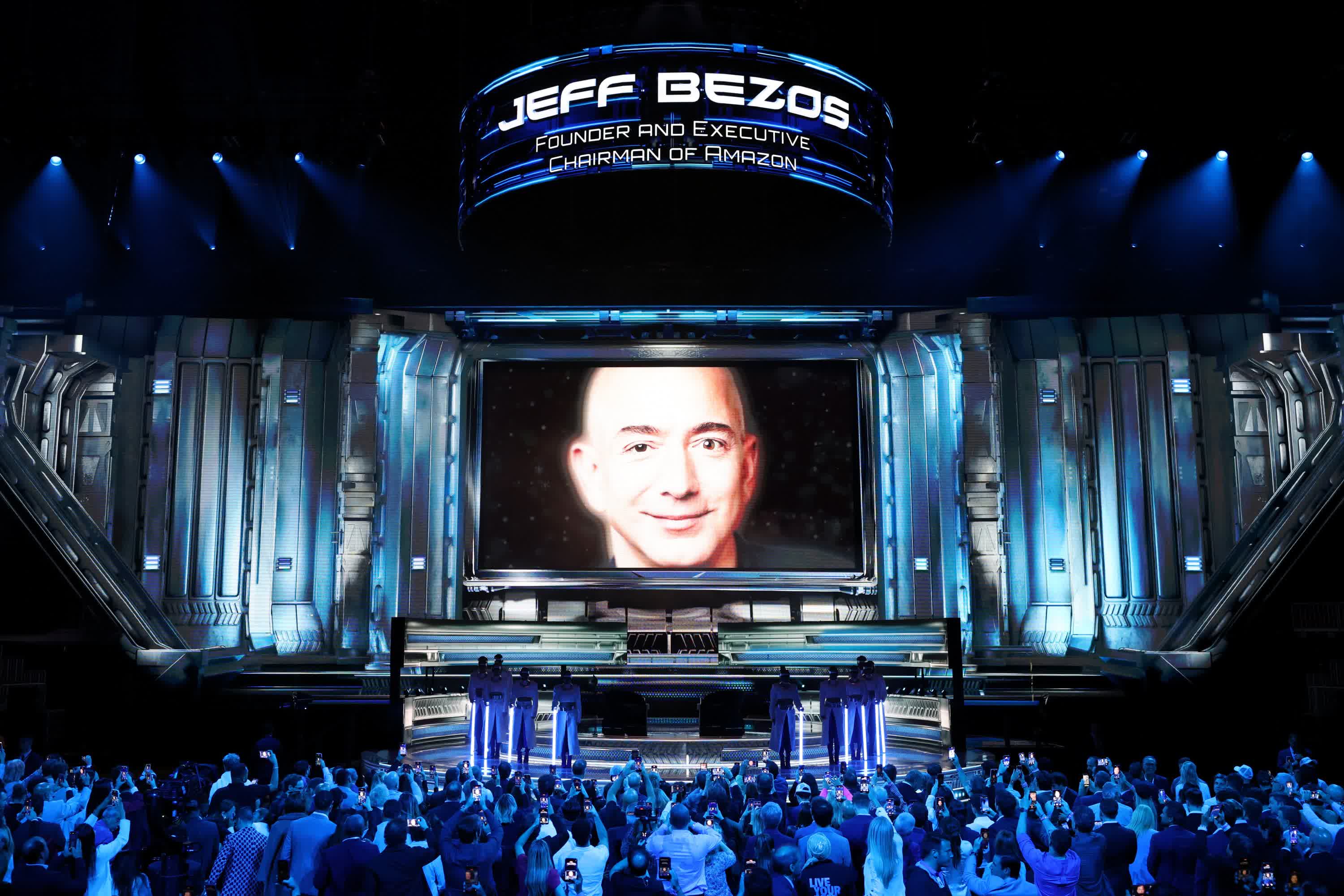
Jeff Bezos at the America Business Forum in Miami, Florida (November 2025). Image credit: The Guardian

The Amazon founder compared the current AI climate to the biotechnology bubble of the 1990s. While many biotech investments eventually collapsed, the period also accelerated research and infrastructure that later contributed to major medical advances and life-saving drugs.

Historically, similar patterns have played out during railroad expansion, the dot-com boom, and large-scale telecommunications buildouts. Investors often absorb enormous losses during speculative periods, but the infrastructure created during those cycles frequently becomes foundational for future industries.

Beyond the broader AI discussion, Bezos revealed additional details about his new AI venture, Project Prometheus. The startup launched in November with $6.2 billion in funding and is reportedly focused on AI systems capable of handling physical-world engineering and manufacturing tasks.

Bezos described the company's goal as building an "artificial general engineer," a next-gen evolution of CAD software capable of helping engineers design physical objects more efficiently.

The company is led by Bezos and former Google X executive Vik Bajaj. According to Bezos, Project Prometheus was intentionally created as a standalone company rather than being folded into Amazon or Blue Origin because the effort required dedicated focus.

The concept hints at a broader shift within the industry away from purely conversational AI chatbots and toward systems designed to automate scientific research, industrial design, manufacturing workflows, and drug discovery.

For now, however, Bezos appears comfortable with the chaos surrounding the sector. If anything, he suggested that the current excess may be a necessary ingredient for building the next generation of tech infrastructure.

Permalink to story:

 
"Historically, similar patterns have played out during railroad expansion, the dot-com boom, and large-scale telecommunications buildouts. Investors often absorb enormous losses during speculative periods, but the infrastructure created during those cycles frequently becomes foundational for future industries."

Except the dot-com boom and bust left behind many useful companies,and useful hardware, an AI bubble crashing would result in a bunch of hardware that has no use aside from AI processing. And I doubt investors would be willing to absorb hundreds of billions on datacenters which have yet to be finished or started up with hardware.

But of course billionaires aren't worried about AI being a bubble, they won't suffer from the economic collapse resulting from the circular AI investment scheme propping up the entire economy.
 
The problem with the AI bubble is that it's paid for mostly with debt. Many companies are severely over leveraged using assets that are over valued. I don't think enough people understand that the way AI is being financed is going to lead to another global financial crisis. AI as a technology is absolutely valuable and world changing, it's the way AI is being financed that's the problem. AI companies are the new subprime loan market
 
That's because Amazon will be fine, as will Microsoft, as will Google.
OpenAI probably disappears, they're often first to market but what can they do that Microsoft, Anthropic or Google etc can't (besides spending money). All those companies that aren't much more than a layer on top of a slightly if even that existing model supposedly worth billions... They'll be gone.
 
No one in their right mind is "worried about the AI bubble" since a very long time.
Given how the demand for tokens outstrips the supply by the day, I think we should finally put the "AI bubble" nonsense to rest.
 
It's not a worry because money isn't a factor to him like everyone else. Mr. Bezos is watching from Elysium the natural selection below, and smiles, kindly enough.
Ah Elysium, the movie that taught us it's ok to steal from people and even kill them, as long as they have more money than you do ... those who didn't already learn this from Stalin and Mao, that is.
 
I take it some have never seen the film Elysium, or idolize crony capitalist mega corpos ravaging the earth while living on a lavish space station, essentially letting everyone become ill or die who didn't have elite status to go live in a utopia where the icky poors aren't allowed.
 
Haven't really noticed any of the uber billionaires that "worry" about (insert latest) bubble.
John D. Rockefeller, Andrew Carnegie and others "survived" the breaking of bubbles.
At least Carnegie gave away a LOT of his wealth before and after he died.
 
AI is not a bubble. You are witnessing a new infrastructure birth. Digital, electrical surveillance via AI. You won't be able to speak freely ever again. You'll pay subscriptions for everything. You people can't see as far as I see.
 
The problem with the AI bubble is that it's paid for mostly with debt. Many companies are severely over leveraged using assets that are over valued. I don't think enough people understand that the way AI is being financed is going to lead to another global financial crisis. AI as a technology is absolutely valuable and world changing, it's the way AI is being financed that's the problem. AI companies are the new subprime loan market
I'm not even going to pretend to understand the intricacies around the cause of the 2007-2008 Global Finanical Crisis, but from my limited knowledge one primary cause was lending to a much broader segment of people ie real estate purchasers. This AI bubble seems to be lending to a much narrower portion of people, so I see the impact of any downturn being a lot more isolated.

Debt is also the backbone of global economies these days. Long gone are the times when people actually buy anything with their own money.
 
I giggle when people talk about the AI bubble. They haven’t seen anything yet. Demand will only grow. Let’s talk again in a few years, when you’re still talking about the bubble that still hasn’t become reality.
 
Ah Elysium, the movie that taught us it's ok to steal from people and even kill them, as long as they have more money than you do ... those who didn't already learn this from Stalin and Mao, that is.
Well, stealing and killing are bad, no matter who practises it. Despite its flaws, Elysium's concept is about inequality and feels increasingly plausible of late. As long as a small percentage holds an indecent chunk of the world's money, whatever the numbers are, and there is hunger, homelessness, and poverty, and the Global South is at a disadvantage to the West, a sort of global apartheid, it will continue to be relevant. I don't know if a Star Trek-like economy can exist, but one can dream and compare it to our present state, or as the poet of Dove Cottage would say, "What man has made of man."
 
Amazon, can't even deliver items on time anymore. And, they hire a bunch of foreigners, who have no clue about what they're doing. I only use them if I have to.
 
Elysium's concept is about inequality and feels increasingly plausible of late...
In a fair, free society, people are guaranteed equality of opportunity, not equality ot outcomes.

As long as a small percentage holds an indecent chunk of the world's money...
You're espousing medieval thinking -- literally from the Medieval period -- when wealth came only by taking it from someone else. Bezos and Musk didn't take their billions from other people; they created their wealth: expanding the economic pie, not devouring the shares of others. The demand for income "fairness" was a founding concept of nations like the former USSR and 1970s-era China -- a vast wasteland of peasant farmers, earning pennies working 18-hour day in the rice paddies. And it's responsible for more human misery than anything else in history.

What's truly 'indecent' are concepts like the "Gini index", where socialists rank a nation where everyone earns $10K a year as superior to a nation where a very few earn $10K, most earn $50K, and some few earn millions.
 
In a fair, free society, people are guaranteed equality of opportunity, not equality ot outcomes.
It should be equality of opportunity, since one person will work more than another or possess greater skill or natural gifts. In practice, though, the few have gamed the system to the detriment of the many. Taken in an abstract sense, a farm labourer might have done vastly more work than a tech CEO, but the remuneration is out of all proportion.

You're espousing medieval thinking -- literally from the Medieval period -- when wealth came only by taking it from someone else. Bezos and Musk didn't take their billions from other people; they created their wealth: expanding the economic pie, not devouring the shares of others. The demand for income "fairness" was a founding concept of nations like the former USSR and 1970s-era China -- a vast wasteland of peasant farmers, earning pennies working 18-hour day in the rice paddies. And it's responsible for more human misery than anything else in history.
I am not espousing stealing from the rich, nor redistribution of wealth, which, in practice, often boils down to stealing from the Former High to make the New High, the Common Folk's plight rarely changing.

It's instructive to think of Earth as an OS with finite resources running 8 billion programs. There's a small class of applications who, honest or not, have secured a majority of the computer's memory and CPU time, causing billions of others to run poorly. Unfortunately, rebooting Earth or updating the kernel isn't possible, and I don't know what the solution is, neither capitalism nor communism as we know them in practice. I do like the idealistic, post-scarcity world of Star Trek and would go there tomorrow if it were possible. It should be noted that the Scandinavian model has led to some of the happiest people.

What's truly 'indecent' are concepts like the "Gini index", where socialists rank a nation where everyone earns $10K a year as superior to a nation where a very few earn $10K, most earn $50K, and some few earn millions.
Gini isn't perfect, like most measures, but has a lot of truth. Take South Africa, which has the dubious honour of the highest Gini index. Yet, it is accurate. The country still deals with massive inequality springing from the legacy of apartheid and poor governance today. In sunny Cape Town, "the best city in the world," tourism paints it as a masterpiece to visit, and certainly it is, if one is going to Table Mountain, Camps Bay, the Waterfront, and all those shiny places. But, take a drive across the city, or better yet, take the train, and the true face of Cape Town reveals itself through the windows: rampant poverty, and townships with shacks a stone's-throw away from top-class areas. Those coming from the airport see it best. After all, "this city works for you."
 
Last edited:
A farm labourer might have done vastly more work than a tech CEO, but the remuneration is out of all proportion.
If a tech CEO creates a successful enterprise, their remuneration is a fraction of the benefit they've given society. Before Bezos reinvented e-Commerce, average delivery time for Internet orders was several weeks, and returns were often practically impossible. With Amazon, I've ordered packages (on a Sunday afternoon, no less) and gotten them in three hours time.

I am not espousing stealing from the rich, nor redistribution of wealth, which, in practice, often boils down to stealing from the Former High to make the New High, the Common Folk's plight rarely changing.
Kudos for acknowledging that.

It's instructive to think of Earth as an OS with finite resources running 8 billion programs.
Nothing could be further from the truth. Again: this is medieval economics you're espousing. If resources were fixed, we'd still have the same global domestic product we did in 1900 -- but instead, year after year after year, the economy grows. Expands.

Gini isn't perfect, like most measures, but has a lot of truth. Take South Africa, which has the dubious honour of the highest Gini index. Yet, it is accurate.
You couldn't possibly be more wrong. I've spent a lot of time in Africa myself. Conditions for the poor in South Africa are far better than throughout most of sub-Saharan Africa -- and South Africa also has a thriving middle class, which is essentially nonexistent in much of the continent.
 
I'm not even going to pretend to understand the intricacies around the cause of the 2007-2008 Global Finanical Crisis, but from my limited knowledge one primary cause was lending to a much broader segment of people ie real estate purchasers. This AI bubble seems to be lending to a much narrower portion of people, so I see the impact of any downturn being a lot more isolated.

Debt is also the backbone of global economies these days. Long gone are the times when people actually buy anything with their own money.
I'm over simplifying here, but the subprime loan market was bad dredit labeled as good credit and you could basically make up an income number and get a loan for whatever. Something very similar is going on right now with corporations instead of individuals. They are saying they work X dollars because AI, but outside of a few niche applications and things like mass surveillance, AI is not profitable. JP Morgan/Chase has already said they are no longer lending to AI companies and lots of venture capital companies are starting the ask for their money back. The thing that sucks is that unused capacity isn't going to training better models, it's being sold off and rented to governments for mass surveillance being paid for with tax payer dollars, so we are bailing out the AI companies in that way.

I don't want to sit here and say AI is all bad, I love some of the projects I've been able to do with Gemini and have even been able to replace lots of subscriptions by making Agents with Gemini. My $20/m Gemini subscription has saved me $100/m in subscription services and has even helped me with rapid prototyping with Raspberry Pis by either finding the repositories I need or just creating the code if they don't exist. and of course I look over the code and do debugging, but debugging isn't part of rapid prototyping.

But before I get too many tangents deep, the AI companies are starting to look like the subprime loan market because they aren't actually making tons of money. At least not relative to the money they're spending. Seeing as they leveraged their stock, or in some cases, the GPUs themselves, once people start selling off AI stocks and GPUs as they are the collateral, we are going to see a cascade effect that will lead to a mass sell off of assets. The only people who will have really made any money are TSMC because people aren't going to be buying GPUs off nVidia at scale anymore in the middle of a crash and you can get them for pennies on the dollar. This is why you don't seeing memory companies expanding capacity, they don't believe the AI boom is a long term trend and they have entire floors of people doing cost analysis and weighing risks. it's better to raise RAM prices 4x than to spend billions of dollars expanding manufacturing capacity only for price to goto half of where it started at when demand falls off.

The banks are getting nervous, VC is getting nervous and many companies never believe this was long term to begin with. But the real kicker that makes me not believe in this a long term trend is that we have more efficient models coming out of China being trained and run on worse hardware.

I ran AI locally for awhile on a 3070ti and gave it access to 256GB of DDR4 on one of my old Xeons and it was basically limited by the speed of the PCie bus. While faster memory is always better, the bigger the memory pool, the bigger the model you can run. that silly setup I fabracobbled was about to do a 70b parameter setup at around 50 tokens a minute. if you aren't sitting there talking to AI all day and maybe need it to do 5 or 10 things a day, that's fine. I have tried a few models that I can remote into I'm at work if I have an idea and even though it's running on a 3070ti, it's typically takes 15-20 minutes per request and I just work on it through out the day when I have spare time. I'll just let it work on a setup I built for under $1000(pre ram shortage) while I'm at work or sleeping instead of giving Claude or Gemini hundreds of dollars a month.

This relates to the sub prime loan market because people who shouldn't have been getting loans were buying houses with money they didn't have at values they weren't worth. These AI companies are buying GPUs significantly above what they're worth with money they don't have.

This is where the Ryzen AI Max systems become a great value. You can build on with the power of a 5060, but it has a 192GB memory pool for $5k instead of dropping $100k on an H100. Just keep that thing chipping away in a closet somewhere with a chain of tasks.

And I see things like the company that spends $90k/m on Gemini or the time me and my brother were collaborating on a project and he got $1,300 bill from Claude. And I'm not saying DONT use cloud AI services, but use them when you need things done now and just automate the other stuff when you're at work or asleep.

There are too many solutions than just cloud AI and data centers. Me and my brother were considering going in on a RTX pro 6000 but 1)wife won't let that happen, she's barely tolerant of my used hardware addiction I get from the recycling center I used to volunteer at. 2) the 3070ti I have chipping away for me on my old Xeons is good enough for now.
 
AI is not a bubble. You are witnessing a new infrastructure birth. Digital, electrical surveillance via AI. You won't be able to speak freely ever again. You'll pay subscriptions for everything. You people can't see as far as I see.

Hoo-boy. Damn, but some people DO have a high opinion of themselves.....and an incredibly low one of everybody else. Lololol!!!
 
Last edited:
If a tech CEO creates a successful enterprise, their remuneration is a fraction of the benefit they've given society. Before Bezos reinvented e-Commerce, average delivery time for Internet orders was several weeks, and returns were often practically impossible. With Amazon, I've ordered packages (on a Sunday afternoon, no less) and gotten them in three hours time.
No doubt, they've contributed to and revolutionised society. But I do not agree that it is somehow right for a class of elites to hold much of the world's resources (if money were a proxy). Others have also contributed: Torvalds, Cutler, the millions of workers whose sweat and toil built this world.

Nothing could be further from the truth. Again: this is medieval economics you're espousing. If resources were fixed, we'd still have the same global domestic product we did in 1900 -- but instead, year after year after year, the economy grows. Expands.
Earth's resources are finite and the population grows.

You couldn't possibly be more wrong. I've spent a lot of time in Africa myself. Conditions for the poor in South Africa are far better than throughout most of sub-Saharan Africa -- and South Africa also has a thriving middle class, which is essentially nonexistent in much of the continent.
South Africa is better off than the rest of the continent, yes, but the point is the gross disparity, the lack of balance, the highs and the lows.

I stand by my arguments, so let's agree to disagree. On a lighter note, my heart has always dwelt in either the Middle Ages or the distant future (but not the "here"). So I take it as an honour to be called a medievalist.
 
Back