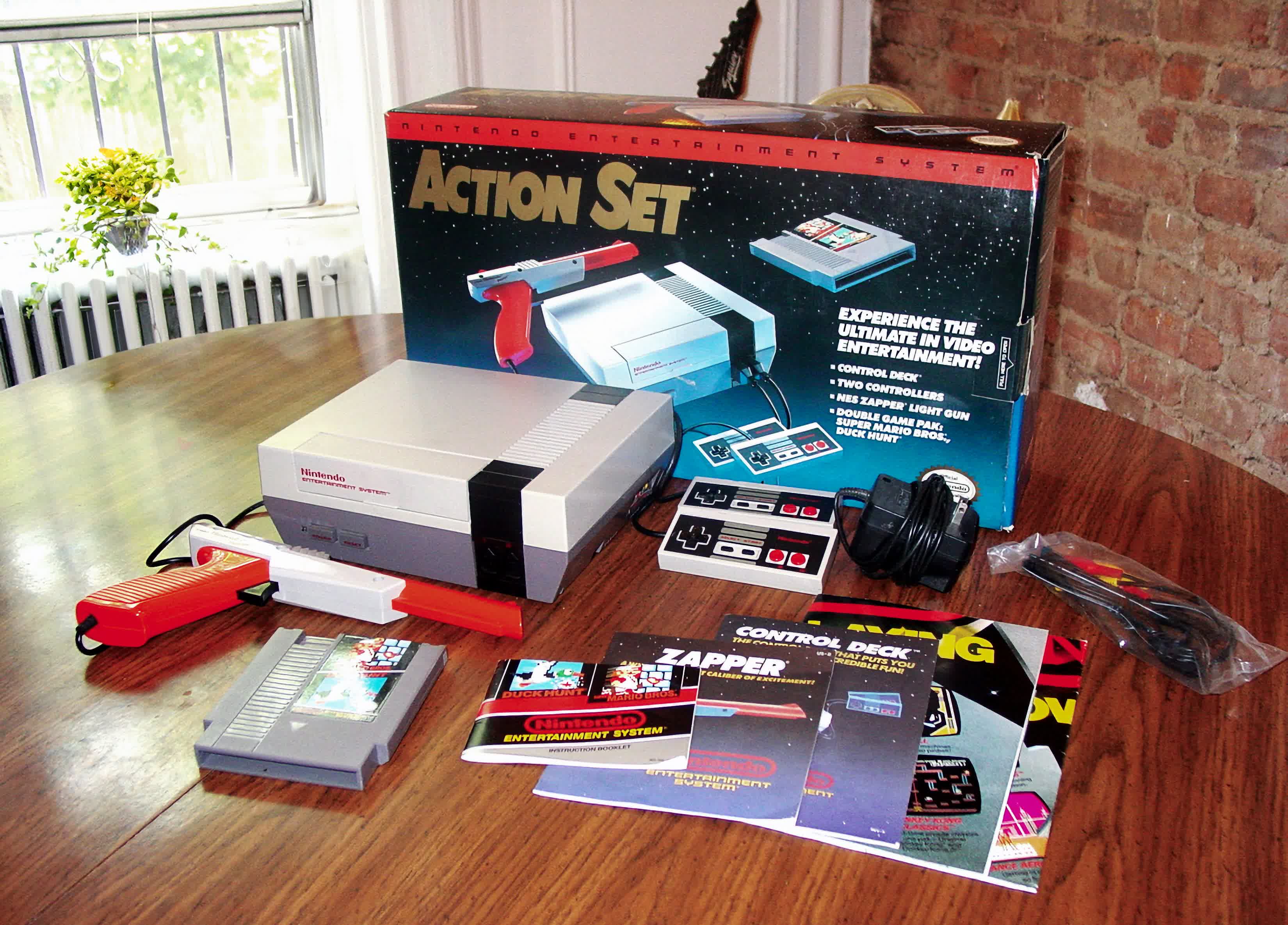
Legends of Tech: Nintendo Entertainment System

Consoles were simply non-existent where I was as a child. No-one had consoles, it was all "home computers." I did see the Sega SC-3000 though. That was the computer version of the SC-1000.
 
One of these days I'm going to get round to finishing my video pouring cold water over this video game crash nonsense. The market was very new so there wasn't much historical data for people to work from, and figures were massively skewed by a spike in 1982, but with the benefit of hindsight, removing the outlier shows the market was relatively stable. Here are unit sales of consoles in the US by year:

1980: somewhere between 1 and 1.5 million.
1981: 3 to 4.5 million.
1982: 7 to 9 million (likely driven by the release of Pac Man for the VCS).
1983: The doom and gloom year where a mere... 5.5 to 6.5 million were sold.
1984: In the depths of the crash now, 3 to 3.5 million.
1985: Somewhere between 1 and 3 million, so still selling better than five years previously.
1986: Sadly "more than 2 million" is as specific as it gets; because the press had declared video games to be dead they stopped covering it in any great detail leading to very few reliable sources of data.
1987: The first full year the NES was available in the US, around 4 million, I.e. not much better than during the worst days of the "crash", and certainly not the "massive hit out of nowhere" that it's heralded to be.

Rather than "the video game crash of 1983" it should more accurately be called "a poor decision by executives at one division of a company led to that division struggling for a bit in the mid 80s". Let's face it, if even the company that "killed" the industry didn't collapse, maybe it wasn't so bad?

(As for the broader video games market - I.e. not just consoles - that was experiencing *massive* growth. EA, Mastertronic, Origin, Mindscape, Accolade, Eidos, Psygnosis, Naughty Dog, Angel Games (now Rockstar San Diego), Westwood, and Cinemaware are just a selection of industry giants that were formed between 1983 and 1985.)

As someone from the UK the NES is little more than a curiosity - despite being a 14 year old nerd in 1987 I didn't even know the NES existed, and it wasn't until the Gameboy and SNES that I became aware Nintendo had done something besides the Game and Watch - and it gets really tiresome hearing Americans banging on about how Nintendo saved gaming.
 
My very first console was the ColecoVision. Sadly I never got any other games for it besides Donkey Kong because no one sold games for it here. I even tried to get my mom to write to Coleco and ask if they would sell us some, lol. I finally got an NES a couple of years later. Super Mario Bros. was so amazing at the time. Mine had the original gray Zapper and came with Duck Hunt and Mario on a single cartridge. I remember the occasional Friday night trip to Family Video to rent an NES game or two and no matter how bad they were I spent the entire weekend playing them. Yes, I'm talking about you Fester's Quest.
 
Why such an obsession with the name Famicom?
Couldn't they have chosen Famcomp for instance, or was that taken already too?
 
Reading this makes you realize how much modern gaming still runs on NES-era decisions. Platform control, curated libraries, even first-party mascots all trace back to Nintendo trying to make sure history didn’t repeat itself.
 
Why such an obsession with the name Famicom?
Couldn't they have chosen Famcomp for instance, or was that taken already too?
Pasokon was already established as the Japanese word for "personal computer" so Famicom was a bit of a play on that. The idea being that it wasn't just a personal computer, it was for the whole family. Nintendo and Sharp were business partners at the time (Sharp made the displays for the Game & Watch handhelds) so an agreement wasn't too difficult to reach. Part of the deal was that Sharp was allowed to produced their own versions of the console, called the Sharp Twin Famicom which included the Famicom Disk System drive built right in.
 
One of these days I'm going to get round to finishing my video pouring cold water over this video game crash nonsense. The market was very new so there wasn't much historical data for people to work from, and figures were massively skewed by a spike in 1982, but with the benefit of hindsight, removing the outlier shows the market was relatively stable. Here are unit sales of consoles in the US by year:

1980: somewhere between 1 and 1.5 million.
1981: 3 to 4.5 million.
1982: 7 to 9 million (likely driven by the release of Pac Man for the VCS).
1983: The doom and gloom year where a mere... 5.5 to 6.5 million were sold.
1984: In the depths of the crash now, 3 to 3.5 million.
1985: Somewhere between 1 and 3 million, so still selling better than five years previously.
1986: Sadly "more than 2 million" is as specific as it gets; because the press had declared video games to be dead they stopped covering it in any great detail leading to very few reliable sources of data.
1987: The first full year the NES was available in the US, around 4 million, I.e. not much better than during the worst days of the "crash", and certainly not the "massive hit out of nowhere" that it's heralded to be.

Rather than "the video game crash of 1983" it should more accurately be called "a poor decision by executives at one division of a company led to that division struggling for a bit in the mid 80s". Let's face it, if even the company that "killed" the industry didn't collapse, maybe it wasn't so bad?

(As for the broader video games market - I.e. not just consoles - that was experiencing *massive* growth. EA, Mastertronic, Origin, Mindscape, Accolade, Eidos, Psygnosis, Naughty Dog, Angel Games (now Rockstar San Diego), Westwood, and Cinemaware are just a selection of industry giants that were formed between 1983 and 1985.)

As someone from the UK the NES is little more than a curiosity - despite being a 14 year old nerd in 1987 I didn't even know the NES existed, and it wasn't until the Gameboy and SNES that I became aware Nintendo had done something besides the Game and Watch - and it gets really tiresome hearing Americans banging on about how Nintendo saved gaming.

You are failing to recognize many of the systems sold in 1985 were sold at 1/5 of the original price. I bought my colocovision for $40 at zayres. The coleco Gemini for 30 and another Atari for 30. They were clearance sales. I did not realize at the time the market was crashing, but you pick up cartridges for as low as $3 in many stores.
 
My older cousins and uncle had the NES Deluxe (Gyromite) package.
My grandma bought me the NES Power Set for Christmas. I still have the Powerpad and Zapper to this day. My uncle has the gray colored zapper - but mine was day glow orange. My first games were the 3 in one Super Mario, Track Meet, Duck Hunt cart and my father bought me TMNT

NES' strength was a lot of new ideas and fun games. There were a lot of obscure games I rented from the video game store which I played, could never beat but had fun anyway.

Section Z, Seicross, Indiana Jones and the Temple of Doom, Air Fortress, Burai Fighter, Conquest of the Crystal Palace, Ninja Gaiden, Legacy of the Wizard - the list goes on and on.

I have a whole lot of memories from the NES.

I still have my NES and my games - as well as the Power Glove and the other peripherals - in my basement.

Fortunately, I can relive those memories on my SWITCH 2.
 
Back