Microsoft faces reality check on AI ambitions as Copilot and Foundry struggle to meet goals

Cal Jeffrey

Posts: 4,595   +1,682
Staff member
Winners & losers: It's hard to argue that we aren't in the midst of an AI bubble – analysts and AI CEOs largely agree. While there are no signs of a crash yet, Microsoft may be the first company to show signs that it overestimated enterprise and consumer interest.
Microsoft's push to make artificial intelligence the core of its product strategy is running into resistance from the very customers it expected to embrace it. Multiple Azure sales units fell short of ambitious growth targets tied to Foundry, Microsoft's marketplace for AI models and agent-building tools.

In response, the company reduced those growth expectations for the current fiscal year, an unusual step for a firm that typically raises quotas annually. The shortfall suggests enterprises remain hesitant to spend more on AI, even as Microsoft promotes agentic systems as the next major shift in workplace computing.

Foundry is central to Microsoft's vision for autonomous AI agents capable of handling multistep tasks with minimal oversight. The company pitched these tools as a way for businesses to automate everything from data processing to report writing, and reinforced the message with new Word, Excel, and PowerPoint agents revealed at recent developer events.

However, many companies that invested in these tools are not using them, reflecting persistent concerns about accuracy, brittleness, and the risk of high-stakes mistakes. Anonymous sources told The Information that one Azure unit asked salespeople to grow Foundry spending by 50 percent last fiscal year, but fewer than one-fifth met that goal. Seemingly in response, Microsoft lowered the target to roughly 25 percent for the current year.

The struggle extends to Copilot, Microsoft's flagship productivity assistant. Some enterprises that adopted Copilot found employees turning instead to competing chatbots for general tasks, leaving Copilot confined to Microsoft-specific workflows such as Outlook and Teams.
For a company that has spent years embedding AI into its operating system, office suite, and cloud tools, the pattern points to a broader disconnect: customers reject new technologies when a company forces them into existing products as default features rather than optional enhancements.

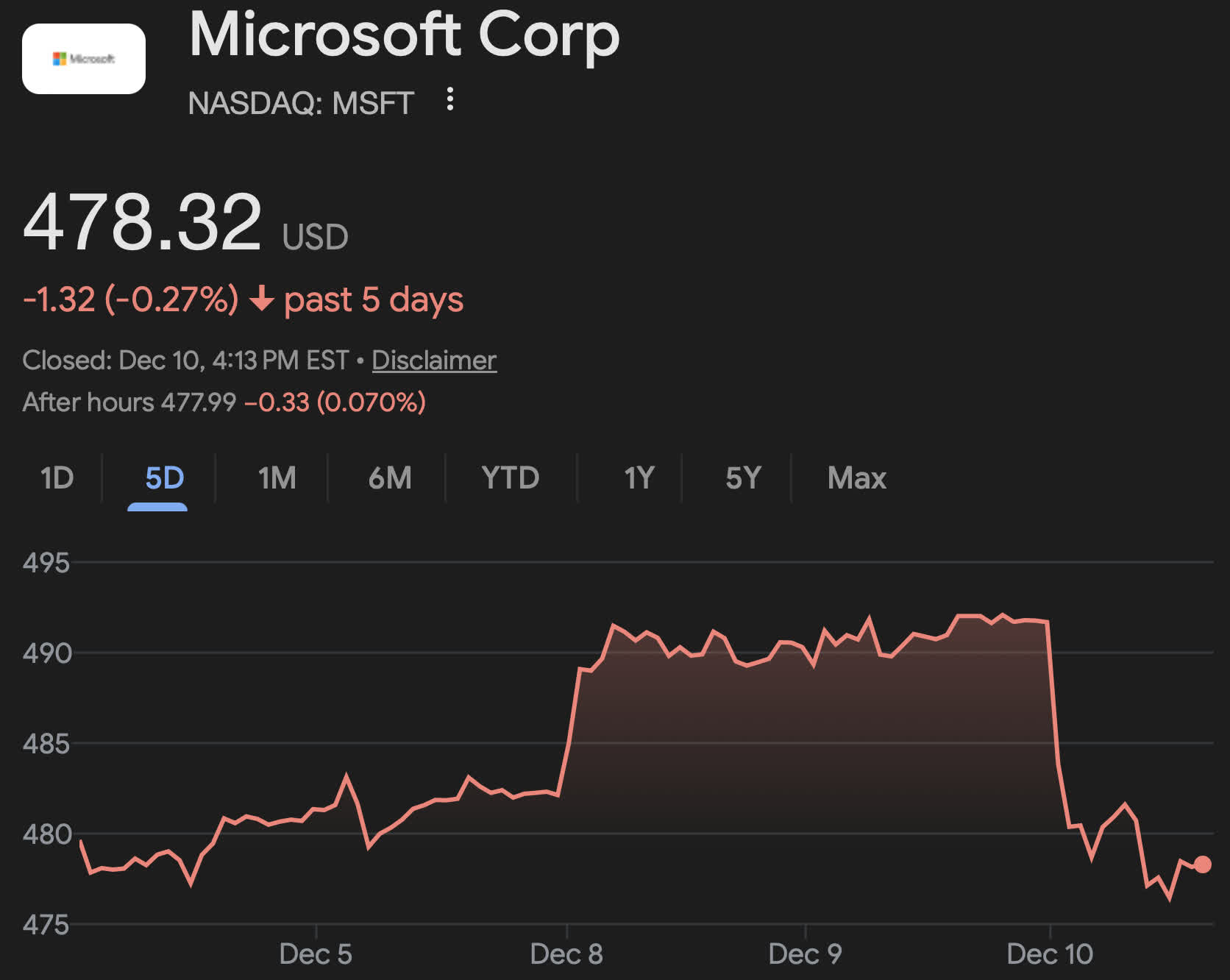
Microsoft went on the offensive after shares tumbled by over three percent when The Information broke the news. "The Information's story inaccurately combines the concepts of growth and sales quotas," a Microsoft spokesperson told Bloomberg. "Aggregate sales quotas for AI products have not been lowered."

Analysts at Jefferies brokerage firm supported Microsoft's position, but its stock still dropped sharply as investors weighed the prospect of softer-than-expected enterprise demand.

Microsoft's predicament highlights the tension across an industry that has "irrationally" invested billions in AI infrastructure, betting that widespread adoption is imminent. Businesses remain cautious, and consumers remain skeptical. Microsoft's aggressive AI-everywhere strategy now serves as an example of the current disconnect that has contributed to the largest economic bubble since the dotcom.

Analysts warn that the AI market will eventually self-correct, creating clear winners and losers. If Microsoft does not adopt a more consumer-friendly approach, it risks losing billions in AI investment.

Permalink to story:

 
Aggregate sales quotas for AI products have not been lowered
2025-12-10-image-16-j_1100.webp

This index chart is everything. It doesn't matter what corporate BS Microsoft puts out. The numbers don't lie, and numbers are all most publicly-traded companies understand. This is especially true of Microsoft, because they aren't just some company. They are the company. Every corporation and government―almost without exception―uses their product catalog. Their software stack is corporate America. If they are under-performing, what does that say about every other industry?

If it goes up high enough and for long enough, Microsoft made the right call and the "age of the 'agentic OS'" is upon us. It not, well...they're in for a rude awakening.
 
Maybe the reason AI isn't working as intended is that LLMs are not AI. Just because you call something AI does not make it AI. Marketing teams around the world vastly oversold the capabilities of LLMs. LLMs and machine learning are useful, I don't think anyone would argue that, the problem is calling something AI doesn't magically make it AI.

I like throwing around the term 'Altman test' instead of the turning test. Can we make an LLM/MLM that is indistinguishable from AI?

And the big problem with integrating AI into everything that no one is addressing right now is that the only reason it's so cheap to integrate AI into everything right now is that all the AI companies are selling it at a massive loss. To use AI the way it is forced on us on a daily basis would cost users hundreds of dollars a month for simple Google searchs.

Another big thing noone is is talking about is that these companies specifically Microsoft, are hiring more employees than they are laying off. They are laying off US employees and outsourcing the developer jobs for pennies on the dollar. The icing on the cake is that they are saying it's because AI is replacing employees and that's just a sales tactic so banks and investors don't start pulling all their money out.
 
Good, the start on the bubble popping...

We need a reset before next year, so we can start the new year on the right foot forward!
 
LLMs is fun to converse with. Up to a point. Anything serious or money related is a no. They completely unreliable hallucinating liars at best of times. This is a far cru from real AI. Altman like any CEO is good at marketing and he did sold this bubble to a lot of managers. Incompetence is key word here. Bubble will burst and hell of a lot of these managers will find themselves at janitors positions. Nobody in his sane mind will be consulting schizophrenic patient at mental facility in middle of episode regarding financial investments. Thinking otherwise and pushing people for it is delusional.
 
Microshaft positions themselves as an authority on what people want but lack the data to back up their claims. Why? Because they never asked. Why? Because they don't care. They want money and people are obstacles.
 
Maybe the reason AI isn't working as intended is that LLMs are not AI. Just because you call something AI does not make it AI. Marketing teams around the world vastly oversold the capabilities of LLMs. LLMs and machine learning are useful, I don't think anyone would argue that, the problem is calling something AI doesn't magically make it AI.

I like throwing around the term 'Altman test' instead of the turning test. Can we make an LLM/MLM that is indistinguishable from AI?

This is the problem, and restoring older terminology will help clear things up. From the science, sci-fi, and research points of view, the aim is strong AI. An LLM is a simulation of our language faculty. Other key pieces are missing; our brains are more than Wernicke's and Broca's areas.

I believe that strong AI will be reached, but not for years to come or perhaps not in our lifetimes. Fundamental understanding of the human brain is incomplete, especially sentience, and we cannot simulate something till we have reverse engineered it.

Apart from sentience, which is likely trivial circuitry once understood, since simple animals and life forms show it, compute is a barrier. At present, the brain's biological, analogue computing is radically more efficient than silicon and GPUs. So, apart from the theory side, including faculties other than language, keeping long-term state, and real-time training, the hardware needs to advance, then we need a way to fabricate the model in that substrate for maximum efficiency.
 
This is the problem, and restoring older terminology will help clear things up. From the science, sci-fi, and research points of view, the aim is strong AI. An LLM is a simulation of our language faculty. Other key pieces are missing; our brains are more than Wernicke's and Broca's areas.

I believe that strong AI will be reached, but not for years to come or perhaps not in our lifetimes. Fundamental understanding of the human brain is incomplete, especially sentience, and we cannot simulate something till we have reverse engineered it.

Apart from sentience, which is likely trivial circuitry once understood, since simple animals and life forms show it, compute is a barrier. At present, the brain's biological, analogue computing is radically more efficient than silicon and GPUs. So, apart from the theory side, including faculties other than language, keeping long-term state, and real-time training, the hardware needs to advance, then we need a way to fabricate the model in that substrate for maximum efficiency.
Sentience and learning require the ability to grow new neuons. AI has no neurons and will never be more than algorithms and output that fits probablistic patterns.
 
Sentience and learning require the ability to grow new neuons. AI has no neurons and will never be more than algorithms and output that fits probablistic patterns.
"AI" uses artificial neural networks that contain simple abstractions of the biological neuron. There's no reason why new artificial neurons can't be allocated in real time. Nor is it clear that our own neural networks aren't algorithms instantiated in a biological substrate.
 
"AI" uses artificial neural networks that contain simple abstractions of the biological neuron. There's no reason why new artificial neurons can't be allocated in real time. Nor is it clear that our own neural networks aren't algorithms instantiated in a biological substrate.
Well....except for the fact that our "artificial neurons" are still binary silicon. Fast hordes of GPUs in major datacenters still cant compare to the complexity of a single human brain. And allocation new ones requires you to build new datacenters. GPUs cant just grow another die.

The human brain isnt binary. There's a plethora of chemical reactions all with very sensitive adjustments allowing far more complex calculation.
 
Well....except for the fact that our "artificial neurons" are still binary silicon. Fast hordes of GPUs in major datacenters still cant compare to the complexity of a single human brain. And allocation new ones requires you to build new datacenters. GPUs cant just grow another die.

The human brain isnt binary. There's a plethora of chemical reactions all with very sensitive adjustments allowing far more complex calculation.

Software and hardware being separate, an artificial neural network can be changed apart from what it's running on. We are more like the ENIAC where software and hardware are one but our hardware continuously changes.

Yes, the human brain is far more advanced. I pointed that out in my original post, and that compute is a barrier. It's a matter of time. Take a look at the phones we use, and compare them to the early computers. The advance is hard to fathom. Nature has shown the superior design with biological computing. Perhaps we're a couple of decades away.
 
"AI" uses artificial neural networks that contain simple abstractions of the biological neuron. There's no reason why new artificial neurons can't be allocated in real time. Nor is it clear that our own neural networks aren't algorithms instantiated in a biological substrate.
The reason is that nee neural networks can't organically grow as learning occurs. Relocating existing memory defeats the purpose. Abstractions of biological brains are not duplicates in function. Some day. Not today. Today is analog to rooms full of vacuum tubes, the processing equivalent today fits in a tiny SOC.
 
The reason is that nee neural networks can't organically grow as learning occurs. Relocating existing memory defeats the purpose. Abstractions of biological brains are not duplicates in function. Some day. Not today. Today is analog to rooms full of vacuum tubes, the processing equivalent today fits in a tiny SOC.

Yes, there is a long way to go, and much advancement to be made. But I do not doubt that it will be possible. Our brains work according to rules.
 
Do they really thing real people use* their shitty product ? NO. they are forced to buy them (because every laptop comes with copilot nowadays).
 
It amazes me how out of touch some of these companies are. It makes you wonder if its deliberate.

That is because these CEOs really want to fire as many people as they can and replace them with AI and computers. It's like their wet dream is to have a company without humans. The dream of complete sociopaths.
 
Back