Nvidia dominates discrete GPU market with 92% share despite shifting focus to AI

DragonSlayer101

Posts: 984   +14
Staff
The big picture: Nvidia has focused more on AI hardware than on traditional PC GPUs in recent years, but it remains the world's leading graphics chip designer. However, its repositioning as an AI-first company has led to a rapid decline in its market share for discrete GPUs, allowing AMD and Intel to gain ground.

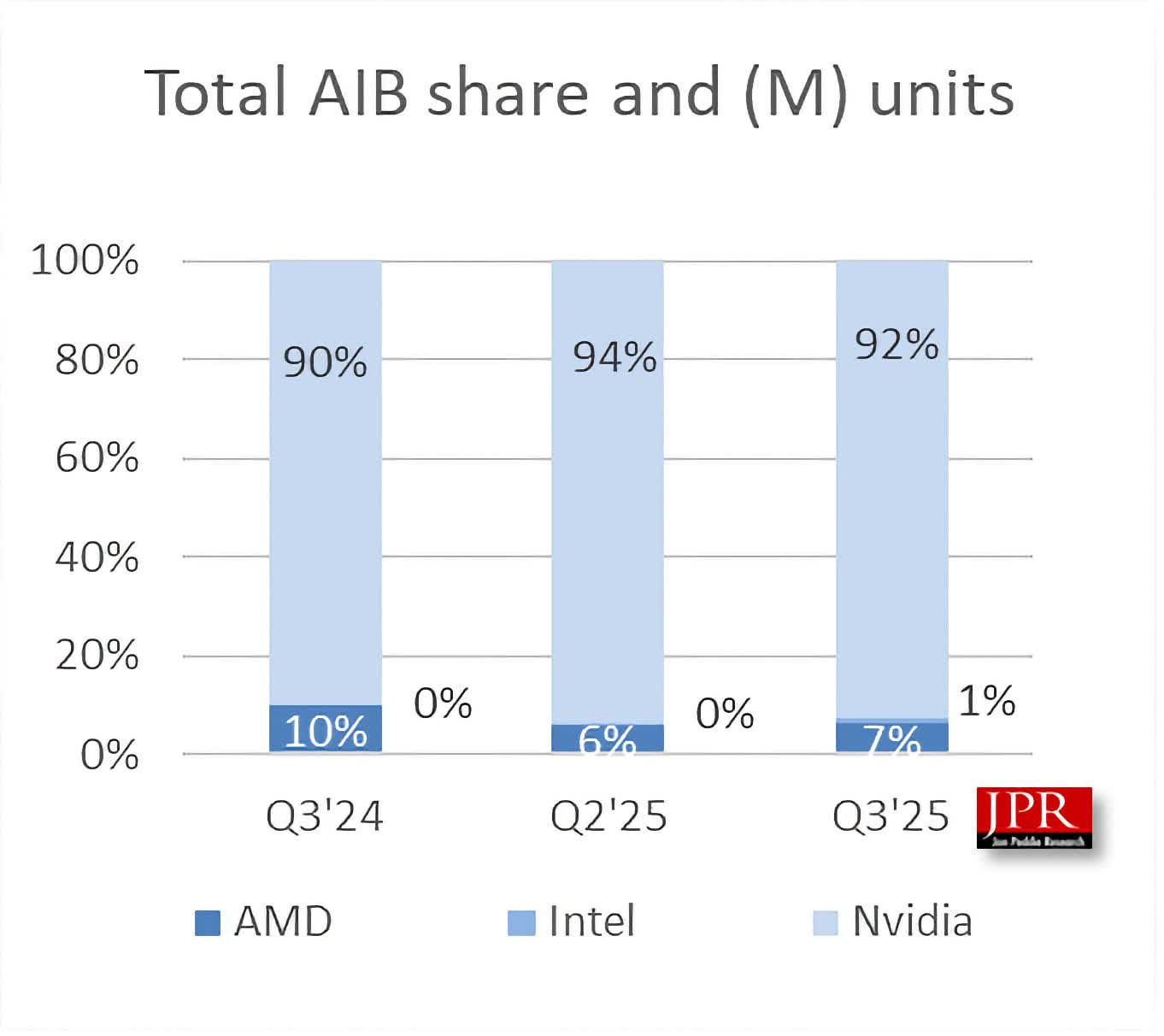
According to a new report from Jon Peddie Research, Nvidia held a 92 percent share of the discrete GPU market in Q3 2025, down from 94 percent in the previous quarter. AMD grew its market share to seven percent, registering a 0.8 percent sequential increase, while Intel gained 0.4 percent to reach a one percent share.

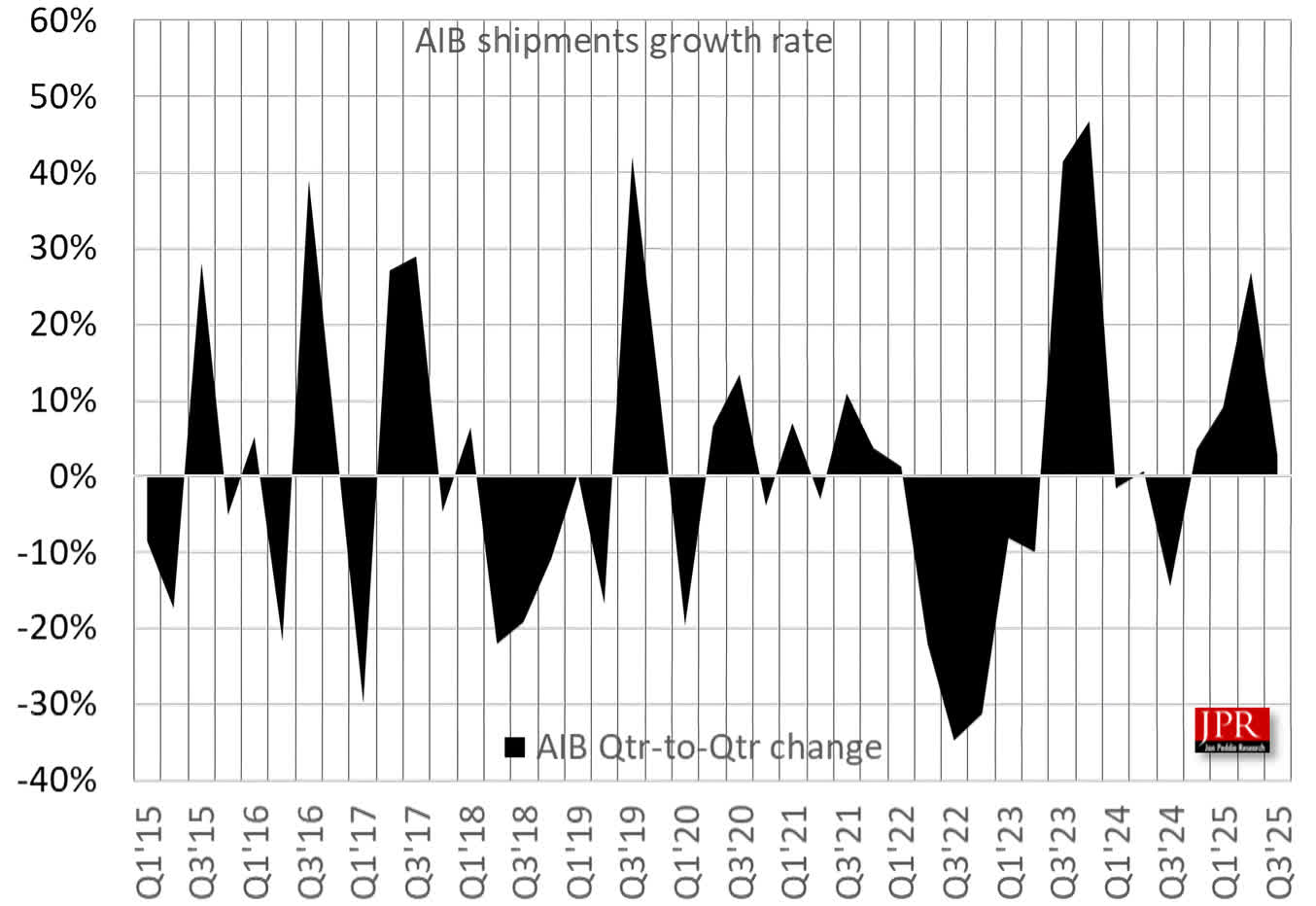
Total add-in board shipments rose 2.8 percent quarter-over-quarter, reaching 12.02 million units. Although this sequential growth was below the historical 10-year average of 11.4 percent for the July – September quarter, it followed an unusually strong Q2, when AIB shipments hit record highs, driven by panic buying ahead of pending tariffs.

Meanwhile, the global desktop CPU market reportedly declined 7.6 percent year-over-year in Q3 2025. However, shipments rose 3.9 percent sequentially over the previous quarter, reaching 19.2 million units. The YoY decline reflects the market's return to a more traditional seasonal pattern after unusual spikes in prior quarters.

JPR predicts the global discrete GPU market will reach 152 million units by 2029, with a 2024 – 2029 CAGR of -0.7 percent. According to the report, ongoing trade wars and concerns about an inflation-driven recession remain major headwinds for the sector, though conditions are expected to improve if trade tensions ease in the near future.

Nvidia's dominance in the GPU market is further illustrated by the latest Steam Hardware Survey, which showed that the top 10 discrete graphics cards on the platform are all from Team Green. The GeForce RTX 3060 leads with a 4.33 percent market share as of November 2025, while the most popular 50-series card, the RTX 5070, holds a 2.23 percent share.

Permalink to story:

 
The RTX 5000 generation of cards can only exist in a world where enterprise offerings can carry the company through. Nvidia and Samsung are beyond comparison in terms of customer exploitation and market manipulation, regularly creating the conditions required to hike their own prices. Meanwhile, AMD is more than happy to chase scraps. The only people losing in this situation, and most others, are end consumers.
 
Ridiculous. For end users, there are only 2 cards that make sense buying rn:

- RX 9060 XT (16G)
- RX 9070 XT

THEREFORE NV has 92% market share. Shameful.

Same as with CPUs. It took 8 friggin' years of AMD absolutely DESTROYING anything that Intel has to offer for AMD to even approach the market share of Intel. Till even the most stubborn fanboys realize their bad choices I guess.

Being a fanboy is the worst thing you can do to yourself. Seriously, just stop it already. I've been a proponent of Intel CPUs for almost a decade, but when Ryzen got released, it became immediately clear Intel just doesn't make any sense anymore and switched with my next purchase. It's not rocket science. It's not hard to do. Just stop having an emotional bond with your hardware. Please.
 
The RTX 5000 generation of cards can only exist in a world where enterprise offerings can carry the company through. Nvidia and Samsung are beyond comparison in terms of customer exploitation and market manipulation, regularly creating the conditions required to hike their own prices. Meanwhile, AMD is more than happy to chase scraps. The only people losing in this situation, and most others, are end consumers.
The geforce division printed over $10 billion last year. That is 4x what AMD's GPU and gaming divisions combined managed to pull in.

Let's not spread misinformation. Even if the AI market collapses, nVidia will still be able to easily outearn AMD. Especially when AMD decides to just leave entire portions of the market out to dry repeatedly.
Ridiculous. For end users, there are only 2 cards that make sense buying rn:

- RX 9060 XT (16G)
- RX 9070 XT
No.

For the majority of their lives so far, the 9070 and 9070XT were selling for well over MSRP. When there is only a $2-30 separation, the 5070ti makes way more sense, with a better feature set. No matter which way you slice it, DLSS has far better support then FSR does, and nVidia is dominant in the CAD space as well as the AI space. Hobbyists in either genre wont even consider AMD.

The 9060xt was in a similar boat, although it did come down in cost earlier and is now very competitive. Now if you go look at Newegg, you will see that the highest number of reviews on AMD 9060xts are similar to the highest number on nVidia 5060tis, upper 70s to low 80s, whereas lesser selling cards are hitting around 30-40 reviews, vs less then 10 for some 5060tis. And the scores are higher. Sure looks like people are buying them.
THEREFORE NV has 92% market share. Shameful.
If you are going to parrot the JPR number, you need to include in that 92% all AI GPU shipments, since 92% is ALL AIB sales, not just consumer sales.

AMD's gaming division has posted much better numbers since the 9070xt launch, and the fact they held onto the price premium for so long sure indicated strong demand.
Same as with CPUs. It took 8 friggin' years of AMD absolutely DESTROYING anything that Intel has to offer for AMD to even approach the market share of Intel. Till even the most stubborn fanboys realize their bad choices I guess.
WTF is this revisionist history?
Until zen 3 launched in november of 2020, which was 5 years ago, AMD lost in gaming performance to Intel, which is the biggest DIY market. The likes of Photoshop also favored Intel's stronger per core performance. Despite this, AMD dominated DIY sales in 2018 and 2019 as well.

Now for OEMs, AMD has always been significantly behind. Whether it be power consumption or professional app support. How soon you have forgotten the utter cluster**** that was AMD's early ryzen APUs, that required manufacturers to maintain the GPU drivers like its 1989. Guess what immediately pisses manufacturers off and gets you kicked out of any serious product development discussion? On the topic of mobile, until the launch of the ryzen 7000 series, AMD also had noticeably worse battery life then Intel's low powered hardware. AMD didnt pick up a lead here until the launch of the 7000u series, in 2023. You know.....2.5 years ago? Not 8. Not even close.

In the server space, AMD is fighting a significant uphill battle of having 0 marketshare. Now, you may not know this, but mixing CPU ISAs is a major no-no. Hyper V even advises against this due to instability. So since intel had 100% x86 marketshare in servers, the only way to justify goign AMD was when everything got switched out. And unlike DIY, in the professional world some Cinebench wins are not going to convince corporate to take a chance, especially when 7+ years earlier AMD had left the market high and dry.

DESPITE THAT, AMD has achieved a 32% marketshare in server since Zen came out. That is MARVELOUS performance. AND, AND, they control 44% of revenue. Meaning they are getting paid a premium while Intel has to cut costs and run sales just to keep chips moving, and still they have not gained any ground back.

The only fanboyism I'm seeing here is your doomerist mindset living in some alternate reality.

"For the full year 2024, AMD reported record revenue of $25.8 billion, gross margin of 49%, operating income of $1.9 billion, net income of $1.6 billion, and diluted earnings per share of $1.00. On a non-GAAP(*) basis, gross margin was a record 53%, operating income was $6.1 billion, net income was $5.4 billion and diluted earnings per share was $3.31."
Being a fanboy is the worst thing you can do to yourself. Seriously, just stop it already. I've been a proponent of Intel CPUs for almost a decade, but when Ryzen got released, it became immediately clear Intel just doesn't make any sense anymore and switched with my next purchase. It's not rocket science. It's not hard to do. Just stop having an emotional bond with your hardware. Please.
I think you need to take your own advice. Stop having an emotional bond to AMD and look at the market as it is, not how you want it to be.
 
The next generation is going to be interesting (assuming fab capacity isn't limited) as AMD has closed the gap on Nvidia and learned the value of not positioning themselves as the -$50 option.

They could make a serious go if they wanted and restore some real competition. But you need plenty of fab capacity so that enterprise/AI isn't preventing making enough GPUs to hit 30% market share (not they will necessarily hit 30% but you can't hit X% if you don't have enough GPUs to sell).
 
Last edited:
Let's not spread misinformation.

The RTX 5000 cards were designed to exploit market conditions and wouldn't be viable without the previous "shortage". That's a fact. If you need hard evidence to drive that nail, Nvidia is currently under investigation from at least two governments, one federal, for market manipulation and monoplistic practices. AMD would be in the same situation were roles reversed because that is the current culture.
 
AMD dropped the ball on price and stock at launch. The delay also caused me to pick Nvidia for the 1st in a very long time.
 
Ridiculous. For end users, there are only 2 cards that make sense buying rn:

- RX 9060 XT (16G)
- RX 9070 XT

THEREFORE NV has 92% market share. Shameful.

Same as with CPUs. It took 8 friggin' years of AMD absolutely DESTROYING anything that Intel has to offer for AMD to even approach the market share of Intel. Till even the most stubborn fanboys realize their bad choices I guess.

Being a fanboy is the worst thing you can do to yourself. Seriously, just stop it already. I've been a proponent of Intel CPUs for almost a decade, but when Ryzen got released, it became immediately clear Intel just doesn't make any sense anymore and switched with my next purchase. It's not rocket science. It's not hard to do. Just stop having an emotional bond with your hardware. Please.

Wrong. RTX 5000 outsells Radeon 9000 with ease due to much better features (price might be slightly higher but has much higher resell value too, due to massive demand)

Radeon 9070 non-XT is the only card that I would pick over the Nvidia equal. However 5070 even with less VRAM beats it in several games, especially when you consider the feature set and DLSS just has much better support in actual games, there is no comparison really. DLSS 4 can easily be forced in Nvidia App in pretty much all DLSS 2+ games. On the AMD side, forcing FSR 4 with Optiscaler is hit and miss and requires massive tinkering at times. Feels like beta really.

I would pick 5070 Ti over 9070 XT any day of the week. Price is similar where I am (Germany), meaning that 9070 XT is just 50-100 dollars/euros cheaper, meaning it is not worth considering for a second.

AMD needs to work bigtime on FSR 4 support in games.

AMD generally needs to improve their feature set as well (FSR Redstone december 10th will be important)

Nvidia sits at 90% or more, without even trying, and you think AMD is doing well?

AMD barely want to make gaming GPUs, as they earn alot more on CPUs, APUs and Enterprise GPUs really. TSMC output is limited. This is the real reason you don't see AMD being agreesive on winning back gaming GPU marketshare. Pretty much no-one choose AMD GPU unless price is very low, and then AMD barely make money on it. And this is why we need AMD to be competitive in the high-end segment, so people don't just buy AMD GPU because they are "cheap and fine for mid-end"

However you can't expect a CPU company first, to dethrone Nvidia in GPUs.

I use AMD CPU. 9800X3D. They make awesome CPUs but their GPUs needs work and this has been true since forever really.
 
The RTX 5000 generation of cards can only exist in a world where enterprise offerings can carry the company through.
What the dumb sh*t are you saying? What does enterprise have to do with consumer segment adoption?
It can only exist in a world where AMD, as always, "never misses an opportunity to miss an opportunity" and doesn't undercut nvidia in pricing enough to win the generation. As long as AMD are dumb as they've ever been, they'll keep allowing nvidia to own the market.
 
What the dumb sh*t are you saying? What does enterprise have to do with consumer segment adoption?
It can only exist in a world where AMD, as always, "never misses an opportunity to miss an opportunity" and doesn't undercut nvidia in pricing enough to win the generation. As long as AMD are dumb as they've ever been, they'll keep allowing nvidia to own the market.
Yeah completely wrong. Just read Nvidia financial reports. They earned alot on selling gaming GPUs in 2024, like more than 10 times of AMD if I remember correctly. And this trend continues into 2025. Has not slowed down at all.

AMD is not that competitive in gaming GPUs really. They make very little profit. Again, read their financial reports. This is not something you need to guess, AMD delivers the exact numbers.

People that think Nvidia don't care about gaming GPUs, must be blind. They earned 10+ billions in 2024 on selling dedicated gaming GPUs. They constantly improve Nvidia App and RTX features as well + massive DLSS/FG/MFG support in games, as pretty much all new games has DLSS. They are years ahead of AMD in many areas (FSR Redstone might change this but AMD for sure won't get in front anytime soon)

Just because AI/Enterprise is a gold mine for Nvidia, does not mean they don't care about gaming. A completely different branch of the company. Why say no to free money? No company will.

AMD is a CPU company first. Can't expect them to go all out on GPUs and if they aim for GPUs, it will be enterprise/AI GPUs not gaming GPUs. This is where the real money is.

I think AMD is fine with a 10-20% gaming GPU marketshare. If AMD GPUs needs to be cheap to sell, they won't earn much anyway. Making these GPUs, eats away at their TSMC output. Not viable really. They earn money on CPUs, APUs etc.

Yet AMD still needs the GPU development process going, for iGPUs, APUs etc. They will never abandon GPUs. They bought ATi for this exact reason.

Nvidia is GPU first. Has tons of money. AMD has pretty much no chance of beating them at GPUs. And this is the reason AMD focuses on "value" but since rasterization performance is not the most important metric today, AMD is facing problems here.

What matters for a good GPU in 2025 and forward:

- Good upscaling, with actual game support (DLSS wins easily and DLSS 2/3 has been worth using for many years now - there is like 1000 DLSS games today and DLSS 4 can be forced in most)
- Good frame gen, with good image quality and low latency (DLSS FG/MFG wins easily with help from Reflex)
- Option for RT and even Path Tracing (RTX wins easily and DLSS + FG/MFG is a must, so it's a win/win/win for Nvidia here, all things matter)

What AMD needs to improve:
- FSR 4 needs to keep going forward, DLSS 4 is still better and game support needs to be massively improved. 3rd party apps like Optiscaler feels like a beta and is hit or miss, mostly miss and requires tinkering. Nvidia has tons of much better 3rd pary apps (plus Optiscaler works on Nvidia as well) and Nvidia App can pretty much force DLSS 4 in most DLSS 2/3 games now, with the push of a button.
- Ray Tracing performance over time will matter, as games will go away from using baked lighting, 5-10 years from now
- FSR FG is alot worse than DLSS FG/MFG and almost on par with Loseless Scaling. which is the worst frame gen method, DLSS FG is the best method with most game support too (Smooth Motion which works on RTX 5000/4000 series, beats AMD AFMF2)


FSR 4 was a big succes IMO. Now they just need to improve game support massively.
The huge downside of FSR 4, is that only RDNA 4 officially supports it 100%
Which does not help with getting game developers to support it.

Over time, this hopefully improve.

I still hope AMD will bring FSR 4 to at least RDNA 3. Should help alot in terms of support. Right now, I would guess that RDNA 4 don't even have 1% of the gaming GPU market, why would developers waste time supporting FSR 4, unless paid by AMD?

I would love to see official FP8 emulation FSR 4 support on ALL RDNA GPUs however performance is a problem, especially for RDNA 1 and 2, as FP8 emulation is very demanding. RDNA 3 has dedicated AI / matrix cores and does it better but RDNA 4 is obviously best, since native INT 8 support (just like RTX 4000/5000 series)
 
Last edited:
Yeah completely wrong. Just read Nvidia financial reports. They earn pretty big on gaming GPUs, like 10 times more than AMD if I remember correctly.
Yeah but what does your comparison have to do with anything anyways??
 
AMD has a lot of work to do in order to catch up with Nvidia. They absolutely need to nail the next gen chiplet GPUs and they also need to stop it with releasing half baked features.

Besides gaming they also need to improve support for more professional workloads. 3D applications and AI applications have very basic support and lag behind a lto in performance. Blender is a good example where they could improve things a lot. I didn't go with an AMD GPU this generation because of Blender and local AI support.
 
AMD has a lot of work to do in order to catch up with Nvidia. They absolutely need to nail the next gen chiplet GPUs and they also need to stop it with releasing half baked features.

Besides gaming they also need to improve support for more professional workloads. 3D applications and AI applications have very basic support and lag behind a lto in performance. Blender is a good example where they could improve things a lot. I didn't go with an AMD GPU this generation because of Blender and local AI support.

December 10, FSR Redstone event - (FSR 4.x or even 5 with "next gen") will be important.

Together with a true next gen arch / UDNA on TSMC 2-3nm could give AMD the upper hand in 2026, if Nvidia "just" relies on a 5000 SUPER refresh in 2026 as well.

That is, if AMD actually cares and works hard to improve FSR 4 support, which is lacking.
I would like to see FSR 4 support on Radeon 7000 at least too. Should be possible, with a slight performance drop due to FP8 emulation. AMD probably won't do it, as their FSR Redstone event clearly says RDNA 4 exclusive as well.

Upscaling is here to stay, and important. Great AA solution with added performance is a nobrainer for most people. Rasterization performance should be decent but is not the only factor in 2025+ // Most GPU buyers looks at the whole feature set and Nvidia just wins pretty easily today, with massive game support to follow.

4000, 4000 SUPER, 5000 and 5000 SUPER is pretty much the same thing. 5nm TSMC, with almost identical core count, clockspeeds and VRAM on most GPUs. 5000 SUPER might be cancelled if RAM crisis continues and VRAM is the only improvement really (+50% VRAM)
 
Last edited:
FSR Redstone (FSR 4.x or even 5+) together with a true next gen arch / UDNA on TSMC 2-3nm could give AMD the upper hand, if Nvidia "just" relies on a 5000 SUPER refersh in 2026.

That is, if AMD actually cares and works hard to improve FSR 4 support.
Right now we have only 1 game with Redstone and it clearly released in an unfinished state with missing features and other issues. FSR 4 game support will naturally increase if the GPUs are good and they continue selling in healthy numbers.
 
Right now we have only 1 game with Redstone and it clearly released in an unfinished state with missing features and other issues. FSR 4 game support will naturally increase if the GPUs are good and they continue selling in healthy numbers.

FSR Redstone launches "soon" Event is december 10th

Problem is that, it is still RDNA 4 exclusive, which is bad for getting developers to support it, unless AMD pays them, and people with RDNA 2 and 3 especially, feels left out

DLSS 4 on the other hand, works flawlessly on RTX 2000 from 2018

AMD hit their promise of 75 FSR 4 games in 2025. I think they are at 85+ or so now. FSR 4 had 30+ titles on release

FSR 4 is good, almost as good as DLSS 4, the biggest problem with FSR 4 is actual game support and the RDNA 4 exclusivity

 
Last edited:
Elephant in the room is the Geforce Driver overhead on CPUs. Majority of benchmarks are done with the fastest CPUs but many users will have an average CPU, if you then compare AMD to Nvidia cards the AMD card will likely be on top due to lower driver overhead on the CPU. (Not saying Nvidia cards aren't bad, if paired correctly with the right CPU).

People need to stop looking at Benchmarks and assuming their setup will be the same. Stop fooling yourself with bar charts your pc will never ever get unless spending X thousands and build a pc that's balanced within your budget constraints.

Only then will we have a fairer competitive market.
 
Ridiculous. For end users, there are only 2 cards that make sense buying rn:

- RX 9060 XT (16G)
- RX 9070 XT

THEREFORE NV has 92% market share. Shameful.

Same as with CPUs. It took 8 friggin' years of AMD absolutely DESTROYING anything that Intel has to offer for AMD to even approach the market share of Intel. Till even the most stubborn fanboys realize their bad choices I guess.

Being a fanboy is the worst thing you can do to yourself. Seriously, just stop it already. I've been a proponent of Intel CPUs for almost a decade, but when Ryzen got released, it became immediately clear Intel just doesn't make any sense anymore and switched with my next purchase. It's not rocket science. It's not hard to do. Just stop having an emotional bond with your hardware. Please.
Stupid take. Intel cpus the last 4 years have been offering a lot more MT performance at every segment. You are calling others fanboys but you are being one for yourself.
 
Elephant in the room is the Geforce Driver overhead on CPUs. Majority of benchmarks are done with the fastest CPUs but many users will have an average CPU, if you then compare AMD to Nvidia cards the AMD card will likely be on top due to lower driver overhead on the CPU. (Not saying Nvidia cards aren't bad, if paired correctly with the right CPU).

People need to stop looking at Benchmarks and assuming their setup will be the same. Stop fooling yourself with bar charts your pc will never ever get unless spending X thousands and build a pc that's balanced within your budget constraints.

Only then will we have a fairer competitive market.

Driver overhead is a small issue and Nvidia beats AMD GPUs in more games overall.

Completely depends on game.

Here is TPU newest GPU review. Few days old. Newest drivers for all current gen cards.


Cherrypicking games makes no sense (unless you play the same game, and nothing else, which I personally don't) meaning Overall performance makes sense.

** 5070 Ti beats 9070 XT by 5/6% in 1440p in pure rasterization. Wins alot more in RT and especially Path Tracing + Upscaling + Frame Gen + Features in general (Reflex, RTX HDR, RTX Video, Shadowplay)


Looking at features in general, and not just raster performance and RTX cards wins with absolute ease really here in 2025, almost 2026.

Also, RTX 2060 from 2018 fully supports DLSS 4. Tons of DLSS 4 support in games.
Meanwhile 7970 XTX from late 2022 almost 2023, don't support FSR 4 and FSR 4 support is lacking bigtime.

DLSS FG/MFG > FSR FG > Loseless Scaling

DLSS 4 > DLSS 3 / FSR 4 > DLSS 2 > FSR 3.x > FSR 2 >>>> FSR 1 and DLSS 1 was completely useless

Upscaling took off with DLSS 2 in 2020. About 6 years ago. Upscaling is here to stay. Game industry embraced it. Developers embraced it. Consoles used it for many years (plus dynamic res), this is nothing new.
Upscaling makes total sense and when implementation is good, it is 100% worth using due to built in AA with alot more performance.

More and more PC gamers use 4K/UHD or more. Realistically, pretty much all of these people will be forced to use upscaling in demanding games, as there is very few GPUs that do 4K+ native well, unless you sacrifice big on framerate and quality settings.

Higher settings, much higher framerates with *good* upscaling like DLSS 2, 3, 4 and FSR 4 makes life alot easier in demanding games in high res and the end-result is what matters.

People that can't use quality upscaling, tend to disagree but for people who have actually tried it, enabling DLSS is a nobrainer.


5 year old article showing that DLSS 2 makes 4K look better, sharper and crisper, while improving performance alot. DLSS has improved bigtime since then and even FSR 4 is better than DLSS 2.

I really hope AMD opens up for FSR 4 to RDNA 3 owners at least, so they can get this awesome feature. Still hope for some FP8 emulation mode for older RDNA cards.
I got 2 AMD laptops which are RDNA 2.x and 3x - No FSR 4 for me and upscaling makes a day and night difference on weaker hardware like iGPUs and APUs.

Or watt limited hardware, like handhelds.
 
Last edited:
Driver overhead is a small issue and Nvidia beats AMD GPUs in more games overall.

Completely depends on game.

Here is TPU newest GPU review. Few days old. Newest drivers for all current gen cards.


Cherrypicking games makes no sense (unless you play the same game, and nothing else, which I personally don't) meaning Overall performance makes sense.

** 5070 Ti beats 9070 XT by 5/6% in 1440p in pure rasterization. Wins alot more in RT and especially Path Tracing + Upscaling + Frame Gen + Features in general (Reflex, RTX HDR, RTX Video, Shadowplay)


Looking at features in general, and not just raster performance and RTX cards wins with absolute ease really here in 2025, almost 2026.

Also, RTX 2060 from 2018 fully supports DLSS 4. Tons of DLSS 4 support in games.
Meanwhile 7970 XTX from late 2022 almost 2023, don't support FSR 4 and FSR 4 support is lacking bigtime.

DLSS FG/MFG > FSR FG > Loseless Scaling

DLSS 4 > DLSS 3 / FSR 4 > DLSS 2 > FSR 3.x > FSR 2 >>>> FSR 1 and DLSS 1 was completely useless

Upscaling took off with DLSS 2 in 2020. About 6 years ago. Upscaling is here to stay. Game industry embraced it. Developers embraced it. Consoles used it for many years (plus dynamic res), this is nothing new.
Upscaling makes total sense and when implementation is good, it is 100% worth using due to built in AA with alot more performance.

More and more PC gamers use 4K/UHD or more. Realistically, pretty much all of these people will be forced to use upscaling in demanding games, as there is very few GPUs that do 4K+ native well, unless you sacrifice big on framerate and quality settings.

Higher settings, much higher framerates with *good* upscaling like DLSS 2, 3, 4 and FSR 4 makes life alot easier in demanding games in high res and the end-result is what matters.

People that can't use quality upscaling, tend to disagree but for people who have actually tried it, enabling DLSS is a nobrainer.


5 year old article showing that DLSS 2 makes 4K look better, sharper and crisper, while improving performance alot. DLSS has improved bigtime since then and even FSR 4 is better than DLSS 2.

I really hope AMD opens up for FSR 4 to RDNA 3 owners at least, so they can get this awesome feature. Still hope for some FP8 emulation mode for older RDNA cards.
I got 2 AMD laptops which are RDNA 2.x and 3x - No FSR 4 for me and upscaling makes a day and night difference on weaker hardware like iGPUs and APUs.

Or watt limited hardware, like handhelds.

Ok but the first article you linked their test bench has a 9800X3D. There's so many people that will buy a 5070ti or an RX 9070 XT but pair it with a Ryzen 5600/7600 or intel equivalent. In that scenario the RX 9070 XT will be quicker. So my point still stands.
 
Back