Nvidia's Jensen Huang calls releasing older GPUs featuring the latest AI tech a "good idea"

midian182

Posts: 11,624   +176
Staff member
What just happened? Nvidia CEO Jensen Huang has lent credence to the recent rumor that the company will restart production of its older GPUs – a result of the current AI-driven memory crisis. But rather than just releasing the same old card, Huang suggested reintroducing the products with modern features, such as the latest performance-increasing AI technology.
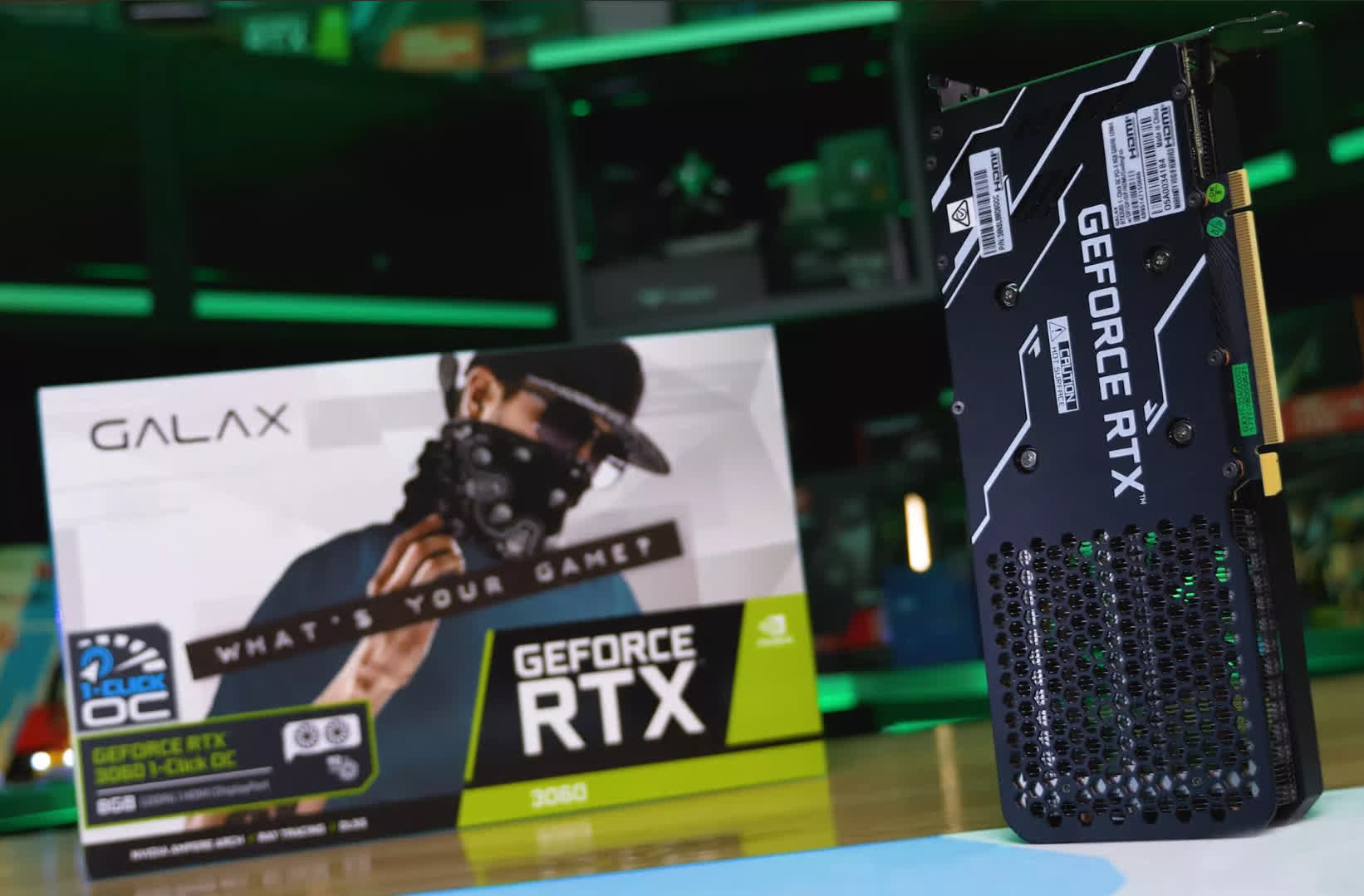
There were rumors this week that Nvidia is set to restart production of the RTX 3060, which launched in 2021 and was discontinued in 2024. With AI data centers gobbling up all the DRAM, GPU prices are climbing: there are reports that the RTX 5090 could reach $5,000.

During a Q&A session at CES, Tom's Hardware reporter Paul Alcorn asked Huang if restarting production on older GPUs on legacy processor nodes could help ease the current supply and production issues.

Huang seemed open to the idea and even suggested a way to make the re-released cards more appealing.

"Yeah, possibly, and we could possibly, depending on which generation, we could also bring the latest generation AI technology to the previous generation GPUs, and that will require a fair amount of engineering, but it's also within the realm of possibility," the CEO said. "I'll go back and take a look at this. It's a good idea."
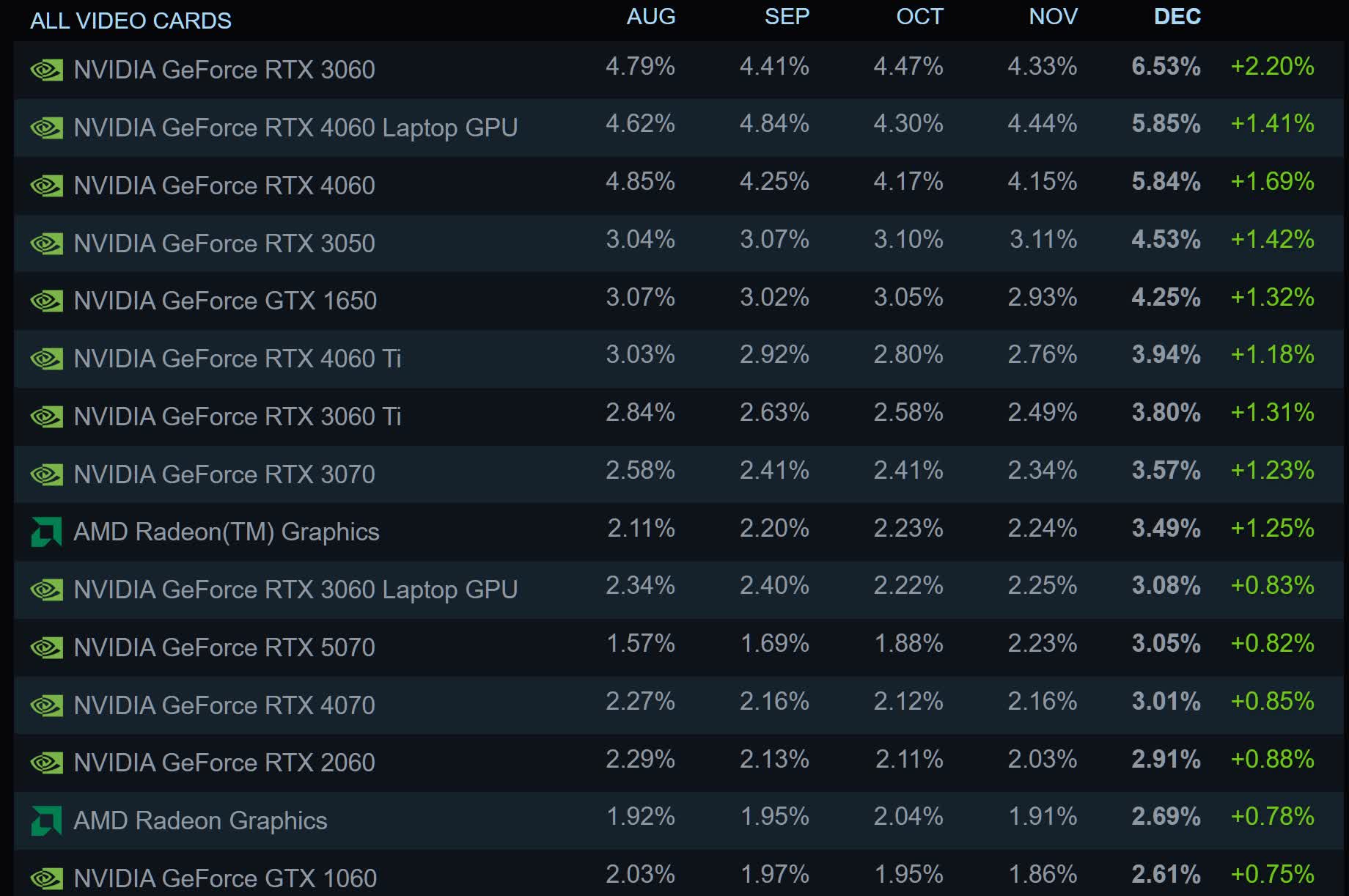
The concept of releasing the old cards with AI features to improve their performance does sound interesting. The RTX 3060 is currently the most popular GPU among Steam survey participants, illustrating its lasting appeal. Relaunching the card (hopefully it would be the original 12GB version and not the cut-down 8GB variant) with some extra bells and whistles and a compelling price point could be a smart move on Nvidia's part.

One new AI feature Jensen could be referring to is DLSS 4.5. The latest version of Nvidia's upscaling tech introduces a slew of graphical and stability improvements, but it comes at the cost of a massive 20+% performance drop compared to DLSS 4 when used on RTX 3000 and RTX 2000 GPUs.

Nvidia felt the need to confirm that there would be no new (or old) GPUs announced at CES this year. However, there has been plenty for gamers to get excited about.

In addition to DLSS 4.5, Nvidia revealed details about its updated G-Sync Pulsar tech. Not only will the latest version further reduce motion blur, claiming to make 360Hz monitors look like 1,000Hz, but it also adjusts a monitor's brightness and color based on ambient room lighting.

Permalink to story:

 
Ampere was "problematic" due to its anti-mining limiter (LHR). Ada Lovelace, likely manufactured on an improved node, represents the minimum necessary for the use of GDDR6X. However, based on what I've read in tech forums I think Nvidia has secured contracts for guaranteed memory supply, meaning there's no real memory supply problem for them. In contrast, AMD and Intel (which started as a memory manufacturing company) do not appear to have such agreements.
 
Adding the lower precision hardware necessary to run DLSS 4.5 efficiently to a 3060 sounds more complicated than getting the 4060 to work on Samsung’s older node.

But maybe I’m wrong and that extra compute can be tacked on. It would be a way to hold cards at older (hopefully 12GB) VRAM.
 
AMD could never afford to pull some bs like this because they are actually trying to compete and survive. Nvidia is luxuriating in their position at the moment.
 
How so? What problems does LHR cause?
Mainly philosophical problems. It artificially reduces the efficiency of the hardware so it contradicts the fundamental engineering principles of enhancing capability and efficiency. It dilutes the product's primal value, which is to offer the “added” freedom of new possibilities.
 
It wouldn't be more appealing to me, especially since Jensen/NVidia will likely tag on an extra-special bonus to the price. And in the extra special price, I'm sure it would turn off many gamers who could care less about AI.
 
"Yeah, possibly, and we could possibly, depending on which generation, we could also bring the latest generation AI technology to the previous generation GPUs, and that will require a fair amount of engineering, but it's also within the realm of possibility,"
It just does not fit into realm of greedines.

Adding the lower precision hardware necessary to run DLSS 4.5 efficiently to a 3060 sounds more complicated than getting the 4060 to work on Samsung’s older node.
3060 with FP8/FP4 means new chip, new masks, and probably bigger chip and more hungry.
40xx on 8nm Samsung node ... new masks, much bigger chip and definitely much more hungry.

But maybe I’m wrong and that extra compute can be tacked on. It would be a way to hold cards at older (hopefully 12GB) VRAM.
4060 would be good enough and could be cheap enough ... but
They use the same process as 5090 and GB200. Which are sold for more $. Much more.

Looks like 8GB will be there for many more years.
 
If this actually means affordable GPUs come back because datacenters ate all the memory, gamers might accidentally benefit from the AI boom for the first time. I’m not holding my breath, but it would be the wildest plot twist yet.
 
Mainly philosophical problems. It artificially reduces the efficiency of the hardware so it contradicts the fundamental engineering principles of enhancing capability and efficiency. It dilutes the product's primal value, which is to offer the “added” freedom of new possibilities.

A temporary and narrow efficiency reduction for the hardware's secondary use which was causing great inefficiency problems for its primary use. A reasonable attempt, ultimately rendered irrelevant by time and circumstance.
 
I quit buying this stuff after 2080. Irrelevant for anything. Quite sure a lot of people did the same.
 
Like all good CEO's Huang is 'beholden' to his (greedy) shareholders. He would probably say 'legally obligated' though this isn't actually true. As such, he has to make every working unit of nVidia 'profitable' or face shareholders' wrath.

IFF Huang could just dump the GPU marketplace entirely, that would be most convenient. If you think he really cares about desktop GAMING gpus, you are dreaming. Look at business share. Follow the money.
 
If Nvidia doesn’t care about gaming why are they working on things like pulsar and DLSS and have 90% of the market?
 
3060 with FP8/FP4 means new chip, new masks, and probably bigger chip and more hungry.
40xx on 8nm Samsung node ... new masks, much bigger chip and definitely much more hungry.
Yes, I realize. I don't know which of these is easier for Nvidia.

Although the FP8/FP4 addition could potentially be a co-chip with driver updates for the GPU to know its there.
 
Yes, I realize. I don't know which of these is easier for Nvidia.
Just to do it at it was.
GA106 chip and 8GB DDR6

Although the FP8/FP4 addition could potentially be a co-chip with driver updates for the GPU to know its there.
I am old enough to remember 8087 co-processors.
Have not had math co-processor in my rig till Pentium 75.
But those 8086/8088, 80186, 80286, 80386SX/DX were designed to work with x87 co-procesor.
nVidia GPU chips are not.
No bus going outside of chip (and not enough contacts on chip for that), no TSV contacts for advanced packaging. And trasfering data up and down trough some SW will be slower than doing that math on existing FP16 units.

If the goal is put cheap GPU to market .. its production costs will be cut-down as possible.
 
I don’t think Nvidia is abandoning the consumer GPU market, but they are very clearly deprioritizing it, and that distinction matters.

My take, and strictly my opinion....It is obvious Nvidia follows margins, not mindshare. Data center and AI silicon bring in vastly higher profit per wafer, per engineer, and per watt than gaming GPUs ever will. Consumer cards still exist for ecosystem reasons like CUDA lock in, developer familiarity, and brand presence, but they are no longer the growth driver for Nvidia.

This explains a lot of what we’re seeing. Longer gaps between launches, recycled or revived SKUs instead of true new low end parts, aggressive segmentation, and pricing that feels disconnected from generational gains. Gaming GPUs now feel like downstream products of a broader silicon strategy.

This is why it feels worse than in past cycles. Nvidia used to push volume and adoption through the consumer stack. Now they’re protecting margins and avoiding cannibalization of higher value silicon. When AI demand is effectively unlimited, there’s no incentive to flood the market with affordable gaming cards.

This creates a real opening for AMD. Just hear me out.

AMD arguably has the best opportunity they’ve had in years, but only if they execute this correctly. They don’t need to beat Nvidia at the high end. They need to win where people actually buy. That means balanced cards, not just competitive compute. Sensible VRAM configs without artificial bottlenecks. Aggressive pricing in the $300 to $600 range. Using GDDR6 and mature nodes to keep costs predictable instead of chasing bleeding edge tech for its own sake.

If AMD can make “just buy AMD and move on” the default recommendation again, they gain mindshare quickly. Nvidia’s current priorities leave a vacuum in the mainstream market.

The risk is that AMD plays it too safe. They’ve done this before. If they price too close to Nvidia or over segment their own lineup, they waste the moment. Nvidia doesn’t need to fail for AMD to win. Nvidia just needs to stay distracted, and right now, they are.

Simply put, Nvidia isn’t walking away from gamers, but they are looking past them. AMD has a window. Whether they capitalize on it is still very much an open question. And let's be real, it’s one they should aggressively capitalize on, because AMD is not going to outcompete Nvidia in the AI market any time soon.
 
Just to do it at it was.
GA106 chip and 8GB DDR6


I am old enough to remember 8087 co-processors.
Have not had math co-processor in my rig till Pentium 75.
But those 8086/8088, 80186, 80286, 80386SX/DX were designed to work with x87 co-procesor.
nVidia GPU chips are not.
No bus going outside of chip (and not enough contacts on chip for that), no TSV contacts for advanced packaging. And trasfering data up and down trough some SW will be slower than doing that math on existing FP16 units.

If the goal is put cheap GPU to market .. its production costs will be cut-down as possible.
The stated goal (by Jenson) was to bring the latest DLSS advancements to older chips (with additional engineering being required to do so also part of his answer) as an intermediate solution to the rising prices.

Specifically the 3000 series was mentioned in the reporters Q to Jenson. Thus the need to update the 3000 series HW to not choke on the latest models as currently seen with 4.5.

I suggested that it might be easier to move the 4000 to a cheaper node than to add low precision FP to 3000 (both changes are complicated).
 
The stated goal (by Jenson) was to bring the latest DLSS advancements to older chips (with additional engineering being required to do so also part of his answer) as an intermediate solution to the rising prices.
Only Huang can sell less for more.
And be praised for that.

Specifically the 3000 series was mentioned in the reporters Q to Jenson. Thus the need to update the 3000 series HW to not choke on the latest models as currently seen with 4.5.

I suggested that it might be easier to move the 4000 to a cheaper node than to add low precision FP to 3000 (both changes are complicated).
Sure.
From technical PoV it would be easier and Slightly cheaper (less desigining work).
And more power hungry running that monster made on Samsung 8nm node.

XfY1deZ.png

It looks even worse when put together.

4060 backported to Samsung 8nm would be a bigger chip than GA104 (3070Ti) delivering only 70% of performance (if it keeps running at 2460 MHz as 4060 does) or even worse when running at 1770 MHz as GA104 does. Aprox 50% of 3070Ti.

It would be easier (and may be even cheaper - no new masks needed) to just make 3070Ti "as it was".

TL;DR - Samsun 8nm node was cheap. Terrible but cheaper than TSMC.
 
Last edited:
Sure.
From technical PoV it would be easier and Slightly cheaper (less desigining work).
And more power hungry running that monster made on Samsung 8nm node.

XfY1deZ.png

It looks even worse when put together.

4060 backported to Samsung 8nm would be a bigger chip than GA104 (3070Ti) delivering only 70% of performance (if it keeps running at 2460 MHz as 4060 does) or even worse when running at 1770 MHz as GA104 does. Aprox 50% of 3070Ti.

It would be easier (and may be even cheaper - no new masks needed) to just make 3070Ti "as it was".

TL;DR - Samsun 8nm node was cheap. Terrible but cheaper than TSMC.
Nice comparison data.

It got me thinking that a simpler solution would be to simply rebrand a faster card as a slower model and make up the performance difference that way. So a 3060 TI sold as "3060 enhanced" can just brute force 20% performance loss to run DLSS 4.5. Knowing Nvidia they would add something to the driver to limit the nonDLSS performance to 3060 levels, but that is simple compared to actually redoing chips. The downside is the 3060 TI had less VRAM than the 3060 so then you are adding the 3GB chips in addition to brute forcing upscaling so is that actually cheaper to make?
 
The downside is the 3060 TI had less VRAM than the 3060 so then you are adding the 3GB chips in addition to brute forcing upscaling so is that actually cheaper to make?
There were more configurations of rtx 3060.
Original with 192 bit bus and 12 GB VRAM
And later one with 128 bit bus and 8 GB.

I somehow doubt the 12 GB model will be revived.

BTW ... there are no 3 Gbit GDDR6 chips
 
Last edited:
I don’t want to buy a new gpu already because my last one cost twice as much. I’m definitely not going to buy an old model that is worse than what I have.
 
Back