One in four CEOs say AI is a bubble but will continue investing

midian182

Posts: 11,755   +179
Staff member
Editor's take: The more money companies spend on AI, the larger fears grow that this is a bubble ready to burst. But for most CEOs, it's more important to be seen spending big on the technology than taking a more cautious approach.

According to a KPMG survey of 100 CEOs (via Business Insider) conducted from late January to mid-February, one in four company bosses believe an AI bubble does exist. However, they also think spending on AI is a key priority – almost 80% of CEOs say they will allocate at least 5% of their capital budgets to AI this year.

Another finding is that six in 10 CEOs said they are prioritizing AI spending to build workers' skills. Moreover, around half said they're using funds to speed innovation and incorporate the technology into day-to-day operations.

Training workers to use AI rather than replacing them with the technology is a positive sign. However, one in five CEOs said they expect to make job cuts this year, though only 9% of those said they expect the layoffs to be the result of AI adoption. That figure seems optimistically low, given the role the technology has played in job cuts at Block, Meta, Amazon, Pinterest, Autodesk, and many others.

One of the concerns surrounding AI is the security implications of introducing it into a business rapidly and without proper security in place. Around two-thirds of CEOs said this is why they are boosting their cybersecurity spending.

It was also found that about six in 10 CEOs are worried about quantum computing attacks against encryption. Two-thirds are apprehensive about whether they have the cybersecurity talent they need, and about six in 10 are responding by training current employees.

Despite all this investment and commitment to the technology, about three-quarters of large-company CEOs said generative AI might have been overhyped over the past year, but its true impact over the next 5-10 years is likely underappreciated.

Some of the negative elements of AI that CEOs worry about include reduced opportunities for early-career employees to build judgement via experience. It's hard to learn from your mistakes when AI is making all the decisions – this is something one in three bosses worry about. Others talked about a general over-reliance on AI and diminished exposure to trial-and-error learning as concerns.
When asked about the economy, 86% of CEOs said they were confident in their own industry's growth. That contrasts with their views on the broader economy: only 55% feel good about US growth and 53% feel good about global growth – and this survey was taken before the US bombings in Iran.

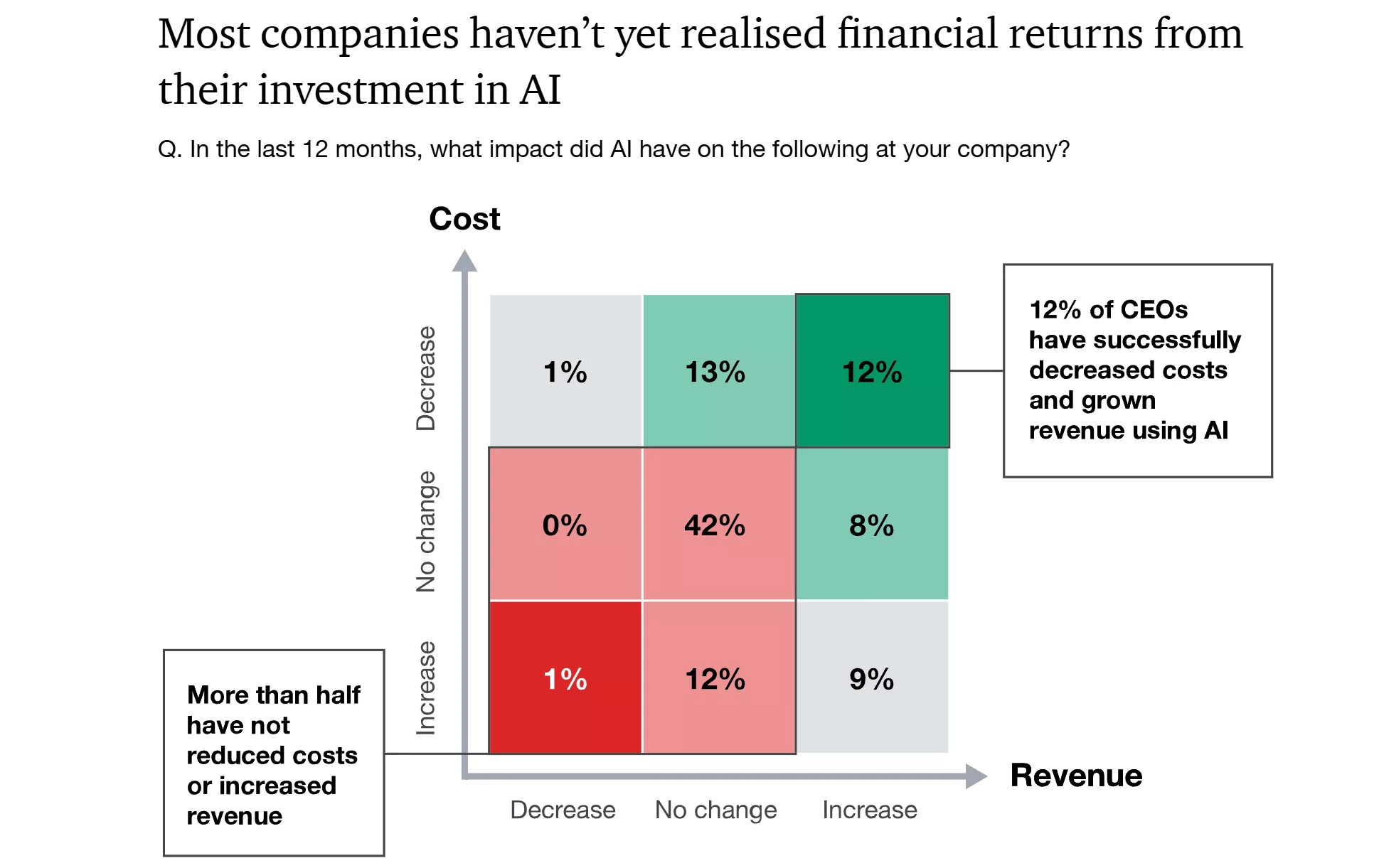
Back in January, a survey that questioned thousands of CEOs found that more than half admitted to seeing no significant financial benefit from AI to date.

Permalink to story:

 
It's a cool headline, but what the survey actually said is almost nearly the exact opposite:

"...In a KPMG US survey, three-quarters of large-company CEOs said generative AI might have been overhyped in the past year, but its true impact and "disruptive potential" over the next five to 10 years is likely underappreciated....."

And I'll again note that generative AI is only a fraction of the total AI market. Predictive AI revenues and profits have been booming for years now.
 
It's a cool headline, but what the survey actually said is almost nearly the exact opposite:

"...In a KPMG US survey, three-quarters of large-company CEOs said generative AI might have been overhyped in the past year, but its true impact and "disruptive potential" over the next five to 10 years is likely underappreciated....."

And I'll again note that generative AI is only a fraction of the total AI market. Predictive AI revenues and profits have been booming for years now.
Nah, you just can't read.

One in four CEOs polled believes an AI investment bubble exists, yet AI remains a key spending category
 
Except that's not where all the investment and hype is going.
All the investment and hype was in predictive AI a decade or two ago. Now it's raking in monstrous profits. So is generative AI in certain areas, in fact ... it's a lot wider field than just chatbots.

Nah, you just can't read.
I read what was actually stated. You swallowed the clickbait headline.
 
Last edited:
How much capital would be wiped off the stock market, if everyone who matters collectively pulled out of the "AI hype" bubble? How much of our economy is propped-up by "vibes"?
 
All the investment and hype was in predictive AI a decade or two ago. Now it's raking in monstrous profits. So is generative AI in certain areas, in fact ... it's a lot wider field than just chatbots.


I read what was actually stated. You swallowed the clickbait headline.
You're seriously going to compare the investment back then to now, seriously? Where more venture capital has been spent on one industry than multiple other historic industries combined and where companies are signing deals they literally have no concept of a plan of actually paying for? Where each query run costs money and billions upon billions are being spent on models like Sora that literally produce nothing but slop and headlines? Where literally not a single company in the industry isn't running at massive, growing, unsustainable losses except NVIDIA (who is also funding a lot of these other companies)? Seriously?
 
How much capital would be wiped off the stock market, if everyone who matters collectively pulled out of the "AI hype" bubble? How much of our economy is propped-up by "vibes"?
Well, the "Magnificent 7" are pretty much the entire reason the stock market's still in the black so...
 
Well, the "Magnificent 7" are pretty much the entire reason the stock market's still in the black so...
In other words, if the bubble bursts, then so does the economy. The hype will stop, but the momentum is already built up. The train is already moving full-speed and making small adjustments or even trying to apply the breaks would destroy everything.

Either the investments pay off or the bills come due...
 
In other words, if the bubble bursts, then so does the economy. The hype will stop, but the momentum is already built up. The train is already moving full-speed and making small adjustments or even trying to apply the breaks would destroy everything.

Either the investments pay off or the bills come due...
All evidence is already pointing to the latter. And yeah, the economy might crash. It's almost like we shouldn't base our economic policy on propping up bubbles and actually have competent leaders.
 
So 25% of CEOs think it's a bubble, 75% think it's overhyped, but nearly 80% are spending big on it anyway. The honest translation of this survey is: "We all privately think this might be insane, but none of us are willing to be the one guy who didn't."
 
All evidence is already pointing to the latter. And yeah, the economy might crash. It's almost like we shouldn't base our economic policy on propping up bubbles and actually have competent leaders.
Well, I guess we're sh*t out of luck then, huh?

In my lifetime, we've had nothing but the former and a complete absence of the latter. (Not to get too r/politics) but, I can't even remember a time in my life, when we weren't in some mountain of debt, fighting wars in some far away land while the country fell into chaos of some kind, piloted by some nitwit who was either being fed bad information or was/is the problem. If we're expecting the laws of the universe to create the conditions for the right mix of competence and benevolence repeatedly and reliably to lead the future, by pure cosmic chance, then we're screwed. Especially now, competence is in short supply, but idiocy in is abundance.

Which is to say, technology does not suck by accident. There is a coordinated effort to neuter the population―mentally, physically, emotionally, any kind of way. Before AI, it was "social media" (probably right around the time of the "Like" button) and before that it was something else. AI is just "the thing" that does it best right now...and it's working.
 
Last edited:
Back