
One of the more interesting trends starting to emerge in personal technology is a simultaneous divergence of devices designed for individual use and a convergence of the computing systems to which they connect. While we're beginning to see a much broader range of intelligent form factors and devices, we're also increasingly seeing them focused on performing AI-powered agentic tasks on our behalf, often through shared platforms.
At Qualcomm's latest Snapdragon Summit event in Maui, which the company graciously sponsored me to attend, this seemingly contradictory set of developments was on full display. Qualcomm introduced a range of additions to its Snapdragon family targeted at everything from smartphones and computers to several types of wearables.
While each has technologies and capabilities optimized for its particular platform, they all share an increasing focus on AI-powered agents that can complete tasks on an individual's behalf.
In many ways, it offered a fascinating look at the evolution of personal computing hardware and how very different types of devices are attempting to achieve a shared new set of goals. Just as interesting is how AI agents are becoming the common glue connecting these different device experiences.
For smartphones, Qualcomm took the unusual step of announcing two flagship processors, the Snapdragon 8 Elite Gen 6 and Snapdragon 8 Elite Extreme Gen 6. As TechSpot covered in detail, both bring the CPU, GPU, and efficiency improvements you'd expect from a new generation, including prime Oryon CPU cores capable of reaching 5 GHz and new Adreno Neural Fusion technology designed to improve gaming performance.

But arguably the more important changes for Qualcomm's broader strategy are the upgraded Hexagon NPU, the newly architected Sensing Hub, and the addition of an Element Accelerator specifically designed to speed up agentic AI workloads.
The updated Sensing Hub, like those found in several of the company's wearable-focused chips, consumes little enough power to remain active all the time. That allows devices to continuously listen for certain audio cues and respond to agentic tasks using the two micro-NPUs embedded within it. Qualcomm demonstrated how the Sensing Hub could power a personal scribe application, for example, transcribing and summarizing conversations while consuming very little battery power.
The Extreme version of the 8 Elite Gen 6 pushes AI, gaming, and creator workloads further through several architectural enhancements. Its Adreno GPU adds matrix cores optimized for the kinds of calculations commonly used in AI inference, while its Hexagon NPU includes 50% more dedicated memory to help it run longer agentic loops. The bigger story, however, becomes apparent when you look beyond smartphones.

In the PC world, Qualcomm highlighted the growing number of computers based on its Snapdragon X2 family, including Microsoft's latest Surface systems introduced earlier this year. The newest 13-inch Surface Pro, for example, is available with Snapdragon X2 Plus and X2 Elite processors, giving Windows PCs substantially more dedicated NPU performance for increasingly sophisticated local AI workloads.
The chips offer 85 TOPS of NPU performance and are compatible with all the latest agentic AI tools, including Perplexity, Hermes agent, OpenClaw, Claude Code, OpenAI, and more. The new Surface Pro also offers optional support for an embedded 5G modem.
Qualcomm is also supporting Google's newly launched Googlebook platform, the next generation of Google's laptop efforts, with Snapdragon X Series processors. Dell and HP are among the first manufacturers bringing Snapdragon-powered Googlebooks to market, combining local AI processing with Google's growing collection of Gemini-powered features and tighter links to Android phones.
Arguably the most intriguing announcement from this year's Summit, though, was the latest generation of Snapdragon Sound. While previous generations primarily focused on high-quality wireless audio and automatic noise cancellation, Snapdragon Sound Elite Gen 2 puts much more emphasis on audio-based AI, including conversations with AI agents and other intelligent applications.
In essence, Qualcomm is bringing some of the intelligence previously associated with its AR and VR platforms, such as the Snapdragon XR chips used in devices like the new Snap Specs, into audio-focused products.
Given the growing range of audio smart glasses, AI recording devices, earbuds, and other "hearables" appearing on the market, Snapdragon Sound Elite Gen 2 feels particularly timely. The dramatically improved audio recognition and processing capabilities these chips enable are creating entirely new ways to interact with AI-powered computing resources.
The ability to intelligently converse with AI platforms like ChatGPT, Claude, Gemini, and others simply by speaking offers a fascinating new way to use AI. In fact, given the size and weight challenges of today's display-equipped smart glasses, along with the still somewhat awkward mechanisms for interacting with them, it's possible that audio-focused smart glasses could ultimately become the mainstream option for the category.
Time will tell, but the seemingly foregone conclusion that display-equipped smart glasses would become the volume leader may not be as certain as previously thought, particularly given the ease of use and growing capabilities of audio-focused alternatives.
Regardless of which form factor ultimately wins out, connecting these devices to a common identity creates something potentially more important. Agentic AI tools can begin to work across devices, producing a degree of convergence and shared intelligence that seemed like a dream only a few years ago.
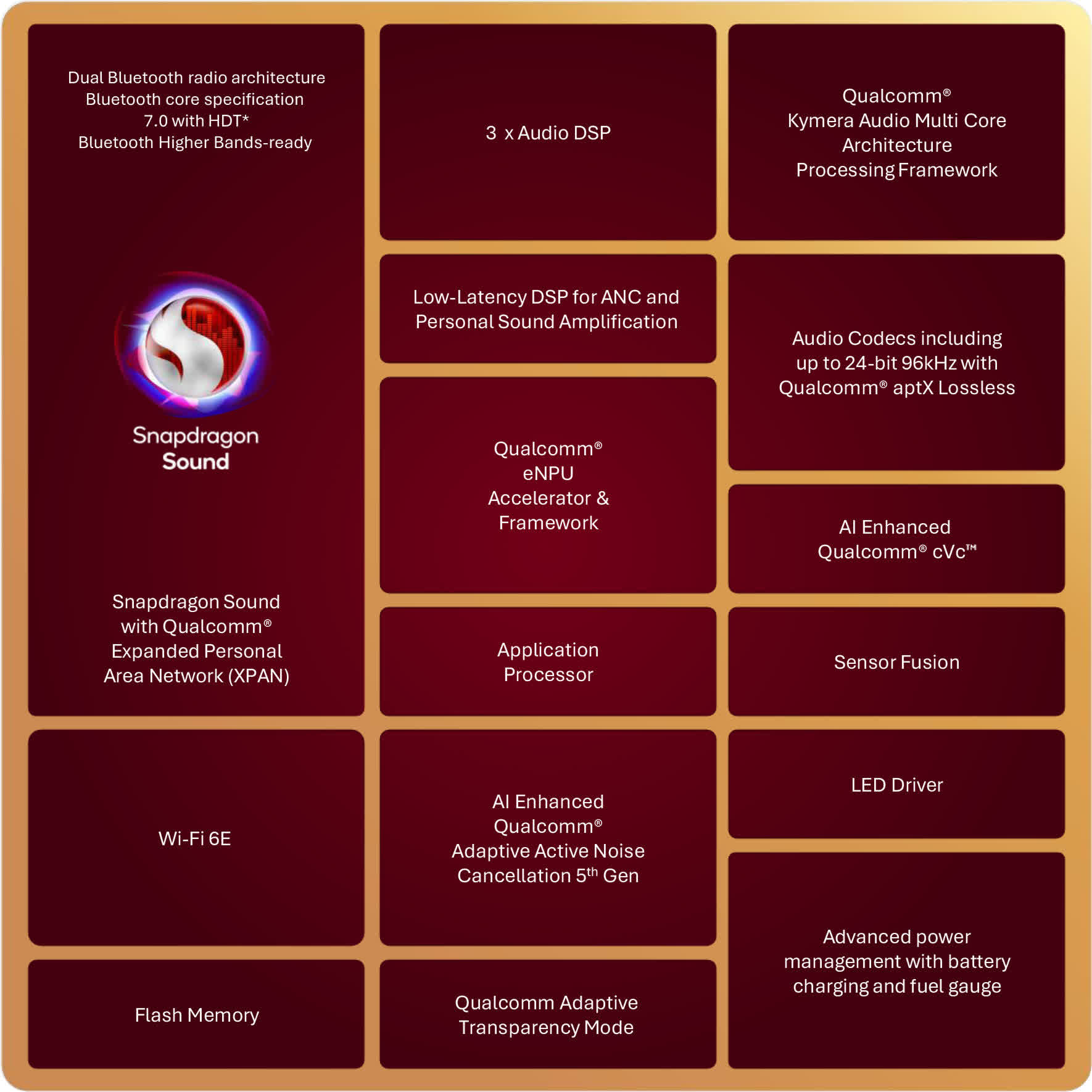
To bring these capabilities to audio devices, Qualcomm had to introduce several new technologies to Snapdragon Sound Elite Gen 2 on both the compute and connectivity sides.
For AI processing, the company integrated a dedicated new eNPU that doubles on-device AI capability compared with the previous generation. It also added micro-power Wi-Fi 6E, allowing devices to connect directly to cloud-based AI services from a hearable form factor. Combined with enhanced Bluetooth capabilities and support for Qualcomm's XPAN personal networking technology, that connectivity allows devices to access agentic platforms, as well as high-quality audio streams, across a much wider area.
Beyond the hardware, Qualcomm also introduced Snapdragon Sound Apps and Agents. Designed specifically for ultra-low-power devices based on Snapdragon Sound Elite Gen 2, these apps, along with the development tools necessary to create them, could help establish an entirely new software ecosystem for hearable devices.
There's no doubt that we're still in the early stages of agentic AI, but it's fascinating to see how quickly tools are starting to tie our devices together into a more unified whole.
The technologies Qualcomm displayed at this year's Snapdragon Summit are helping push that development forward. By combining advanced compute, AI acceleration, and connectivity across an increasingly diverse range of devices, the company is moving toward a world where our individual portable digital identities, and all that entails, can follow us wherever we go, whatever we're doing, and whichever device we happen to be using.
Bob O'Donnell is the founder and chief analyst of TECHnalysis Research, LLC a technology consulting firm that provides strategic consulting and market research services to the technology industry and professional financial community. You can follow him on Twitter @bobodtech
Qualcomm's new chips show how AI agents are tying together phones, laptops, and earbuds


