Robots just installed 100 MW of solar panels in the desert

Skye Jacobs

Posts: 2,030   +59
Staff
The takeaway: The expansion of automation in renewable energy construction has taken a significant step forward in California's Mojave Desert, where a fleet of Maximo robots has completed the installation of 100 megawatts of solar capacity at AES's Bellefield solar complex – one of the largest demonstrations to date of field robotics operating at utility scale. The project marks a shift for solar construction, an industry traditionally dependent on manual labor.
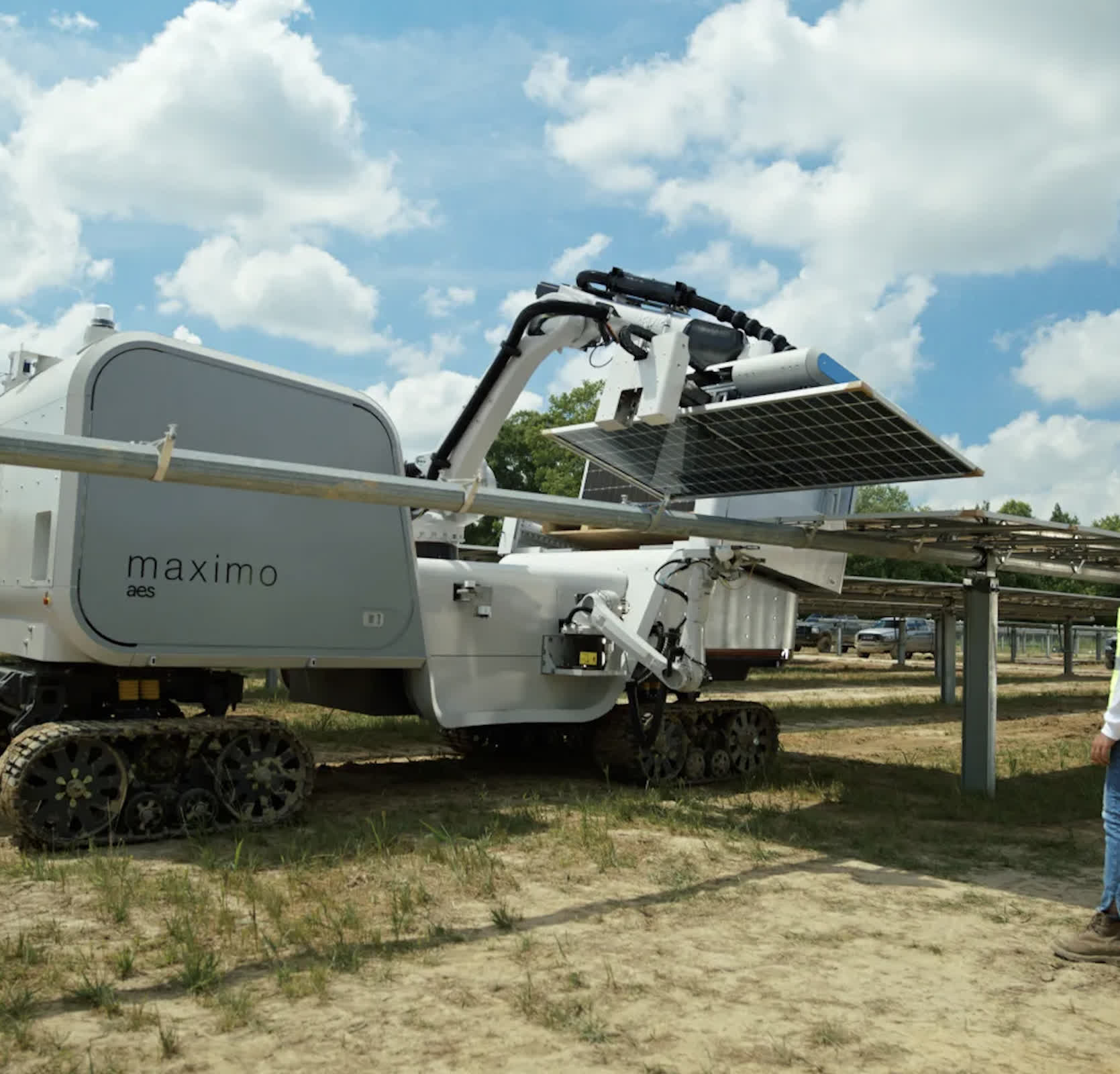
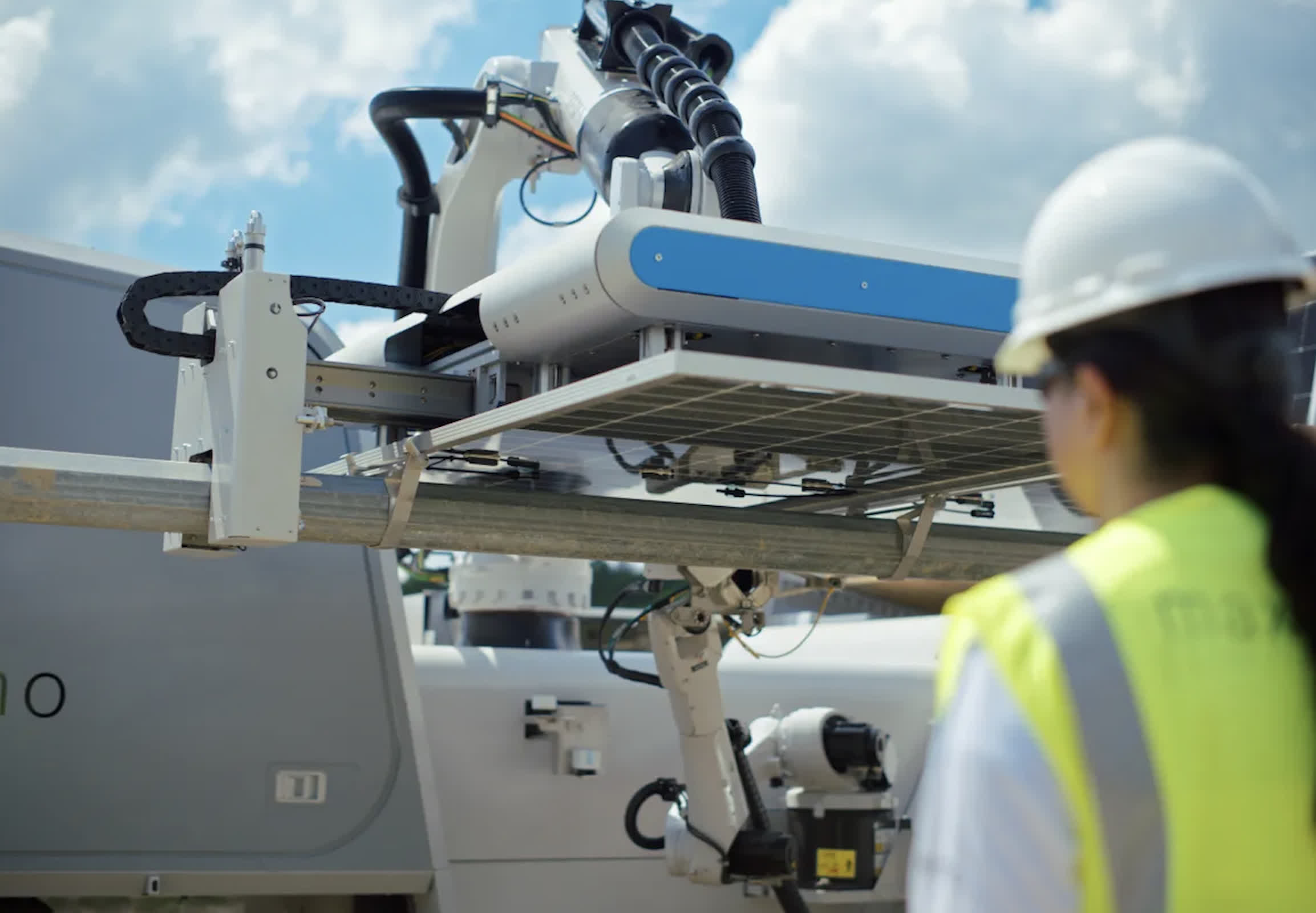
According to Maximo, its Version 3.0 robots now enable crews to install solar panels at rates previously impossible by human teams alone. Workers using the robots have been able to place as many as 24 photovoltaic modules per hour per person, supported by machines that assemble panels at a rate of more than one per minute. This pace – nearly doubling throughput compared with other large-scale photovoltaic sites across Southern California – highlights the growing role of robotics in a process that has long been labor-intensive.

"Reaching 100 MW is an important milestone for Maximo and for the role robotics can play in solar construction," said Chris Shelton, president of Maximo. "It demonstrates that field robotics can move beyond experimentation and deliver consistent results at utility scale."

For Maximo, the Bellefield deployment also demonstrates how industrial AI systems can accelerate robotics development. The company built and refined its robotic models using Nvidia and Amazon Web Services cloud technologies. By leveraging Nvidia's AI infrastructure, Omniverse simulation libraries, and the Isaac Sim robotics development platform, engineers were able to digitally model and stress-test robot movements before deploying updates to live sites. According to Maximo, this approach has shortened development cycles and improved performance confidence across its growing robotic fleet.
The Bellefield complex, which will eventually exceed 1 gigawatt of generation capacity, is part of a wave of large-scale solar and storage projects across the American Southwest. These developments are arriving at a moment of heightened urgency for energy diversification.

With energy markets still rattled by the ongoing Middle East conflict and depleted fossil fuel supplies, the need for reliable, carbon-free generation has become acute, especially as new data centers and electric vehicle infrastructure place additional pressure on the grid.

This convergence of rising energy demand and industrial labor shortages has made automation particularly attractive to developers. Construction remains one of the most labor-constrained sectors in the US, prompting growing interest in robotics platforms that can supplement human workforces while improving throughput and consistency.

Maximo's achievement offers a glimpse of what widespread robotic integration could mean – not just for renewable energy projects, but for heavy construction more broadly.

Permalink to story:

 
"industrial labor shortages"

Yet millions cant find a job. Hmmmm......
They are usually speaking about very specific shortages: undesirable jobs that do not pay well, highly specialized job that require both natural talents and a lot of experience. There are shortages not because there are no people like that but because the people they need already work somewhere else where they are paid better. There is no shortage of people who can be replaced by robots in few years.
 
They are usually speaking about very specific shortages: undesirable jobs that do not pay well, highly specialized job that require both natural talents and a lot of experience. There are shortages not because there are no people like that but because the people they need already work somewhere else where they are paid better. There is no shortage of people who can be replaced by robots in few years.
Maybe they should pay better and the executives take home 50 million each rather than 60.
 
Maybe they should pay better and the executives take home 50 million each rather than 60.
Only a small handful of CEOs earn $60M+ a year,and nearly all of them are in high-tech or private equity fields where many employees earn high six or even seven-figure salaries.

About the closest 'blue collar' firm for which a CEO earns that much is Carrier Global, where David Gitlin earned $65M last year. He could take a pay cut to $50M ... but split among their 54,000 employees that would only raise the average Carrier salary by $23/mon. You think one free pizza a month will motivate many people?
 
Only a small handful of CEOs earn $60M+ a year,and nearly all of them are in high-tech or private equity fields where many employees earn high six or even seven-figure salaries.

About the closest 'blue collar' firm for which a CEO earns that much is Carrier Global, where David Gitlin earned $65M last year. He could take a pay cut to $50M ... but split among their 54,000 employees that would only raise the average Carrier salary by $23/mon. You think one free pizza a month will motivate many people?
We’re talking energy companies here

Nice moving of goalposts there my dude
 
We’re talking energy companies here

Nice moving of goalposts there my dude
You didn't read the post you replied to; the original reference was to industrial labor in general. If you want to restrict it to energy companies alone, your argument is even worse: I know none for which their CEO earns that much. The CEO of the company above, for instance, (AES) has a base salary of just $1.25M ... last year his stock options did well, which pushed his total compensation to $9M.

But hey, in the interests of promoting anti-capitalism, perhaps we should ask him to take a $10M pay cut, eh?
 
So, despite the nonsensical clickbait title, what actually happened was that people installed solar panels. Those people used robots.

Anyone using the right tools can do a job "at previously impossible rates".
E.g. a person with a truck will do many jobs at rates impossible for a person without a truck. But it's idi0tic to claim the truck is doing the job.
 
Oh wow all that land for 1/30 of the output of a nuclear plant which you’ll only get for a fraction of the year.
A power plant costs between 5b to 30b. And is a lot of research going on, and the power will come online in few years.

The solar panels energy you get it as fast as you can built it.
Imagine getting a debt and getting ROI as soon as you settled the first panel.

Soon human kind will transform the deserts into solar energy output.
 
The solar panels energy you get it as fast as you can built it.
This particular solar farm is taking ~3 years to complete. But the main problem with solar is that it isn't a demand-based source: a solar farm is always producing either too little or too much -- and for a power grid, one is just as bad as the other. Also, solar farms generally have only about a 15-25% capacity factor. This particular farm is sited on one of the best possible locations (the cloudless Mojave), so if we assume 25% for it, that "100MW" of power works out to only 25MW.
 
A power plant costs between 5b to 30b. And is a lot of research going on, and the power will come online in few years.
And lasts 70 years vs 20 and outperforms solar on price per W
The solar panels energy you get it as fast as you can built it.
Imagine getting a debt and getting ROI as soon as you settled the first panel.
Aside from the panels don’t pay themselves off very quickly vs their lifespan whereas nuclear does.
Soon human kind will transform the deserts into solar energy output.
And what will we do for the other 12 hours of the day?
 
You didn't read the post you replied to; the original reference was to industrial labor in general. If you want to restrict it to energy companies alone, your argument is even worse: I know none for which their CEO earns that much. The CEO of the company above, for instance, (AES) has a base salary of just $1.25M ... last year his stock options did well, which pushed his total compensation to $9M.
Which is a decrease on last year and is not the full amount he gets becaure then it would be taxed.
But hey, in the interests of promoting anti-capitalism, perhaps we should ask him to take a $10M pay cut, eh?
It’s anti capitalism either way bud. Either you pay people fairly or you replace them with machines and AI and have to implement UBI
 
Which is a decrease on last year and is not the full amount he gets becaure then it would be taxed.
It's his entire compensation.

Either you pay people fairly or you replace them with machines and AI and have to implement UBI
Honestly, the salaries aren't the issue. The problem is an educational system that tells even the lowest-performing students they need to be college bound. So they go to uni, pick a major in something they think can survive in, and we graduate millions a year with degrees in "communications", marketing, psychology, art history, political science, etc -- 20X or more as many as actually needed.
 
"Solar farm projects do not need to wait for the entire site to be completed to start producing power; they can, and often do, begin generating electricity in phases.

While the entire project must be commissioned and tested before it is fully operational, large-scale projects are frequently connected to the grid section by section.

How Solar Farms Start Generating
Phased Energization (Sectional): Large utility-scale projects are divided into blocks (e.g., 5MW sections). Once a section of panels is mounted, wired, and connected to an inverter and transformer, that section can be tested and energized to start sending power to the grid, even while construction continues elsewhere on the site.
Immediate Functionality: Individual solar panels technically begin working as soon as they are installed, exposed to light, and connected, but they cannot send usable power to the grid until their "string" is connected to an active inverter.
Commissioning Phase: Once construction is finalized, a rigorous testing and commissioning phase ensures all components meet safety standards before the entire farm goes fully"

Here is the solution to the solar panel output.
If the momentum is fast enough, theoretically if a grid gets 10% power from solar and 90% from others, this steady pace would soon surpass the other source of energy simply because the speed of the growth compared to the slow progress to other alternatives. Actually there is no other alternatives so there is no progress at all. AI proves this. Electric cars don't have enough grid power too!
 
Here is the solution to the solar panel output.
If the momentum is fast enough, theoretically if a grid gets 10% power from solar and 90% from others, this steady pace would soon surpass the other source of energy
You fail to grasp the problem. The largest issue a utility faces isn't generating the power; it's matching supply with demand in real time, second by second. Wind and solar always produce too much or too little. 10% of grid capacity is manageable, but anything over 25% starts to cause serious issues. Germany's "green" push took it from the cheapest electricity in Europe to one of the most expensive, and they're only able to average 50% by selling huge amounts of wind and solar power to their fossil-fuel reliant neighbors, then buying back fossil fuel power when the wind isn't blowing and the sun isn't shining ... essentially using those nations as enormous storage batteries. A neat trick -- but only works when your neighbors don't have lots of wind and solar too.

Batteries can in theory solve the problem ... but battery arrays large enough to power entire cities for hours on end can easily quadruple or quintuple the base cost of the power .. and batteries degrade much faster than solar panels.
 
It's his entire compensation.
You sweet summer child. Let me guess you think Zuckerberg is on $1 a year too.
Honestly, the salaries aren't the issue. The problem is an educational system that tells even the lowest-performing students they need to be college bound. So they go to uni, pick a major in something they think can survive in, and we graduate millions a year with degrees in "communications", marketing, psychology, art history, political science, etc -- 20X or more as many as actually needed.
No the issue is the minimum wage is too low, a lot of states do not have a minimum wage that has kept up with inflation never mind the increased cost of living beyond that plus jobs moving to part time rather than full time to skirt employment law and rights etc.
 
You sweet summer child. Let me guess you think Zuckerberg is on $1 a year too.
Key employee compensation is a matter of public record for all publicly-traded corporatiosn. Spare us the tinfoil-hat conspiracy theories, please.

No the issue is the minimum wage is too low
As Nobel-prize winning economist Milton Friedman says, minimum-wage laws are "as clear a case as one can find of a law the effects of which are precisely the opposite of those intended" He notes they act as an effective legal ban on employers hiring low-skilled workers, and allowing them to gain skills to get higher-paying jobs.

In any case, your point couldn't be any more irrelevant, since these industrial jobs pay well above minimum wage already, and in fact only about 1% of the jobs in the entire country are minimum wage.
 
Honestly, the salaries aren't the issue. The problem is an educational system that tells even the lowest-performing students they need to be college bound. So they go to uni, pick a major in something they think can survive in, and we graduate millions a year with degrees in "communications", marketing, psychology, art history, political science, etc -- 20X or more as many as actually needed.

-I'm curious on your perspective on how to upend this system.
 
Can these same robots REPLACE these panels when they break/wear out?
Nuclear is MUCH better, but thanks to environmentalist, we don't have enough
to support all of the EV nonsense.
 
Key employee compensation is a matter of public record for all publicly-traded corporatiosn. Spare us the tinfoil-hat conspiracy theories, please.
Taxable compensation is, I again point to Zuckerberg who has taken $1 a year base salary and has for at least 2 years of the last 10 only taken that and nothing else.
As Nobel-prize winning economist Milton Friedman says, minimum-wage laws are "as clear a case as one can find of a law the effects of which are precisely the opposite of those intended" He notes they act as an effective legal ban on employers hiring low-skilled workers, and allowing them to gain skills to get higher-paying jobs.
Which is complete nonsense because the minimum wage is currently not enough to live on now. Lowering it wouldn’t change employment prospects because if its not worth doing for minimum wage it’s not worth doing for less.
In any case, your point couldn't be any more irrelevant, since these industrial jobs pay well above minimum wage already, and in fact only about 1% of the jobs in the entire country are minimum wage.
Barely and the travel cost wipes out more than that anyway. And what’s the income over the year becaure again even if it’s double minimum wage if you’re only offered 10 hours a week and you have to spend 1/3 of it to get to work it doesn’t really matter dies it.
 
Back