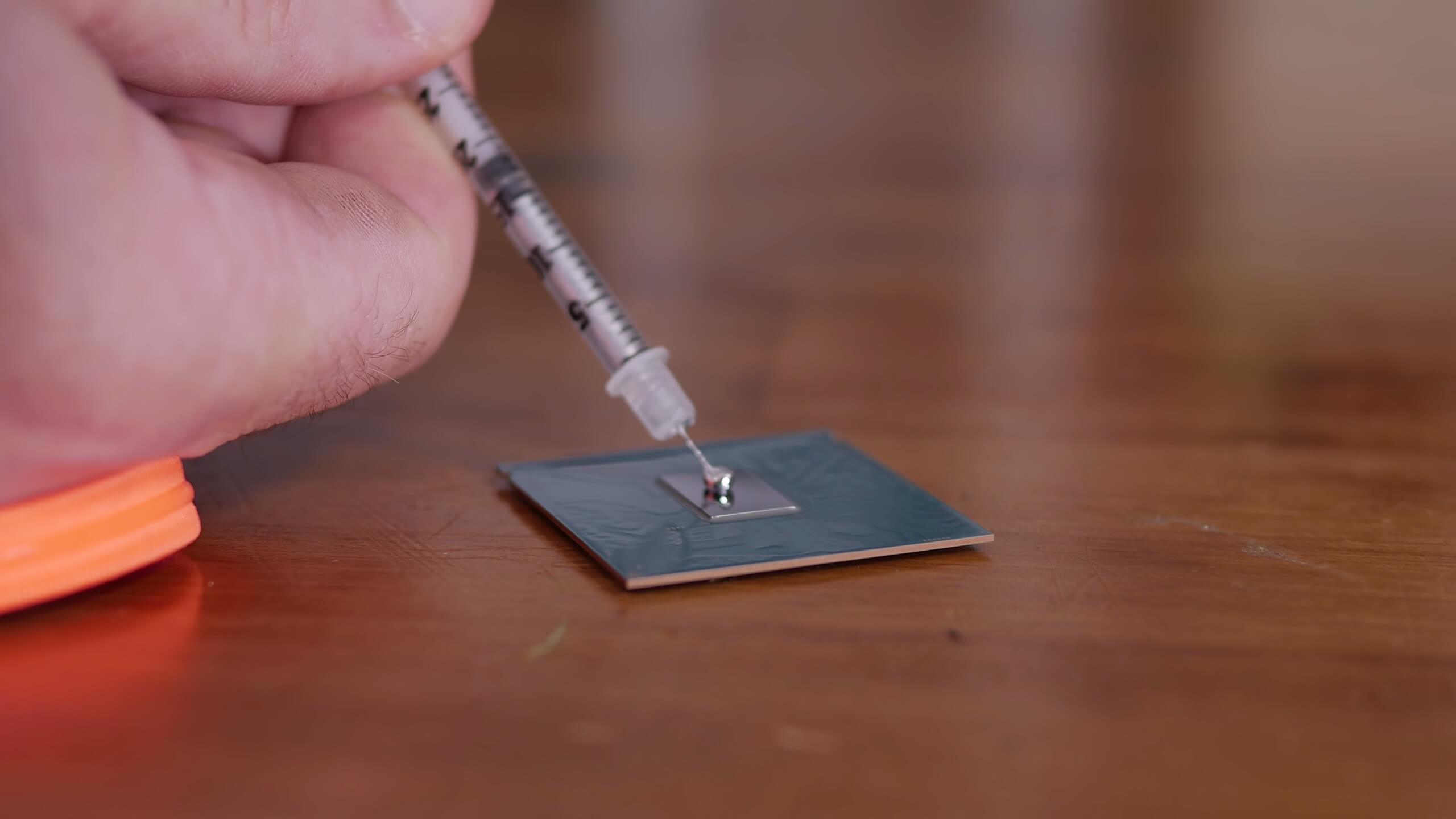
Solder vs. Paste on the Core i9-9900K

Julio Franco

Posts: 9,313   +2,248
Staff member
Makes sense...paste probably has more "air" molecules between the solids, versus solder which is a liquid solid. Plus one is all metal.
 
Considering this seems to be Intel's attempt at pulling out all the bells and whistles - it seems to me the age of CPU improvements is coming to an end. It seems this CPU is on the verge of melting, yet the improvements vs the 8700k or 8086k are minor. Where to go from here, have we reached the pinnacle of CPU performance we can expect without extreme cooling solutions?
 
Considering this seems to be Intel's attempt at pulling out all the bells and whistles - it seems to me the age of CPU improvements is coming to an end. It seems this CPU is on the verge of melting, yet the improvements vs the 8700k or 8086k are minor. Where to go from here, have we reached the pinnacle of CPU performance we can expect without extreme cooling solutions?
actually intel has milked all it can at 14nm but is still trying....
hence the "wall" at CPU improvements.
if it was not for AMD we would still have those quad i5 @ WHOPPING 4.3 GHZ @299$$$
 
Considering this seems to be Intel's attempt at pulling out all the bells and whistles - it seems to me the age of CPU improvements is coming to an end. It seems this CPU is on the verge of melting, yet the improvements vs the 8700k or 8086k are minor. Where to go from here, have we reached the pinnacle of CPU performance we can expect without extreme cooling solutions?

Jim Keller, "hold my beer I got this!"
 
Considering this seems to be Intel's attempt at pulling out all the bells and whistles - it seems to me the age of CPU improvements is coming to an end. It seems this CPU is on the verge of melting, yet the improvements vs the 8700k or 8086k are minor. Where to go from here, have we reached the pinnacle of CPU performance we can expect without extreme cooling solutions?
I think this has to be their desire to be in those 5Ghz+ speed to ACTUALLY BE ABLE to edge AMD, like if you think about it these 9th gen CPU would not be able to even compete vs Ryzen or ThreadReaper.
 
Before the CPU was always soldered to MOBO. Paste in time wears out and cracks thus the CPU starts to get hotter and will shutdown the system. PII and PIII use to use cartridge type. Wasn't that soldered to the board inside the cartridge.
 
Considering this seems to be Intel's attempt at pulling out all the bells and whistles - it seems to me the age of CPU improvements is coming to an end. It seems this CPU is on the verge of melting, yet the improvements vs the 8700k or 8086k are minor. Where to go from here, have we reached the pinnacle of CPU performance we can expect without extreme cooling solutions?

People have said this for decades. Kind of like "PC gaming is dead!!". The Pentium 4 chips come to mind with regard to heat. They will find yet another way to get past any roadblocks. If not just change CPU architecture. Humans are creative, and some are competitive. Intel doesn't want to let AMD take the crown.
 
Before the CPU was always soldered to MOBO. Paste in time wears out and cracks thus the CPU starts to get hotter and will shutdown the system. PII and PIII use to use cartridge type. Wasn't that soldered to the board inside the cartridge.
What are you smoking? BGA applications have only ever been popular on small embedded applications. Socketed CPUs have been the norm on desktops since the stone age.

We are talking about the IHS being soldered to the CPU, not the CPU being soldered to the MOBO. IHS were soldered from the Pentium days onward, previous chips just had an exposed die instead. Paste wasnt used until ivy bridge in 2012.
 
Considering this seems to be Intel's attempt at pulling out all the bells and whistles - it seems to me the age of CPU improvements is coming to an end. It seems this CPU is on the verge of melting, yet the improvements vs the 8700k or 8086k are minor. Where to go from here, have we reached the pinnacle of CPU performance we can expect without extreme cooling solutions?
CPU improvements are not over, the clock wars are, as long as we are stuck on 14nm. Ryzen showed there is plenty of room for improvement, even on 14nm still.

Ryzen's modular design will likely be used by intel sooner or later, for two reasons:

1. the modular design is much cheaper to make, monolithic chip costs are destroying intel in the server space.

2. the modular design spreads heat amongst multiple dies, all of which contact the IHS. This helps prevent the issue intel is having, removing the heat from the dies. A single, massive die is going to develop more cooling problems, and as transistors shrink, this issue will get worse.
 
I'm going to buy a 9900k. I need CPU, MB, RAM and it will cost me an extra AU$348 dollars for a 9900k setup over a 2700x setup. Which is only 21% more for the extra performance I will get and seeing that I don't upgrade every year or even two I can accept that. I like that it is soldered because I can likely run 4.8GHz to 5.1GHz daily on a 360mm loop and not void my warranty by having to de-lid.

If AMD comes up with something amazing next year and I'm keen on that instead I can likely sell the 9900k setup and get the latest AMD offering for very little changeover cost. I think that's a win, win... win.

PS: I'm no loyalist to any brand, I've got an AMD system at the moment. I'll go with whatever makes sense to me at the time.
 
The silicon on these chips isn't thicker, its the material used for bonding. With tim, you don't have to worry about bonding so less layers are used between the actual silicon and the TIM. With solder, you have to worry about different expansion ratios for different metals and adhesion. For this, there are multiple layers of noble metals that are used to cater to the bonding. What debau8er did was remove the solder, and sand down through most of that bonding material to get to the base (think its nickel) layer and got it closer to the TIM chip densities.
 
You're stating the vcore instead of the actual votlage after vdroop: VR VOUT. Just giving your vcore setting is useless as a reference for anyone that isn't using that motherboard with exactly the same LLC settings as you. Instead of 1.366v you're actually getting 1.307 at load.
 
Back