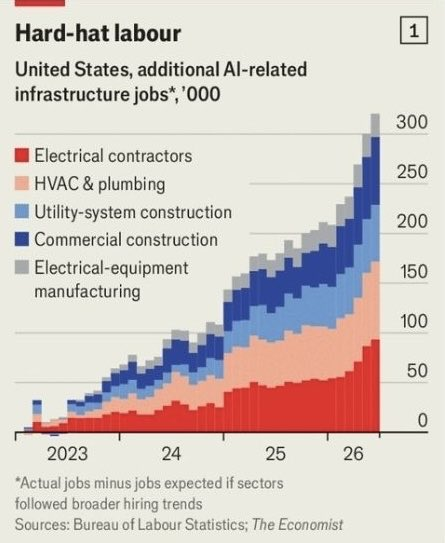
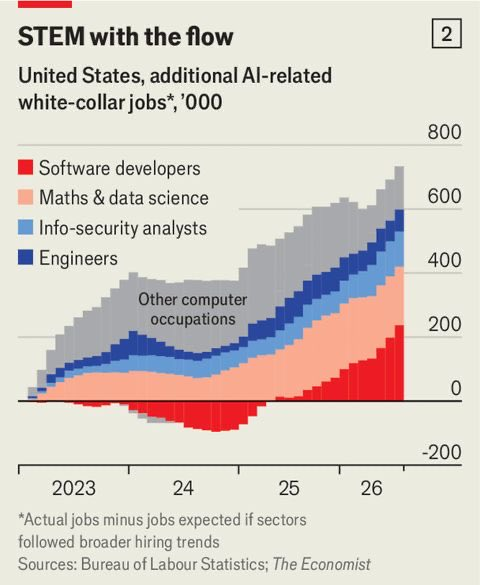
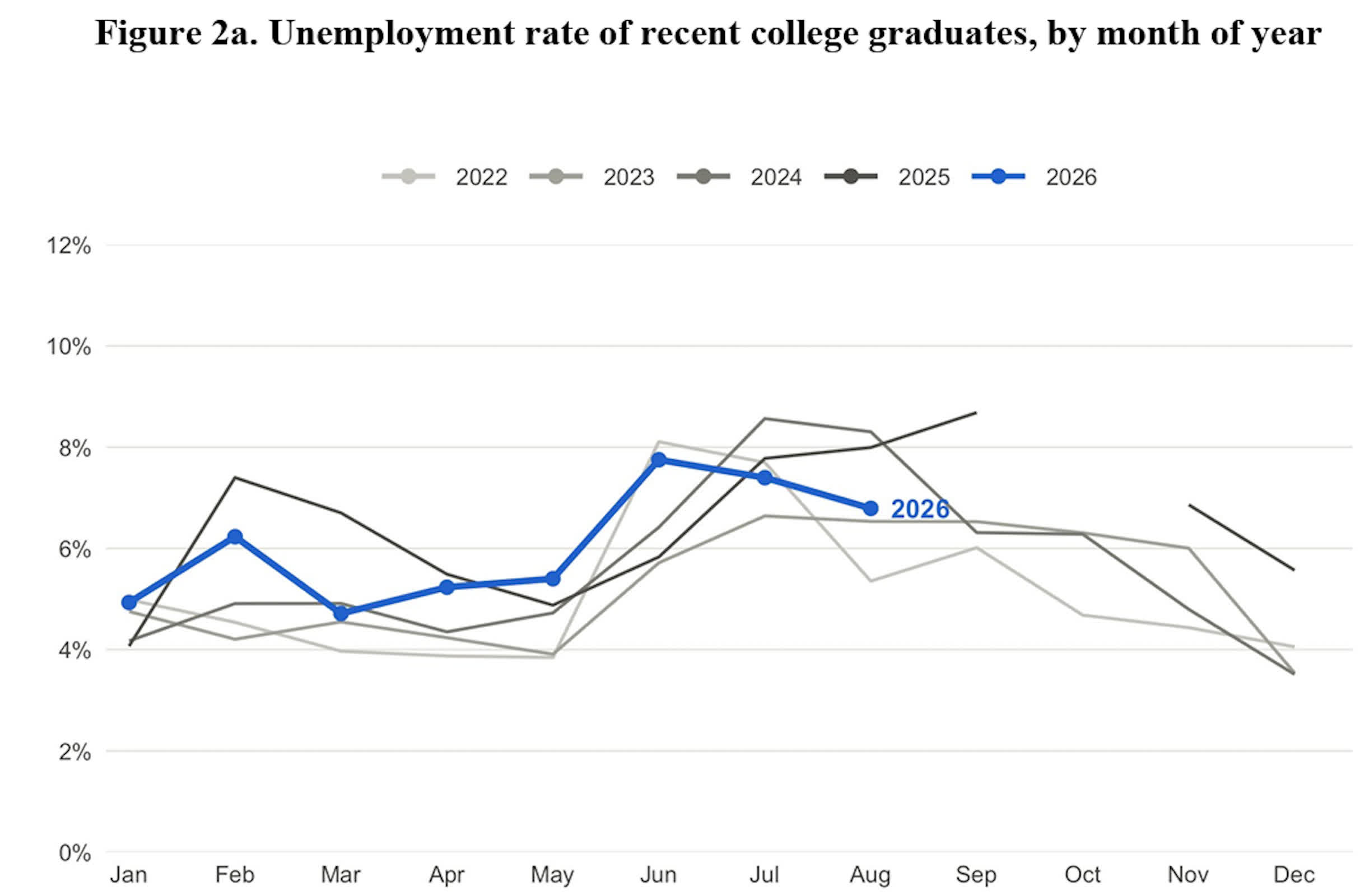
The takeaway: A new analysis of US employment data finds no clear sign that AI has pushed recent college graduates out of the labor market – at least not yet. The paper, published by Munich's CESifo research institute, examined unemployment among bachelor's degree holders ages 22 to 25 who were not enrolled in further education. The researchers found that the group's unemployment rate in summer 2026 was 7.3%, within the range seen in the previous four years.
That result runs counter to growing concern that companies are using generative AI to cut back on entry-level hiring. It also differs from a recent Stanford University study, which found weaker employment trends for younger workers in occupations considered heavily exposed to AI.
CESifo researchers Robert Fairlie and Jane Wu focused on new graduates because hiring reductions may be one of the first ways AI affects employment. Companies can limit new openings for routine office work without laying off experienced employees already on staff.
Many entry-level roles involve tasks that are increasingly within reach of generative AI systems: summarizing documents, preparing first drafts, producing basic analysis, processing information and handling other standardized work. As these systems improve, employers may be able to assign part of that work to software rather than new hires.
Fairlie and Wu used microdata from the Census Bureau's Current Population Survey, which tracks employment and unemployment across the US workforce. They looked at summer results from 2022 through 2026, a period that began after the labor market had largely recovered from the pandemic and included the release and rapid adoption of ChatGPT.
The 7.3% unemployment rate recorded for recent graduates this summer was higher than the 6.3% level in 2022, but below the 7.8% rate recorded in 2024. The researchers also broadened their analysis to include people who said they wanted jobs but were not actively looking. That test did not materially change the result.
They then compared recent graduates with workers of the same age who did not have college degrees, as well as older college graduates aged between 30 and 49. The paper also categorized jobs by their estimated exposure to AI, using earlier research on the occupations where AI systems could potentially handle more tasks.
Those comparisons did not show statistically significant differences in employment trends during the period studied. "Unemployment among recent college graduates in summer 2026 was not unusually high relative to earlier summers," the authors wrote.
The finding does not mean that AI has had no effect on the job market. It means the effect is not yet clear in this particular measure of employment.
The difference between the CESifo and Stanford studies may partly reflect the data they use. Stanford relied on payroll records from HR company ADP to measure changes in employment across occupations. That can show whether employers are adding or cutting jobs in specific fields.
The CESifo paper measures unemployment instead. It captures both job availability and the number of people seeking work. A company could reduce entry-level hiring in an AI-exposed field, for instance, while unemployment remains stable if workers find jobs elsewhere or fewer people seek work in that area.
Still, there are reasons to watch the next several graduating classes closely. The CESifo researchers noted that more companies have reported using AI to automate employee tasks. Spending on AI per worker has increased, and use of ChatGPT Enterprise has also grown over the past year.
Executives and investors have begun to make similar warnings. Venture capitalist Marc Andreessen said earlier this year that "AI literally until December 2025 was not actually good enough to do any of the jobs that they're actually cutting." BlackRock CEO Larry Fink has also said that "when this year's college graduates enter the workforce, we could see the highest unemployment rate among them in years – even without a recession."
So far, broad Census data do not support that outcome for the class of 2026. But the CESifo researchers said it may be too soon to draw firm conclusions. If companies keep expanding AI use, graduates entering the labor market in 2027 and beyond could face a different hiring environment.
The AI job apocalypse hasn't hit recent college grads, at least not yet