These humanoid robots can only work half as fast as humans, but factories are buying them anyway

Skye Jacobs

Posts: 2,030   +59
Staff
In a nutshell: China's ambitious drive to automate its factories is running up against the physical and computational limits of current humanoid robots. Shenzhen-based UBTech Robotics, one of the country's leading developers in the sector, admits that its latest Walker S2 humanoids achieve only 30 to 50 percent of a human worker's productivity – a stark reminder of how far the technology still must advance before it can reliably replace people on industrial production lines.
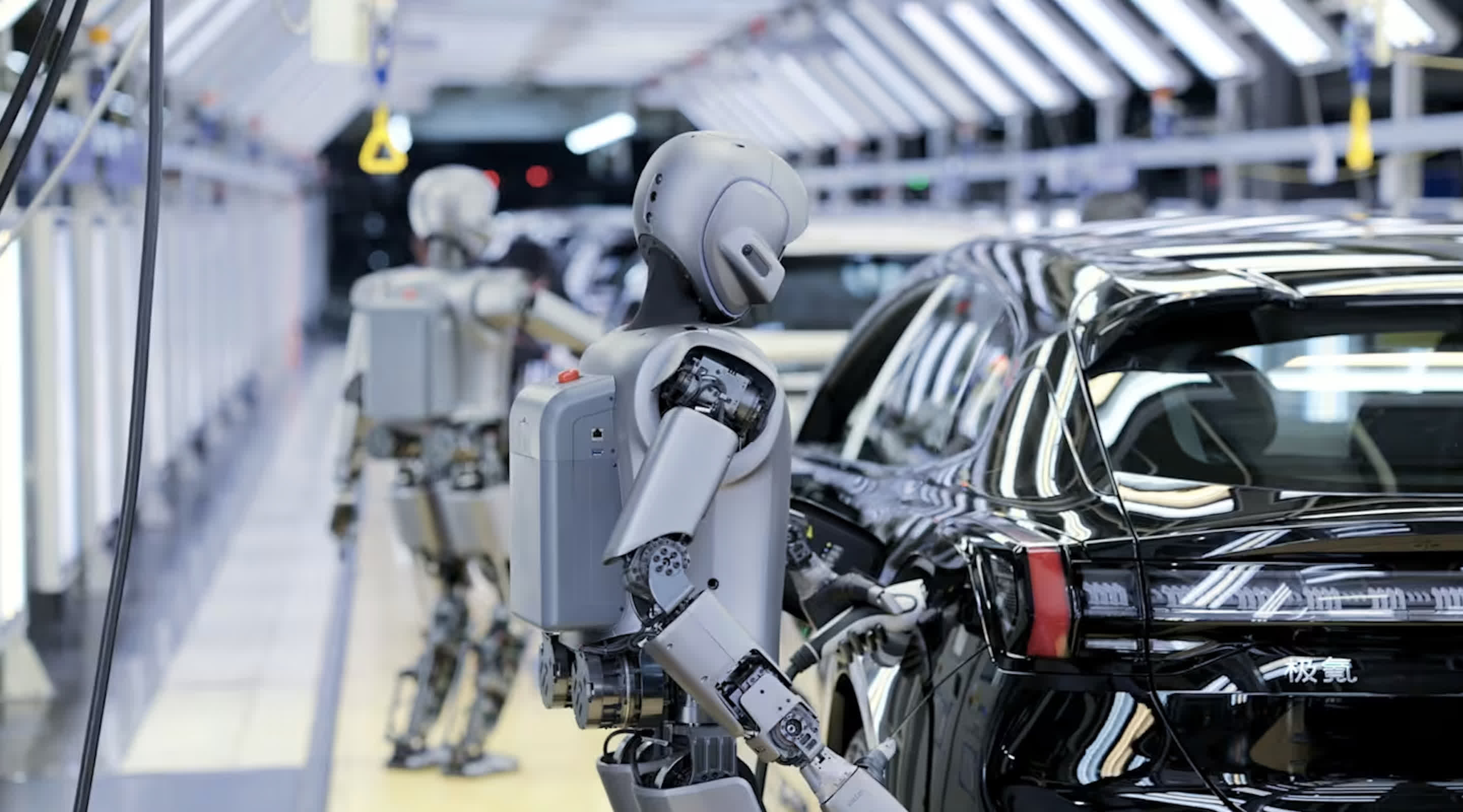
Even with those limitations, orders for the machines are accelerating. Manufacturers such as BYD and Foxconn, both partners with UBTech, are experimenting with humanoids to offset labor shortages and remain competitive in automation.

"You can imagine … if Tesla has the advantage of deploying their own human robots into the manufacturing line, that means maybe BYD, they are staying behind," UBTech's chief brand officer, Michael Tam, told The Financial Times.

The Walker S2 is optimized for controlled, repetitive tasks: moving parts between stations, stacking boxes, or performing visual inspections for defects. Unlike traditional industrial arms which make up the majority of China's global robot installations, the Walker S2 is designed to walk between assembly lines, potentially allowing manufacturers to repurpose it across multiple applications. That flexibility is the central selling point for humanoids as a new class of general-purpose labor.

However, current hardware limitations highlight how challenging that goal remains. The Walker S2 still requires appendage swaps for different tasks, meaning a human operator must exchange hands or tools. Engineering teams are now developing a multi-functional hand that would allow the robot to manipulate a variety of components without human intervention.

Power autonomy also remains a hurdle. While UBTech's demo robots can swap their own batteries, real factory use will demand stronger power management and more durable joints for continuous operation.

The Chinese government has made humanoid robotics a strategic priority, promoting AI-driven automation as essential to sustaining manufacturing growth. Yet even policymakers acknowledge that the field is still in its infancy.
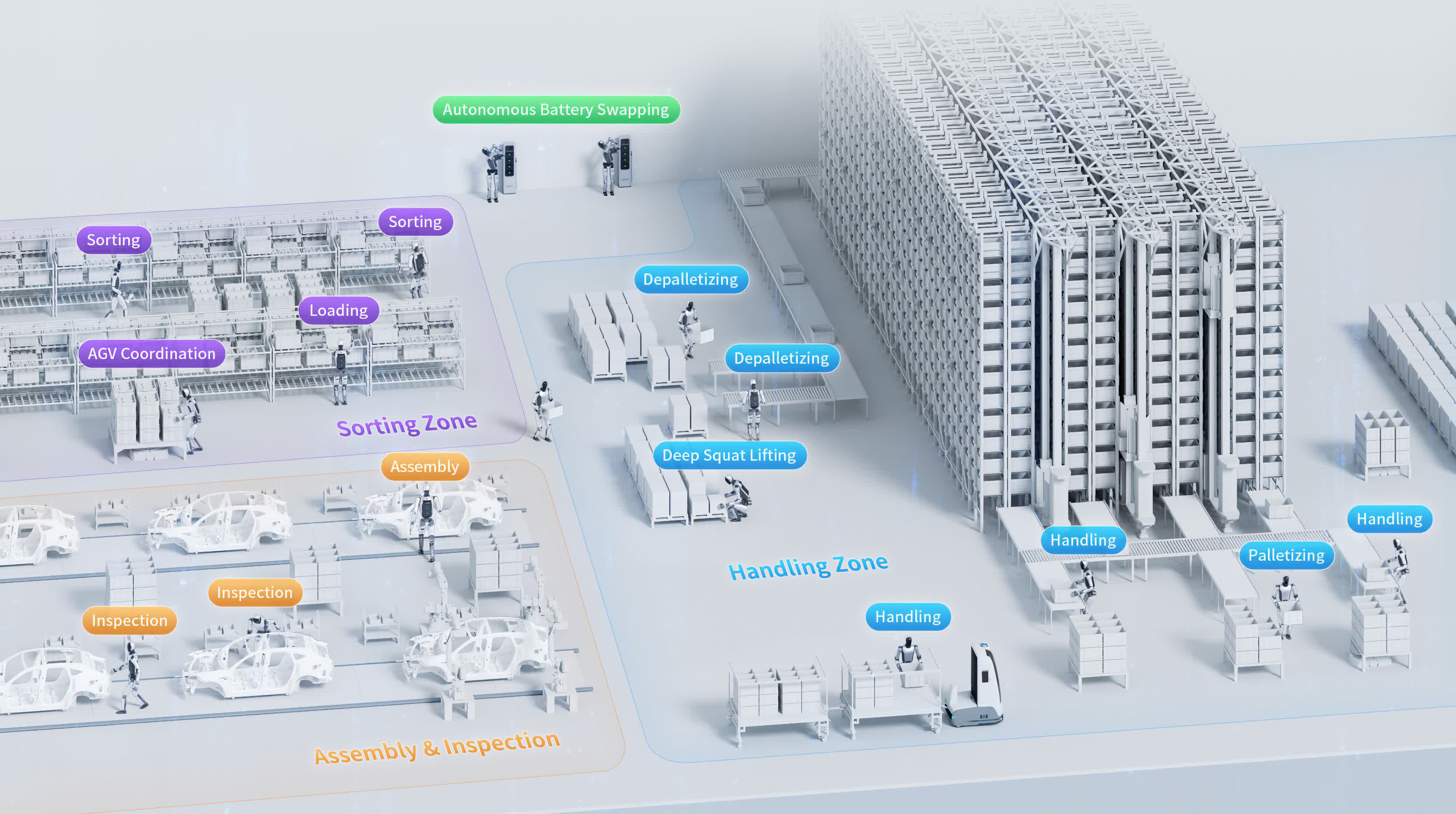
Most humanoid deployments in China remain limited to state-funded pilot projects and concept tests. Many are still proof-of-concept demos, said Marco Wang, a Shanghai-based analyst with Interact Analysis, noting that commercial viability is still some distance away.

UBTech has taken steps to expand its industrial footprint beyond China. It recently announced a concept-stage collaboration with Airbus and, last year, signed a partnership with Texas Instruments. Airbus described the project as "very early testing," suggesting that broad deployment remains speculative.

Still, UBTech aims to produce 10,000 humanoid units in 2026, up from 500 delivered in 2025, as it chases scale and data-driven refinement. Tam said each deployed robot contributes valuable field data to improve algorithms and mechanics. "The more human robots that could be deployed into the real world, the more real data could be collected. And then, like a circle, it … [will] help human robots grow," he explained.

Despite mounting research costs, UBTech's financials show gradual improvement. The company narrowed its first-half 2025 losses to 440 million yuan (about $62 million), down from 540 million yuan a year earlier, while revenue climbed 28 percent to 621 million yuan.

Roughly a third of that income funds research and development, much of it derived from consumer and educational product lines that serve as testbeds for advanced robotics.
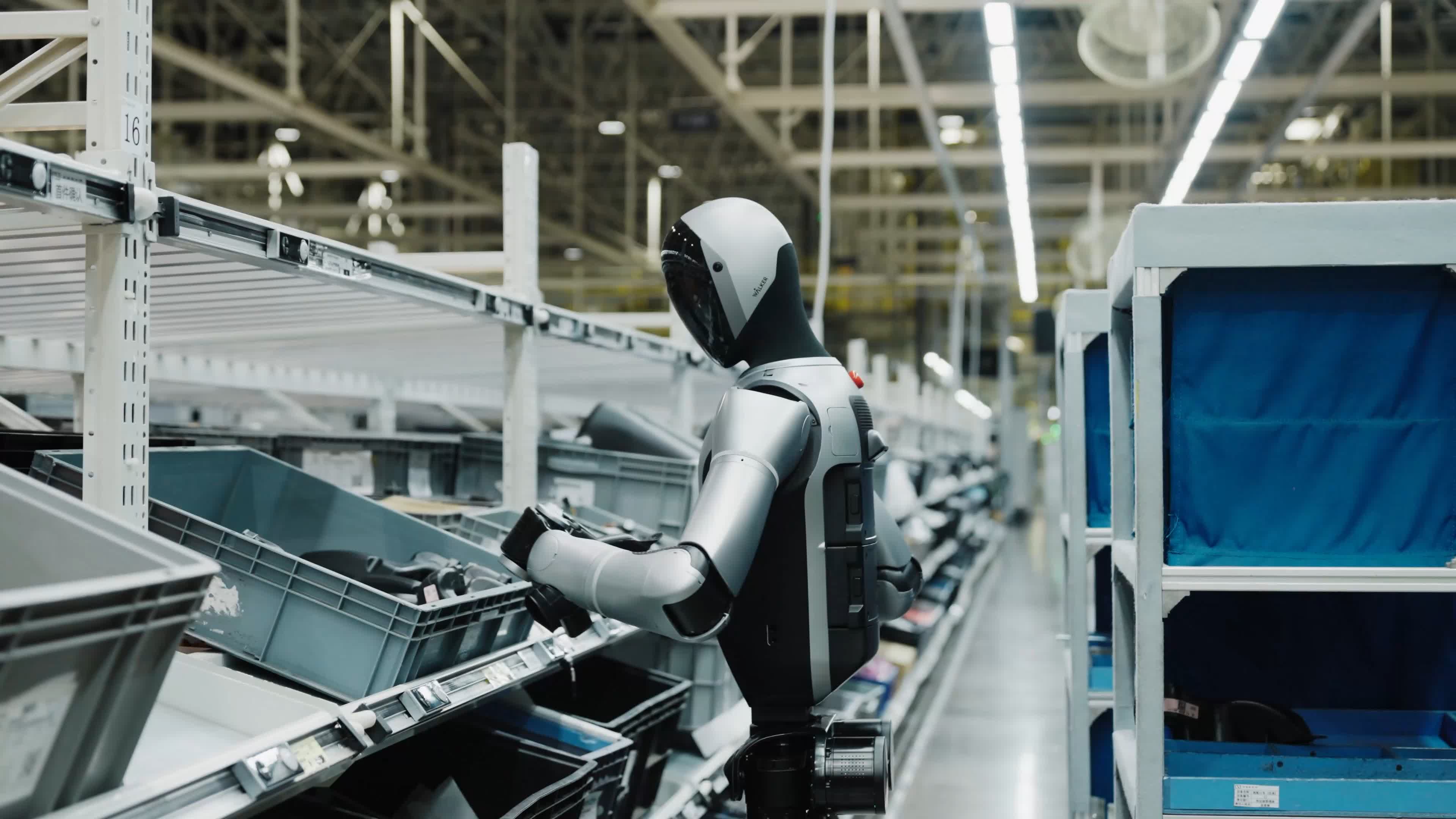
Daiwa Capital Markets analyst Kelvin Lau argued that while UBTech's goal of reaching 80 percent of human efficiency by 2027 is ambitious, it is not unrealistic. "It should be gradually improving," he said, noting that 80 percent of human efficiency could suffice for factories, since robots do not require breaks or holidays.

UBTech is competing alongside a growing group of domestic developers, including Dobot Robotics, Unitree Robotics, and X-Humanoid, all vying to define what a "factory humanoid" should be. Tesla's Optimus project has also raised expectations worldwide, even as it grapples with the same mechanical and computational constraints.

For now, the humanoid revolution remains more vision than transformation. UBTech's robots may still fall short of human dexterity and stamina, but their gradual climb in productivity demonstrates how China's manufacturing ambitions are translating into an incremental, data-driven evolution in applied robotics – one learning cycle at a time.

Image credit: The Financial Times

Permalink to story:

 
No healthcare costs, no workplace injury claims, no bogus calling in sick after [Big Sporting Event], no pay raise requests, no complaints about Employee X's BO, no workplace harassment claims, no half hour restroom breaks, no restrooms, no industrial espionage (heh, maybe...).

Not saying this is a good thing but from Mr. Richguy Company Owner's narrow perspective, you can see why they're trying this.
 
Makes sense if they only work half as slow as humans, if they work a 24hr shift they would be more than 1.5X more productive than a single shift of humans. No Unions, No required breaks, no healthcare, no pension/401K company matches, no sick days or PTO and no employee factory safety and health regulations.
 
30 to 50 percent of a human worker’s productivity is honestly the most realistic robot stat I’ve heard in years. We’re nowhere near iRobot, we’re still in the stage where the humanoid needs a tool change like it’s a Formula 1 pit stop.
 
30 to 50 percent of a human worker’s productivity is honestly the most realistic robot stat I’ve heard in years. We’re nowhere near iRobot, we’re still in the stage where the humanoid needs a tool change like it’s a Formula 1 pit stop.
I guess you're talking about humanoid robots? Otherwise I guess you've never been to a car production line.
 
I guess you're talking about humanoid robots? Otherwise I guess you've never been to a car production line.
Article about humanoid robots... so yeah. It is about human-like robots, yeah. He dont talk about arms and cranes or whatever they use in the automated factories, that's for sure. Yes, these are perfect, but the human robots are total junk as of right now. Sadly, any tech gets better with time.. so they will get better too. It probably wont take a 100 years either. Just a while ago, nobody had a computer in their pockets. Now we all do.
 
This article leaves me wondering why the government is so keen to encourage this when China has such a huge population that needs to find enough work to feed itself. They can (eventually) make the robots much more efficient and increase the production of junk to sell to the world but what will they do with the humans? Recycle them into cheap dog food?
 
I hope you all know people that will have their lives ruined by robots and AI and look them in the eye as you tell them how this is so good.

It is, for their stock price derived benefits.

Of course, the economy will eventually collapse from the strain of so many out of work and not participating in the economy, but that's a problem for later. Because CAPITALISM!
 
The only way for them to get better is to use them, gather data and when faster cpus and more memory is available, just implement that. they be very fast at 70-80% of human, with all the benefits of them not being human.

To anyone that say they need no breaks, they actually do. Battery has certain capacity. They need to be charged, serviced. Still cheaper than human and much more manageable.
 
We walk right into the same trap generation of the flood walked in. They destroyed themselves.

Don’t hope for universal base income to do any good. Half the population will end up on drugs and alcohol killing themselves off slowly, another half go crazy from pointless existence. You can’t expect anything replace human with a robot but what’s the point unless you plan to sell your products to robots.
 
"To offset labor shortages" huh ? Aren't those labor shortages something that they created by themselves?
 
I feel societies have already lost their mind. Think about this, people need work to earn money to spend. If people are not earning money because jobs are replaced by machines, who is going to spend to buy these goods? Or rather, who can afford to buy these goods or services? Hence, the idea of replacing human workers for robots is a very short sighted and irrational decision. Yes, you may be able to cut cost on paper, but your demand is going to tank.
Also, I feel we may be over simplifying the "cost savings" here. Cost is not just about the one time sunk cost of buying the robot. Robots uses electricity, so it can work 24/7, but I am not sure how much power you need to pay for each month just to keep them running. Then there are maintenance, repair and replacement cost to consider. We are assuming these robots will work flawlessly and will never fail. But in reality, we all know it is not the case. Lastly, in a place like China where labour is abundant and cost of labour is low, I really wonder if it is worth the cost of a robot (factoring the above other costs).
 
I feel societies have already lost their mind. Think about this, people need work to earn money to spend. If people are not earning money because jobs are replaced by machines, who is going to spend to buy these goods? Or rather, who can afford to buy these goods or services? Hence, the idea of replacing human workers for robots is a very short sighted and irrational decision. Yes, you may be able to cut cost on paper, but your demand is going to tank.
Also, I feel we may be over simplifying the "cost savings" here. Cost is not just about the one time sunk cost of buying the robot. Robots uses electricity, so it can work 24/7, but I am not sure how much power you need to pay for each month just to keep them running. Then there are maintenance, repair and replacement cost to consider. We are assuming these robots will work flawlessly and will never fail. But in reality, we all know it is not the case. Lastly, in a place like China where labour is abundant and cost of labour is low, I really wonder if it is worth the cost of a robot (factoring the above other costs).
At some point in all this there will have to be some form of "Universal Basic Income" for all. There is no way industry can sell their products to a perpetually unemployed, broke populace.
 
I feel societies have already lost their mind. Think about this, people need work to earn money to spend. If people are not earning money because jobs are replaced by machines, who is going to spend to buy these goods? Or rather, who can afford to buy these goods or services? Hence, the idea of replacing human workers for robots is a very short sighted and irrational decision. Yes, you may be able to cut cost on paper, but your demand is going to tank.
Also, I feel we may be over simplifying the "cost savings" here. Cost is not just about the one time sunk cost of buying the robot. Robots uses electricity, so it can work 24/7, but I am not sure how much power you need to pay for each month just to keep them running. Then there are maintenance, repair and replacement cost to consider. We are assuming these robots will work flawlessly and will never fail. But in reality, we all know it is not the case. Lastly, in a place like China where labour is abundant and cost of labour is low, I really wonder if it is worth the cost of a robot (factoring the above other costs).
My question is why this is not worrying ultra rich a lot. Do they really think they are going to escape being taxed many times more than right now if even 30% of current workforce cannot find a job.
Do something, you fools. Create jobs, save your money.
 
This makes sense from a strategic perspective. Robotics allows for the decoupling of industrial output from an aging population and avoids your population becoming "too expensive" for factories as your GDP per capita rises.

China always seems to be playing the long game while we lurch from election to election and crisis to crisis.
 
Back