Valve says its loot boxes are more like trading cards than gambling

Skye Jacobs

Posts: 2,030   +59
Staff
The big picture: Valve is preparing to challenge New York's effort to classify its loot box systems as illegal gambling. The complaint frames Valve's design as an online casino, pointing to slot machine – like animations and alleging particular harm to minors, whom James says are being conditioned to gamble. Valve sees the case as a test of how digital item economies should be regulated in the state and potentially beyond.
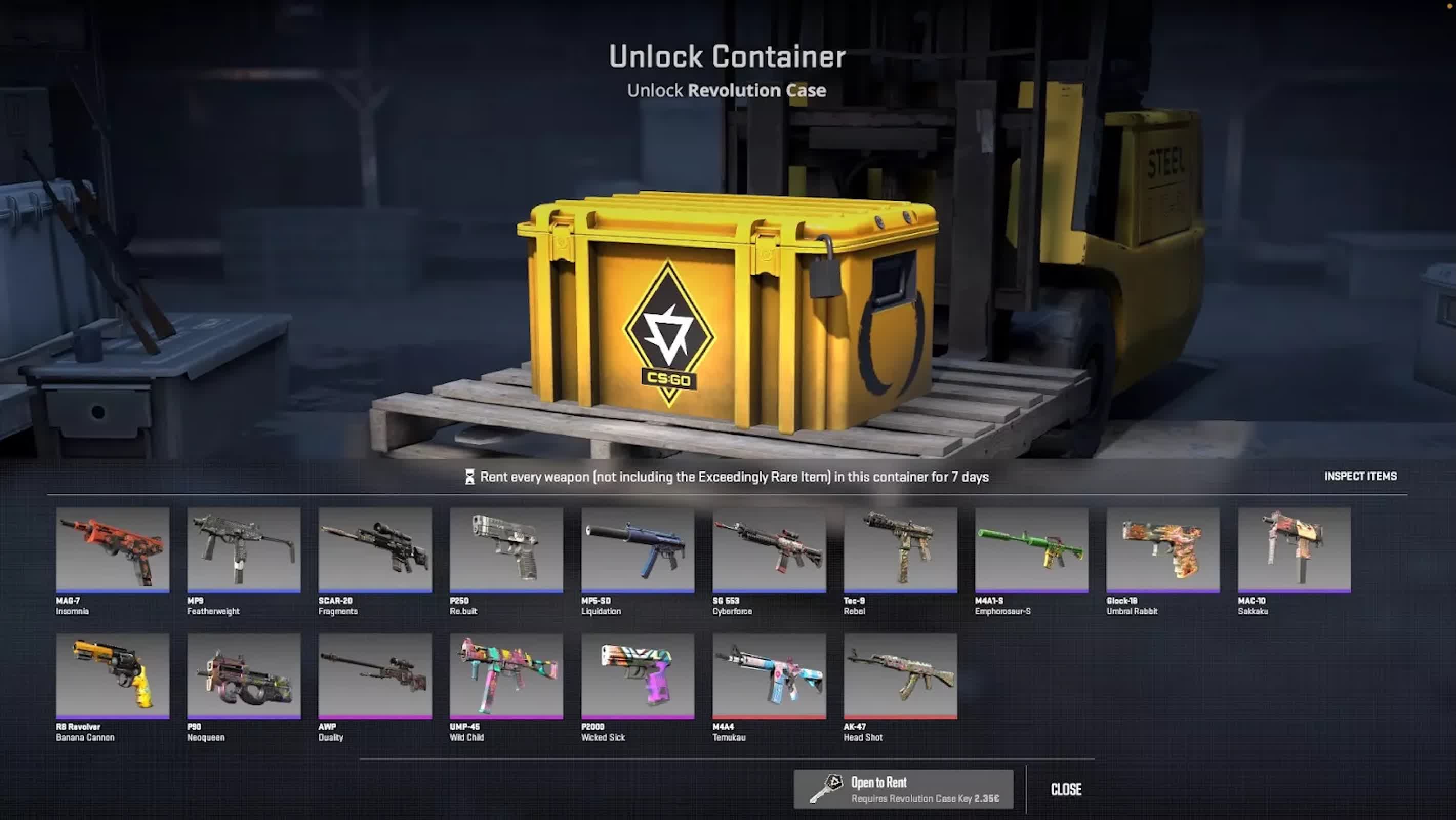
New York Attorney General Letitia James sued Valve in February, arguing that mystery boxes in Counter-Strike 2, Dota 2, and Team Fortress 2 constitute "quintessential gambling" because players pay for a chance to obtain rare cosmetic items that can carry significant monetary value and be traded for real money.

Valve's response, published on a dedicated Steam Support page, challenges that premise on both legal and technical grounds. The company argues that its mystery boxes – crates, cases, and chests – fall within a much older model of randomized collectibles, equating them to baseball card packs, Magic: The Gathering and Pokémon card boosters, blind boxes, and Labubu figurines, where buyers have long accepted probabilistic rewards and secondary markets.

Valve stresses that these items are purely cosmetic, do not affect gameplay, and that "most" players never open boxes at all, instead playing without engaging with the loot economy.
Under the hood, Valve has built a tradable-item economy around these cosmetics, presenting it as a consumer-friendly feature rather than a gambling vector. Skins and other drops can be transferred through Steam Trading or sold between users on the Community Market, which Valve says mirrors how physical cards are traded or sold in hobby markets.

The New York attorney general has reportedly pushed to strip transferability from these digital items, but Valve says it "refuse[s] to do that," describing the ability to move items between users as a fundamental right that should not be removed.

At the same time, Valve outlines a series of technical countermeasures designed to curb third-party gambling around these items. The company says it has locked more than a million Steam accounts that were being misused by third-party operators for gambling, fraud, or theft, and has introduced features like trade reversals and trade cooldowns to make it harder for skin-betting sites to exploit users and inventory flows. Valve also prohibits gambling-related businesses from sponsoring tournaments for its games and insists that it does not cooperate with gambling sites.

A key point of friction is data collection and geo-compliance. Valve says New York wanted it to deploy invasive technologies globally to detect users masking their location – for example, via VPNs – and to gather more personal data for age verification than it currently does during payment processing, despite many payment methods already performing their own age checks. Valve argues that expanding surveillance and data retention in this way would undermine user privacy and exceed what New York law currently requires.

On the policy side, Valve says it will comply with any loot box – specific laws the New York legislature passes, but contends that the attorney general is effectively trying to enforce rules that do not yet exist and push obligations beyond the state's borders. The company also objects to rhetoric linking games to real-world violence, pointing to studies it says show no causal connection and arguing that such claims are a familiar mischaracterization of the medium.

For now, both sides are staking out positions that could reshape how randomized monetization and item trading function in one of the largest digital game ecosystems. Valve has told New York players that it is ready to defend its systems in court rather than accept a settlement it believes would harm users, third-party developers, and its ability to experiment with game design.

Permalink to story:

 
Valve's attitude makes them look bad.
As in "evil".
While I don't do business with them from now on that's a hard rule.

Still, maybe I just don't get it (I may be stupid and not know it) but to me it seems that people who BUY games in which they have to spend REAL MONEY are kind of beyond help anyway.
It seems hard if not impossible to protect people who've already gone off the deep end from themselves.
 
Loot boxes are a scam and so is government surveillance. Money money money. It makes the world go around and ethics go down.
Thing is its really easy to avoid loot boxes (simply don't buy them), but avoiding government surveillance efforts is a lot more difficult.

That said, I agree with Valve here; if loot boxes (as implemented in Valve's games) are gambling, then any sort of "mystery box" type purchase should also qualify as gambling. I would have to see the specifics of New York state's gambling laws and how they define gambling to see if loot boxes would even qualify. Frankly it seems like the New York state government is just using this as an excuse to shake Valve down for some cash and push more privacy invasion.
 
Thing is its really easy to avoid loot boxes (simply don't buy them), but avoiding government surveillance efforts is a lot more difficult.

That said, I agree with Valve here; if loot boxes (as implemented in Valve's games) are gambling, then any sort of "mystery box" type purchase should also qualify as gambling. I would have to see the specifics of New York state's gambling laws and how they define gambling to see if loot boxes would even qualify. Frankly it seems like the New York state government is just using this as an excuse to shake Valve down for some cash and push more privacy invasion.

Trading cards are physical products that the company themselves don’t benefit from after POS. Valve on the other hard generates infinite amounts of digital cosmetics, sells them in loot boxes and then profits again when they’re sold on their own platform. Ultimately it’s a real world collectible item vs a pseudo digital currency. They also turn a blind eye to illegal gambling on third party sights
 
Okay, I didn’t realise you could trade what you get from loot boxes with other players on valves games, I stopped playing TF2 when it went free-to-play and was never a DOTA or CS fan.

That makes the attack on Valve specifically even more questionable, EA, Epic, Activision Blizzard, theres no trading with other players, you just keep pulling that slot machine until you’ve spent a small fortune and finally gotten the item you wanted.

Seems like the others would have been an easier target to me.
 
If you want to offer entertainment, you must provide meta-stable forms of tension that evoke feelings. Recording a peaceful aquarium for two hours will not likely result in footage that could pass as a blockbuster movie, people would not stand in line outside theaters to buy tickets to watch it. A movie must have stakes, conflict, fights, explosions, plot lines with unexpected twists, emotional arcs, or, in other words, forms of tension. The same applies to entertainment via games; the randomness(the thrill of the random change) of loot boxes is a form of tension. It is a fundamental part of entertainment and the fact that it can be monetized is a secondary consideration.

Right now, I do not know for sure the exact reasons why lawmakers view gambling as harmful, but I suspect (maybe I am wrong and it’s only for tax reasons) it is because gambling is unproductive, it can easily scale up and cause economic damage to the person, it is addictive (because it is entertaining), and other similar factors that create a bad mix. Therefore, I suspect the lawmakers do not want young people to become familiar with that framework. Okay. But from another perspective, people give their money to buy entertainment and they cannot derive satisfaction without elements like "gambling," “violence”, “sex”, etc. They are teenagers and they are not intellectually mature enough to find satisfaction in the abstract tension that a chessboard can offer. Especially when even those who are intellectually mature get bored after some time with that type of abstract tension.

This is not a blockbuster movie
 
Okay, I didn’t realise you could trade what you get from loot boxes with other players on valves games, I stopped playing TF2 when it went free-to-play and was never a DOTA or CS fan.

That makes the attack on Valve specifically even more questionable, EA, Epic, Activision Blizzard, theres no trading with other players, you just keep pulling that slot machine until you’ve spent a small fortune and finally gotten the item you wanted.

Seems like the others would have been an easier target to me.
The fact that items in Valve's lootboxes have cash value is why Valve is a target.
 
Thing is its really easy to avoid loot boxes (simply don't buy them), but avoiding government surveillance efforts is a lot more difficult.

That said, I agree with Valve here; if loot boxes (as implemented in Valve's games) are gambling, then any sort of "mystery box" type purchase should also qualify as gambling. I would have to see the specifics of New York state's gambling laws and how they define gambling to see if loot boxes would even qualify. Frankly it seems like the New York state government is just using this as an excuse to shake Valve down for some cash and push more privacy invasion.

-----
In Valve’s most popular game, the process resembles a slot machine, with an animated spinning wheel that eventually rests on a selected item. The randomly selected virtual items have no in-game functionality but can be sold online for money, with one item reportedly being sold for more than $1 million.
-----

THAT is a digital lottery that crosses state lines. NY is 1000% right to challenge and shut down the game forever, or force valve to end the lootbox based on geo.

Also on privacy... you have a cell phone. so you have no privacy.
 
New York runs a lottery. It also has laws allowing pari-mutuel racing, charitable bingo, commercial casinos, and mobile sports betting. I'm seeing neither moral high ground nor obvious legislative intent here.

I'm also not a fan of DAs using the legal process to roll the dice on how laws written on one topic might be morphed into new, unpassed, laws on an adjacent topic. That's what the legislative branch is for and if it is the actual will of New Yorkers to ban loot boxes they have a clear mechanism to do so that comes with the advantage of no one being left to guess exactly what the rules or limits are.

If I was the DA I would have maybe written a letter to legislators with suggested legislation, or simply outlining or my concerns, or perhaps concluded that this was not yet my job to worry about given lots of actual crime reports from citizen-victims still awaiting justice on their case.
 
The fact that items in Valve's lootboxes have cash value is why Valve is a target.
And that's precisely why they're closer to trading cards than slot machines with valueless winnings.
So do trading cards. So does literally everything in the world.
Well... That's not always true, in EA games, lets take Battlefront 2 as an example, you've spent $3000 on loot boxes to finally get Darth Vader as a playable character, but unlike Valve games, you cannot trade this, you cannot sell it, it's just stuck on your account.

So is it worth anything? You've spent $3000 to get it, but you cannot re-sell or trade it in for something else, so does it have value? EA will eventually turn off the servers and remove your access to it at some point in the future, which could be tomorrow, it could be 10 years, but it will happen eventually, so does it hold any value?
 
Trading cards that you bought with real money, inside a game, that then sell on grey markets for the price of a used car. Classic Pokémon stuff...
 
Valve comparing loot boxes to baseball cards is technically correct, but baseball cards never came with neon lights, spinning animations, and a dopamine soundtrack that screams jackpot.
 
Valve comparing loot boxes to baseball cards is technically correct, but baseball cards never came with neon lights, spinning animations, and a dopamine soundtrack that screams jackpot.
They’re also cards to play a game, valve customaries have no functional value
 
Back