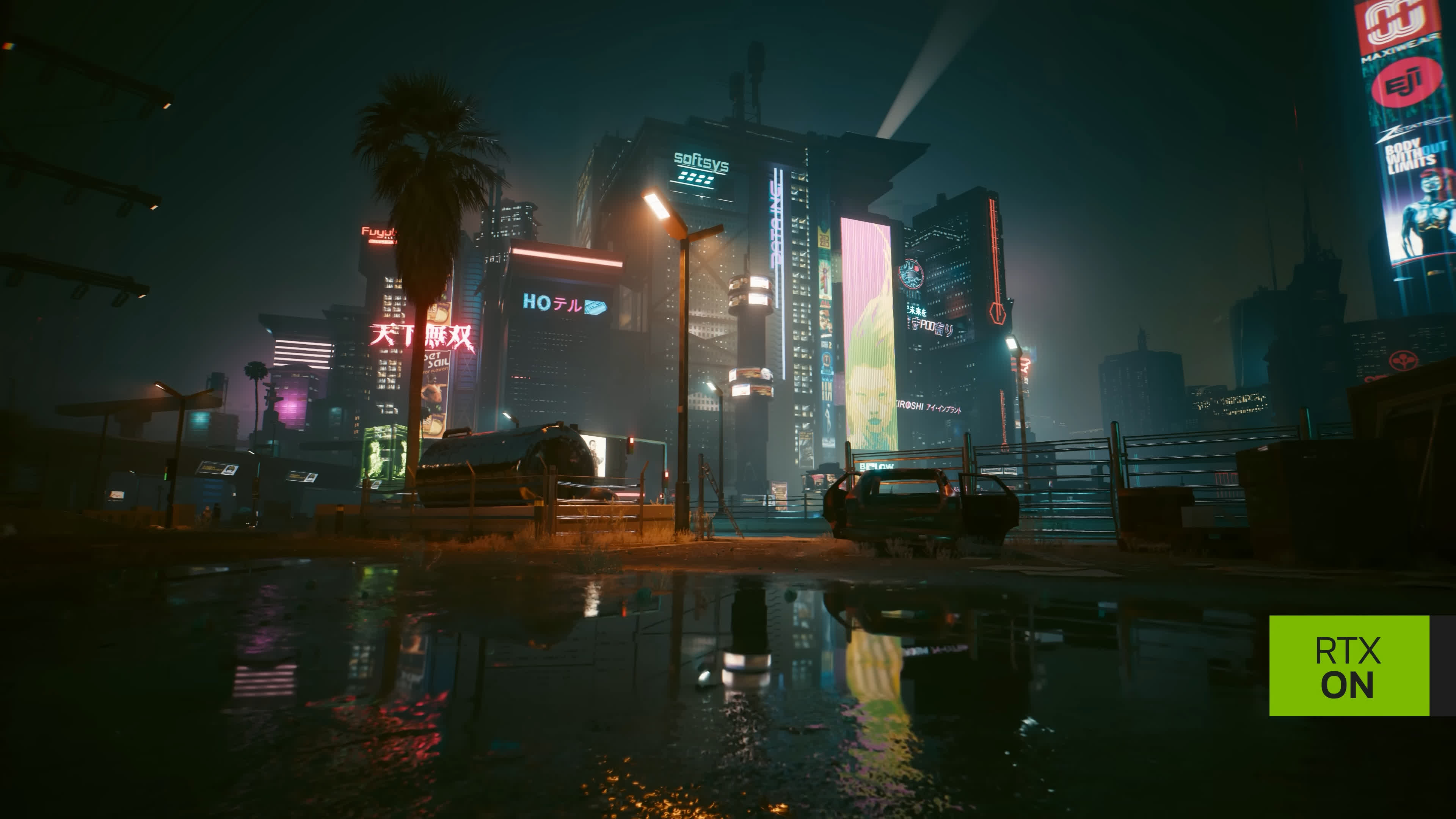
Was Ray Tracing a Scam?

I've always believed that a new graphics quality option should deliver a significant visual leap without crippling performance. RT degrades performance, but nothing else. How can we accept having mirror-like reflections in the street, like in Cyberpunk 2077, when we're aiming for photorealism or beautiful shadows that appear to be nothing more than higher contrast in those areas? When I think about DLSS, which is just a band-aid solution for the disappointing raster performance at standard resolutions these days, it disgusts me even more.
 
I'm not one of these FPS obsessed tech gooners who's running cards though benchmarks.
My measurement for tech is: "is it fun to play and does it look good".

I had the 2080Ti and it came with Call of Duty: Modern Warfare. Ifelt the graphics were some of the best I'd seen up till then and I accepted Ray Tracing.

Then I got Cyberpunk 2077. I upgraded that week to the 3090 which visually ran smoother than my 2080Ti. That game easily had the best graphics effects I'd ever seen in any game ever.

Now I'm playing Battlefield 6 on my 5090. Easily the best multiplayer war graphics I've seen to date.

So I ask myself: is Ray Tracing worth it?

Well: I personally think Nvidia arbitrarily raised the bar and changed the goal post. AMD can't compete with Nvidia and that's obvious. The reality is: Nvidia's cards are second to none.

Ray Tracing and DLSS are just two AI technologies along with noise cancellation which raise the bar. I think we could do without Frame generation, however.

In the long run, the end goal is that less-expensive, lower-end laptops, mini-PC and desktops will benefit from these technologies by allowing them access to the same high-end gaming as those wasting thousands of dollars to rebuild their machines every time a new piece of tech comes out.

Considering the way things are going: prebuilts could end up being the only option as the hardware manufacturers get starved for cost-effective parts.
 
I think RT was just the next PhysX, something for nVidia to say they could do that AMD couldn't.

Game developers slapped PhysX into games and made it part of the experience which made the games run far better on nvidia hardware than it did on AMD hardware. Here they did the same with RT. Without it there isn't much reason to buy Nvidia hardware unless you want the fastest GPU availalbe and money is no object.
 
What this article is basically saying is that most of those who bought RTX 2000 -series card "because it has ray tracing" were brainwashed by Jensen. That is something many (including myself) have been saying for years. And even when they realize they were indeed scammed, they still believe anything that Jensen says. No wonder AMD has no interest competing on high end market.
 
Nothing better than getting a game and enabling Ray Tracing when you play it. /s

That upwards of 50% hit to your performance is now overshadowed by upscaling software that wouldn't even need to be around if Nvidia (and AMD) didn't need a way to boost your performance for enabling RT.

I thought 3 generations would give them enough time (AMD and/or Nvidia) to get ray tracing to a point it would become more of a norm in gaming, but neither of them have made any improvements on it. Clearly I was mistaken.

When rasterization performance goes up, the RT performance would improve, but that's only because the hit to your high FPS still left you with high enough FPS to give you a smooth performance. The problem was, even after every generation of new GPUs the hit to FPS was nearly the same across the board.

Enabling RT, going off 1080p:
RTX 3090 roughly 33% loss on average from what I can find
RTX 4090 roughly 31% loss on average from what I can find
RTX 5090 roughly 30% loss on average from what I can find

As you can see the loss is pretty much the same for the top-tier GPUs of the past 3 generations. You're always going to lose out on around 30% performance. Because RT performance wasn't improving, something had to be done and that is when upscaling was pushed out; DLSS because of the massive loss to performance that RT gave us when the RTX 20xx series came out.

This brings in other problems that are somewhat fixed over the version upgrades, but they're still there; blurriness, smearing/smudging, ghosting, over sharpening, shimmering

Now that Nvidia (and AMD) are working on trying to best each other with their upscaling and "improved ray tracing", both have become lacking in the rasterization gains since the introduction of Ampere/RDNA 2:
Here's Nvidia, going off 1080p:
2080Ti to 3090 = 21% gain
3090 to 4090 = 20% gain
4090 to 5090 = 11% gain

2080 to 3080 = 35% gain
3080 to 4080 = 23% gain
4080 to 5080 = 7% gain

2070 to 3070 = 39% gain
3070 to 4070 = 20% gain
4070 to 5070 = 4% gain

With the abysmal gains in rasterization performance, the RT performance feels lack luster as well. Now they need a way give more FPS without actually giving more FPS so they introduce frame generation. However, this also adds in more issues such as; increased latency, ghosting, smearing

To address latency from Nvidia they give you Reflex. To address latency from AMD they give you Anti-Lag.

This has been one long crappy journey to "improve" ray tracing from these companies. On this journey rasterization gains have plummeted, multiple new software "fixes" have been introduced to only give us more problems and you have people on all sides praising these software additions because they think they make the games better? To each their own, but come on.....this feels like a farce. These companies are doing little to improve actual performance and are just masking their failings with more and more software. Perhaps I'm too harsh, but from where I sit I have been given zero reasons to upgrade my GPU in the past nearly 5 years and with the direction generational gains have been going I don't expect to see any real improvement there with the next gen either.
 
RT is also appealing form a game developer point of view. Game developers use a lot of tricks and clever ingenuity to make "realistic looking" shadows and lighting. Shadow maps, parallax maps, ambient light sources, render distance optimizations and on and on and on. All of this takes a lot of effort and skill to do right but developers do it because that's what players expect.

RT promises a simpler design. You draw the polygons, put your main light source, and everything just works. Red surfaces naturally reflect red, water surfaces naturally sparkle.
 
What this article is basically saying is that most of those who bought RTX 2000 -series card "because it has ray tracing" were brainwashed by Jensen. That is something many (including myself) have been saying for years. And even when they realize they were indeed scammed, they still believe anything that Jensen says. No wonder AMD has no interest competing on high end market.
Maaaaan, I was right there back in the old PhysX days. I remember picking up a BFGTech Geforce GTX 260 MAX OC for PhyisX and then barely used it because most games used Havoc anyway. lol

I stayed on team green for 2 more generations of GPUs that self-destructed due to overheating after a driver update. Then I jumped ship.
 
What is the point on having best visual with whatever hardware if you need a nuclear power plant as you house. I would never run a 5090 in my house. Everything above 200 w on gpu is too much, and 5070 or 9070 are already too much. So they should inovate even more. Current visuals is enough for now.
 
RT is also appealing form a game developer point of view. Game developers use a lot of tricks and clever ingenuity to make "realistic looking" shadows and lighting. Shadow maps, parallax maps, ambient light sources, render distance optimizations and on and on and on. All of this takes a lot of effort and skill to do right but developers do it because that's what players expect.

RT promises a simpler design. You draw the polygons, put your main light source, and everything just works. Red surfaces naturally reflect red, water surfaces naturally sparkle.

Yup. RT's "problem" is that devs became very skilled at emulating RT over the last couple of decades.
 
Nothing like watering down the word "scam" because a feature was under-delivered and/or overhyped. Nothing about it was illicit or fraudulent. And it was never about gameplay, it was about the industry's weird push for realism above all else (which doesn't really add to gameplay).

Might as well try convincing me that 3D movies were also a scam (another tech that under-delivered and was overhyped).
 
Ray tracing was never about improving gamplay, but about improving visuals, and getting more realistic graphics. Personally I´ve had an RTX 2060 Super, then for work reasons had to change my dektop for a laptop with an RTX 3070 mobile, and now im back to a Desktop with an 4080 Super.

Ever since I had the 2060 Super Ive always tried to make ray tracing work, using optimized settings from DF to mirror a PS5 is a good start but for me, it was a must, I play mostly single player games and prefer eye candy over frames per second everytime. I used to aim for 40 fps on a 120 hz display, used to play at 30 fps back in the day so 40 fps is a huge upgrade.

I remember playing Control with Ray Tracing on the RTX 2060 Super with DLSS and it looked amazing could never go back to raster for sure, also had a great time with the Guardians of the Galaxy and Resident Evil Village with RTX on. And even Cyberpunk on the 3070 Laptop, turning RTX off was never one of my options.

Recently I played Alan Wake 2, Indiana Jones, Resident Evil 9, Pragmata, all of them with RTX, for me is a must have technology, so it really depends on your tastes in games and priorities.

Of course that does not mean it should be mandatory as there will always be a need for a lighter engine for weaker hardware but other than that Ive enjoyed RTX in games a lot even on my old 2060 Super with the right compromises
 
I usually disable all of this post-processing garbage down to motion blur.

Most of it is a stack of tech meant to mitigate the issues of each preceding gimmick.

Quality game development from a competent team within supportive conditions exists and doesn't require rays to be traced or frames to be generated. The results demolish anything else. Always have.

Cyberpunk is the dead horse publications love to beat on because it was the corporate lovechild of CDPR and Nvidia. Why? Because developers had to be compensated and supported to even care about the tech. Nvidia will never reach out like that again, so the tech will slowly die or become trivialized.
 
I think RT was just the next PhysX, something for nVidia to say they could do that AMD couldn't.

Game developers slapped PhysX into games and made it part of the experience which made the games run far better on nvidia hardware than it did on AMD hardware. Here they did the same with RT. Without it there isn't much reason to buy Nvidia hardware unless you want the fastest GPU availalbe and money is no object.
I miss physx. Still find it funny my deciders system can run Arkham asylum maxed out better than my main system because of Physx.
 
Think about the other side:

All that transistor budget, all that CUDA count that was drained on RT cores, tensors and FP/Int divided cudas - maybe if it all went to pure OG style GPC and we got 100K cuda by now, we would get the same RT/PT perfomance, but 10x raster? OR better perf overall?

Maybe I miss a point or two, but not more, cuz the fact that they went with neural cudas in Blackwell
 
Well, every next generation of RTX cards was supposed to be the one that will allow RT with good framerates but that was only possible with first and second fastest card in the lineup and without DLSS it was poor. And I always questioned whether developers were intentionally lowering raster graphics quality to push for RT usage. RT introduced a new segment in benchmarks which made Nvidia look dominant and certainly many people bought these cards because of RT advertising but never actually used it.

 
The truth is, I was never fully sold on the ray tracing dream.
Now, see—that is the whole problem with this discussion. How can you not be? How can you not want better visuals? Ray tracing and path tracing are obviously the way towards that. How do you think Pixar and animated movies are made? Movies like Avatar, etc.—they have been made with path tracing for a long time. What are we even talking about here?

This whole discussion is disingenuous.
 
Well, every next generation of RTX cards was supposed to be the one that will allow RT with good framerates but that was only possible with first and second fastest card in the lineup and without DLSS it was poor. And I always questioned whether developers were intentionally lowering raster graphics quality to push for RT usage. RT introduced a new segment in benchmarks which made Nvidia look dominant and certainly many people bought these cards because of RT advertising but never actually used it.
Just like with 4K. It's been "4K ready" since the 980 Ti, yet, we still can't get even stable 60 FPS.

All we get is 1000+ Hz monitors. Because rationality.
 
RT GI alone is enough reason for me to like RT. It makes worlds so much more realistic.

But you need at the very least RTX 3090(ti) level of RT capabilities to make it a playable experience. And if Nvidia wanted to make it to be a real success, they should have given all cards at least that level of RT performance starting with the 30 series.
 
Back