
The big picture: Although consumers have largely transitioned to fast and durable solid-state drives, data centers and other sectors requiring mass storage still rely on disk drives. Competitors Western Digital and Seagate have spent years pushing the limits of HDD storage, developing various technologies to edge past the 30TB mark while reducing costs and power consumption.
Western Digital recently announced new data center HDDs that increase Shingled Magnetic Recording (SMR) capacity to 32TB and Conventional Magnetic Recording (CMR) capacity to 26TB. The company achieved these unprecedented capacities by squeezing an 11th platter to the industry-standard HDD form factor, making the new products compatible with existing infrastructure.
The 32TB Ultrastar DC HC690 represents the next step in Western Digital's implementation of Ultra Shingled Magnetic Recording (UltraSMR) technology, which arranges data tracks in overlapping layers. Meanwhile, the 26TB HD590 offers a more cost-effective solution for clients who prefer the mature CMR technology.
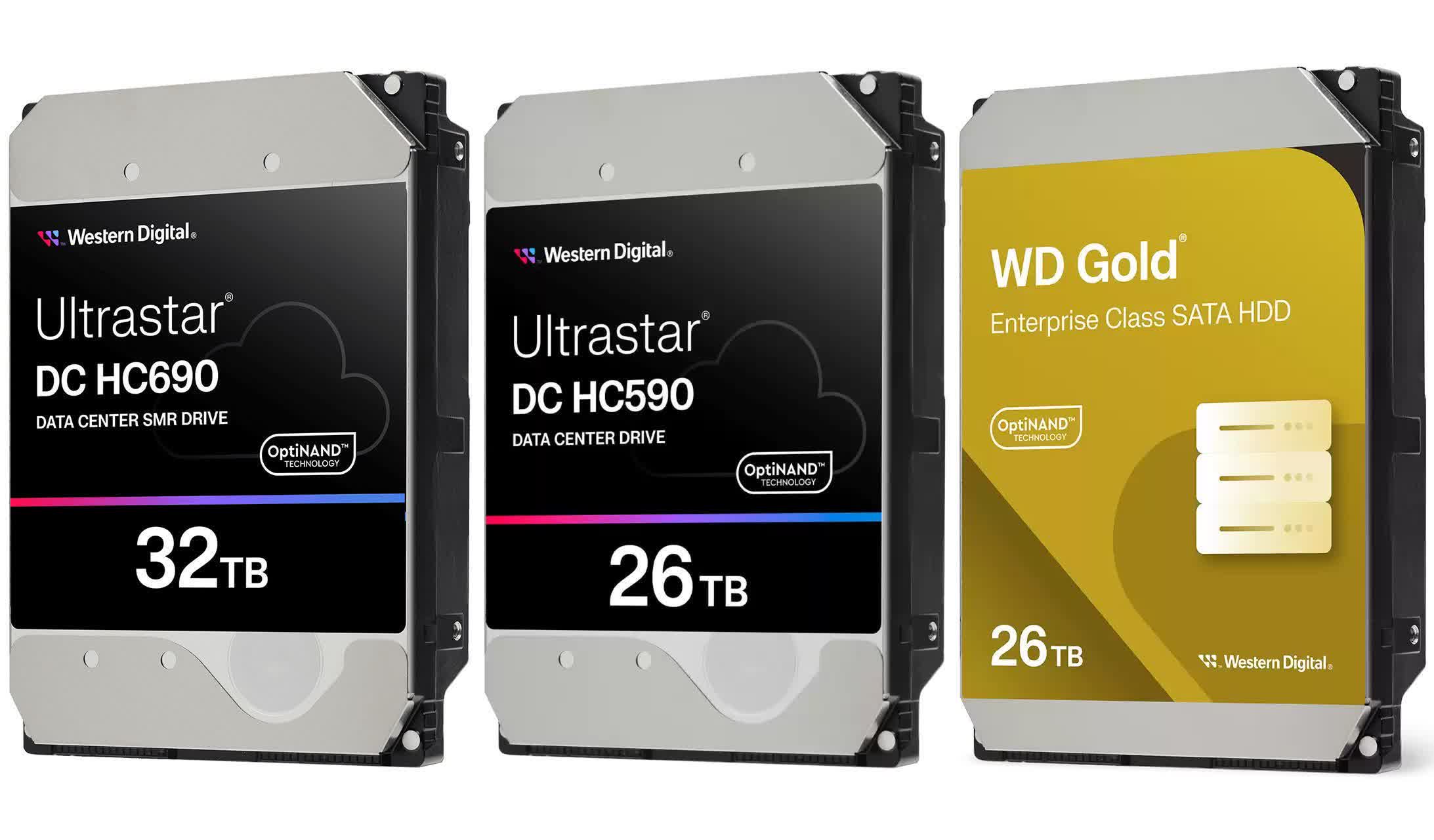
Both products also use Energy-Assisted Perpendicular Magnetic Recording (ePMR), which employs additional electric currents to increase the areal density of bits written to the disk. However, the primary boost in capacity came from the addition of the extra platter.
Traditionally, hard drives contain up to 10 platters within the industry-standard dimensions. While adding more platters is a straightforward way to increase capacity, it can limit adoption by requiring clients to adapt to new, larger form factors.

As a result, companies like Western Digital and Seagate have focused much of their innovation on increasing the data stored per platter. This is the main purpose of ePMR, but Seagate recently introduced 32TB HDDs using Heat-Assisted Magnetic Recording (HAMR). Seagate has spent years developing HAMR, which temporarily heats tiny sections of the disk to increase data density without disrupting magnetic stability.
In contrast, WD achieved its 11-platter design for both SMR and CMR drives by reducing the space between platters and optimizing the surrounding mechanical components. The company made improvements to the suspension system, circuit board, disk stack, and read/write head to accommodate the extra platter.
These changes increased storage capacity while maintaining compatibility with existing server racks, all without increasing power consumption. Western Digital aims to eventually reach 50TB capacity through similar methods in the future.
Meanwhile, both Seagate and Western Digital are pushing other recording technologies to steadily increase capacity over the next several years. Industry forecasts suggest that 60TB HDDs could arrive by 2028. Seagate is targeting 100TB by 2030, though analysts believe this milestone may not be achievable before 2037.
WD unveils new high-capacity 32TB SMR and 26TB CMR disk drives


