Windows will soon grade your PC's security, and apps like Battle.net get to see the score

zohaibahd

Posts: 1,038   +24
Staff
The big picture: Plenty of online PC games already refuse to launch unless Secure Boot is enabled. Microsoft now wants to turn checks like that into one standard question that any Windows 11 app can ask your PC. If the answer comes back no, the developer decides what happens next. Some apps may just show a warning; others could refuse to run altogether.
Microsoft calls the feature Windows baseline protection. Insiders can already try it, though a broader release isn't planned until 2027. None of the protections it checks are actually new. The feature simply rolls eight existing ones into a single pass-or-fail result. Those include TPM 2.0, Secure Boot, virtualization-based security, and memory integrity, along with a few rules that stop unsigned or known-flawed drivers from loading.

Ironically, Microsoft's own advice could trip up some gamers. Back in 2022, it suggested turning off memory integrity to claw back a few frames. Windows began switching the feature on automatically in October, but PCs where someone disabled it by hand are left alone, so those machines fail the check.

Secure Boot causes the same problem for anyone who switched it off to dual-boot Linux. Those PCs already can't play Battlefield 6, since its anti-cheat demands Secure Boot too.
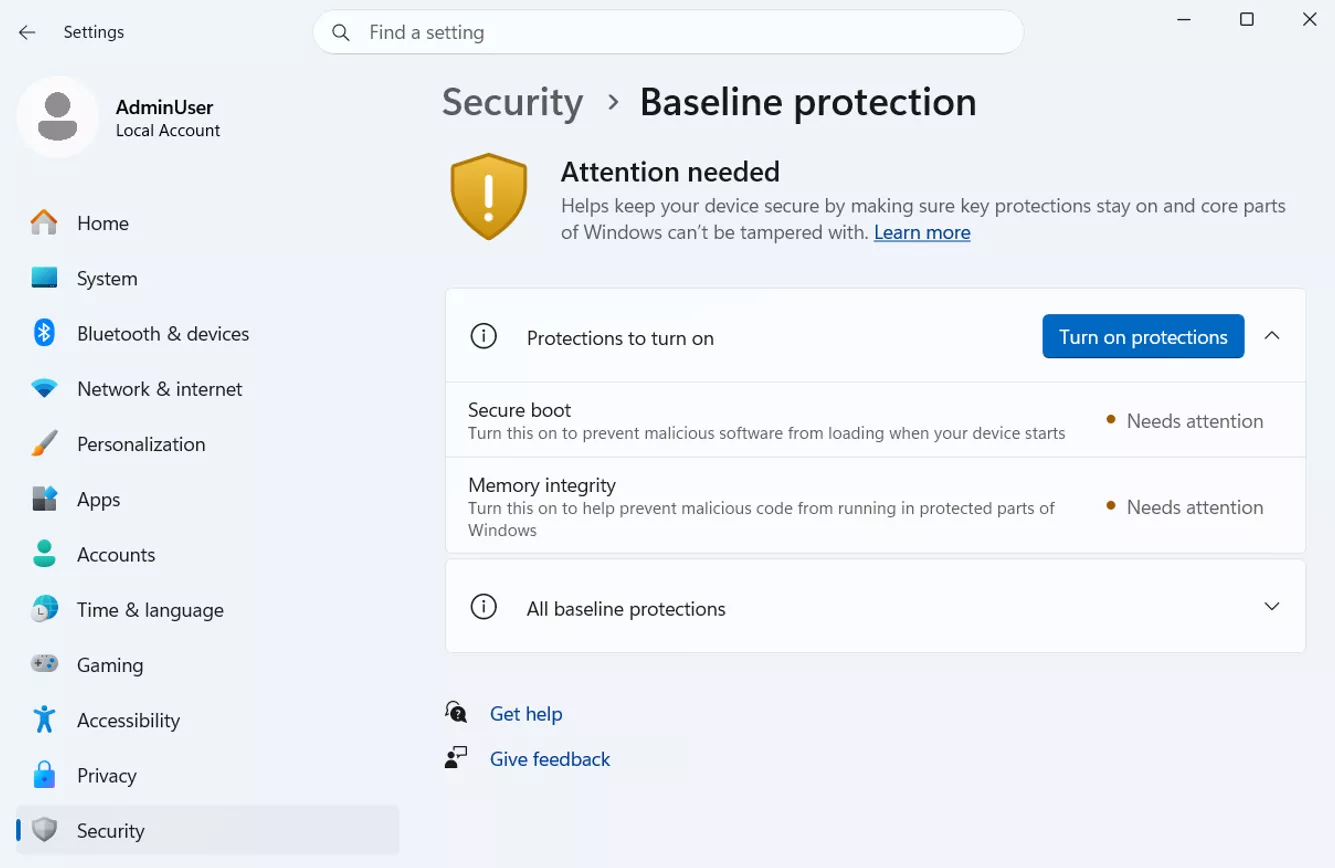
Most of this can be fixed from a new Baseline protection page under Settings > Security. A single button there turns on whatever Windows can handle by itself, then restarts the PC. Secure Boot still means a trip into the UEFI menu, but Windows will at least walk users through it with a QR code.

On the developer side, apps can ask for a plain yes or no or for a list of exactly what's missing. For higher-stakes cases, Windows can also hand over a hardware-backed token that the developer verifies on its own servers. As Windows Latest points out, that's much harder to spoof than a check running on the PC itself.

Adobe, Battle.net, 1Password and exam software maker Schoolyear are already testing the feature. Microsoft's own blog post lists launcher app Raycast as an early partner, too. Schoolyear has the clearest use for it so far. The company says it checks a student's PC against the standard before an exam starts. That said, none of these companies has announced plans to actually lock out PCs that fail.

Even so, the check makes that kind of lockout much easier to set up. Until now, any app that wanted to vet a PC's security had to build its own check, like Battlefield's anti-cheat does. Now Windows hands over the answer ready-made, so far more developers could start asking for it.

The bar those apps check against will keep moving, too. Microsoft plans to raise it with each new version of the baseline, so a PC that clears it now could fall short later.

Permalink to story:

 
Great, its the windows equivalent of the android safetynet, fantastic backsliding and I was going to say a reason to be on Linux again as a Linux user, but this will make wine more complicated if it has to emulate these safety checks and get past them (if it can)
 
Great, its the windows equivalent of the android safetynet, fantastic backsliding and I was going to say a reason to be on Linux again as a Linux user, but this will make wine more complicated if it has to emulate these safety checks and get past them (if it can)
I was thinking that this seems like MS's way to maintaining a grip on the PC market. I see that Valve is dumping stupid amounts of money into developing Arch and even developing it's own ARM compatibility layers. I have a feeling we will see Steam on Android in a few years. I see Valve's ARM development as a big push to get things working better on Mac's with then benefit of opening up anyone with an ARM phone to their platform. ARM gets hated on a lot, but the GPUs on lots of ARM devices are actually pretty powerful.

Anyway, seeing most of what I want to use Linux for I have started learning Arch more and transfering myself away from Ubuntu. Ubuntu is getting over zealous at I see lots of Ubuntu based distros making Debian editions. I've been using Ubuntu for over 10 years and dailying it on on devices for around 4. I can basically think like an ubuntu system so tranfsering to Arch hasn't exactly been easy. I still recommend something Ubuntu or Ubuntu based for new years but I have a feeling over the next few years we're going to see Arch take the lead. Arch's biggest problem has always been elitism and gatekeeping. SteamOS is Archbased and CachyOS is extremely popular right now. I actually think it's funny watching how mad Arch Users get seeing how popular CachyOS is.
 
Great, its the windows equivalent of the android safetynet, fantastic backsliding and I was going to say a reason to be on Linux again as a Linux user, but this will make wine more complicated if it has to emulate these safety checks and get past them (if it can)
The solution to this is to not play games that require invasive "safety" measures to play.

Give us private servers again or we wont play. Simple as.
 
I don't know how to reconcile my thoughts on this one.

On the one hand, it appears I would actually benefit: this wouldn't stop anything I'm doing, and I very much appreciate the security for my work and personal data, and I don't like being cheated against in multiplayer games (although I don't play the type where it's really a big concern.) And if platform lockdown eventually resulted in me paying a little more to Microsoft, it's just not that big a deal in my overall budget. I've never jailbroken any of my iPhones and never felt I was missing anything -- I just like that they are generally reliable appliances for the few things I do on them.

On the other, I can't help but feel open platforms serve an important or at least entertaining and fulfilling purpose.

Maybe we'll see a bifurcation where boring routine everyday tasks & multi-player games move to more locked down platforms, and hobbyists and enthusiasts do their tinkering on separate systems. As we've already to started to see, AI should help ensure that any software that starts on only the locked side will get substitutes on the free side.

Then there's the vast fleets of enterprise and industrial machines that are just supposed to do their basic defined tasks reliably and securely. History has shown that not every organization is responsible about securing them, and even the ones that are can still lose to an attacker. Moving the odds of stability in their favor is probably in most people's interest.
 
supposed to do their basic defined tasks reliably and securely.
... not every organization is responsible about securing them
You are mistaken. This is like Google's SafetyNet "certifying" that an Android 10 phone (7 years ago) still gets their seal of approval. Meanwhile an up-to-date and secured up to the teeth latest GrapheneOS (Android-based) will never get the same approval and apps refuse to run on it. The difference? It checks whether the device has been changed by its rightful owner, the user (99 out of 100 cases), not whether the device is secure. A malicious app on Android 10 has an easy game to pwn the device and will not get detected. Likewise this Windows crap.

The 1 out of 100 cases Trusted Boot solves, is the evil maid attack. This attack would require a movie-like operation to develop and silently install a bootkit on the owner's laptop. Obviously, companies will use the same mechanism (solely controlled by Microsoft) to ensure a computer only runs their approved configuration.

The only unambiguously useful additions to Windows were "virtualization-based security, and memory integrity" that prevent kernel exploits.

The end game will be 3rd party apps to requesting and forcing users to have all latest updates installed, to prevent exploitable patch gaps. Just wait. It will be like driving "your" leased car, that you don't actually own.
 
Back