The name OCCT comes from OverClock Checking Tool. This application will let you benchmark and overclock your system components. OCCT is the most popular all-in-one stability check and stress test tool available.
It generates heavy loads on your components while checking for errors, and will detect stability issues faster than anything else. OCCT embeds HwInfo's monitoring engine to get precise readings and diagnose issues faster.
Can I use OCCT to benchmark my CPU and GPU?
OCCT is primarily a stress test tool used for checking stability issues. With this program you can stress test your CPU, GPU and determine the memory usage on your system. You can configure the app to stop the test when the temperature is too high or when it finds any error so you can prevent hardware failures.
How long does it take to run an OCCT benchmark?
With OCCT you can run stability tests on your hardware from one minute to as long as ten hours. However, it is advisable to stress test your CPU for at least an hour.
What is the new coil whine detection feature in OCCT 15?
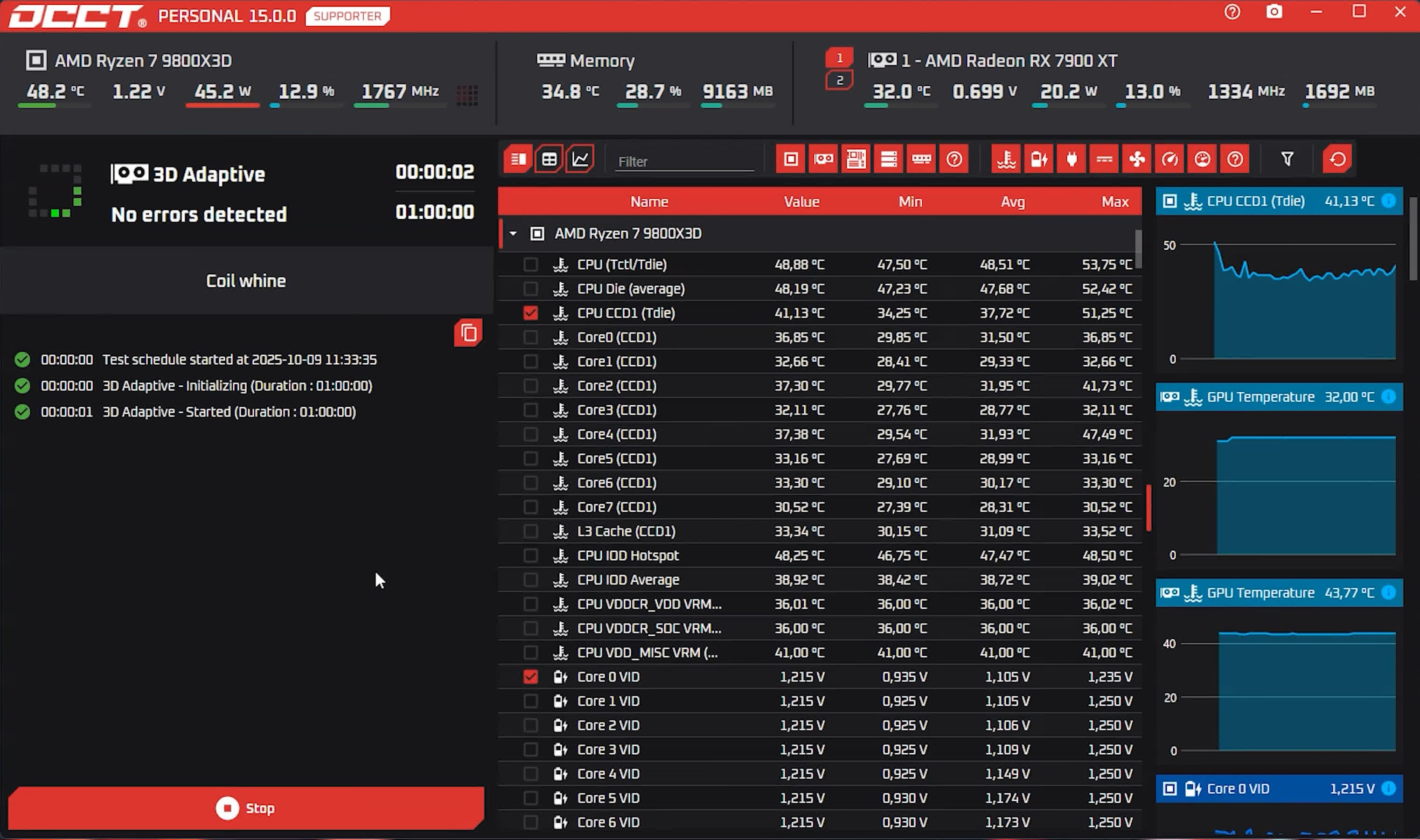
OCCT integrates coil whine detection helping users identify electrical noise from their GPU under load. By controlling GPU stress patterns and fan speeds, OCCT can make your card "sing" with distinct tones, making it easier to detect coil whine even in noisy environments. Results vary by GPU model, cooling design, and case acoustics.
Is the new storage test safe for my SSD or HDD?
Yes, but it's intentionally very demanding. The storage test pushes drives to their thermal and workload limits to verify stability and endurance. While it's safe for occasional diagnostics, running it too frequently may shorten the lifespan of SSDs or HDDs due to sustained high temperatures and write cycles.
Is OCCT free?
OCCT is free for personal use, but some features such as the Stability Certificate are reserved for paid users. For commercial use there are paid versions that start at $5 per month that include more features such as unlimited time duration.
Features
- Up to 16-core support ( for instance, up to a Quad-Kentsfield or an Octo-Conroe )
- Customizable tests ( Duration, Priority, CPU or RAM, ... )
- CPU and Motherboard detection
- Monitoring support through 3rd party application ( i.e. MBM5, Speedfan and Everest Ultimate Edition 3.50 or above )
- Can produce graphs showing temperature and voltages during the test : Unique feature !
- Multi-language support
Don't let your work go to waste
Ensure your computer is stable before working on your beloved projects - don't let a reboot or memory corruption put your hard work to waste
Is this a game bug or my computer?
Find out by stress-testing your components. If anything's wrong, OCCT will pick it up and tell you ! By having a wide-range of test integrated, you'll be able to pinpoint which one is faulty.
Stop wasting time with after-sale services
Find out which component is faulty and gain time by giving after-sale services proof your hardware is faulty. I don't promise you it'll go smooth, but at least, you'll have backup.
Modern monitoring dashboard
Create easy-to-read, attractive monitoring dashboards showing how your component is behaving in real-time.
Check your cooling
OCCT test will make your components go all out. If anything is wrong with your cooling, you'll quickly know.
The ultimate CPU test
OCCT's CPU test gives you full control on which core is tested - Cycle through cores, know which one generated an error, invert them... Lots of fun there.
Squeeze every MHz of your components
OCCT will help you pinpoint ideal values for your overclocked components and ensures rock-stable day-to-day usage.
What's New
- Storage: Fixed a bug where the benchmark would idle for 10 seconds before starting
- Memory: Improved test reliability and maintainability
- Fixed: The steam edition would display Patreon membership options and not Steam
- Fixed: OCCT will now properly launch when your temp path or folder containing OCCT has a space in it. Thanks Paimon
- Older AMD CPUs will now use TCTL/TDIE sensors in the top monitoring bar
- The auto-updater will now retry when it cannot update the current exe file in case it is locked by the antivirus or another program
- The last known state will now use a rolling scheme to ensure it is more reliable and more often displayed
- Fixed: When the last known state following a crash was corrupted, OCCT would refuse to start
- Fixed: 17.0.2 numbering was off, leading to it believing it's a beta when it's a stable version. Thanks Oliver
Last month, we introduced one of the biggest evolutions in OCCT's history: a completely redesigned and fully modular Memory Test.
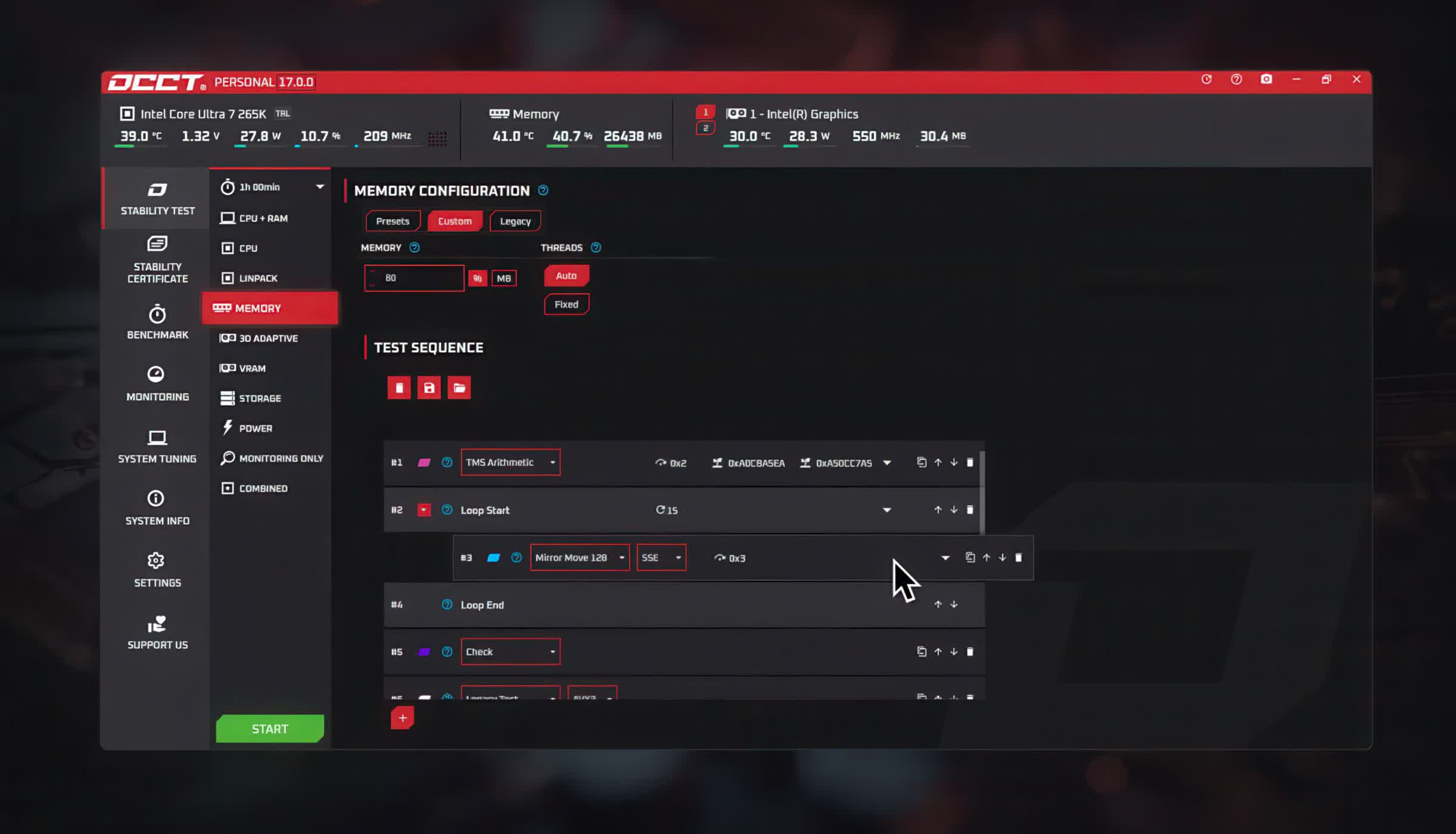
Today, we're excited to officially release OCCT v17, bringing together the new Memory Test system alongside a new launcher for OCCT and major optimizations and quality-of-life improvements across the entire application.
This release also comes with new presets for the memory test, including a community-made preset by Stephen Shanks, with even more to come in future releases.
A New Memory Test
OCCT v17 introduces a full redesign of the Memory Test, rebuilt entirely from scratch around a highly modular architecture.
Currently, the new system includes 16 individual testing blocks that can be freely combined to create highly customized memory stress tests. This makes the new OCCT Memory Test one of the most flexible and customizable memory validation solutions available.
Whether you're validating system stability, investigating intermittent memory issues, or creating specialized test scenarios, the new framework gives you complete control over how memory is stressed and analyzed.
Optimizations and Quality-of-Life Improvements
Alongside the new Memory Test, OCCT v17 delivers major improvements to performance, reliability, and overall usability.
- Faster Startup Time - A brand-new launcher improves startup times by approximately 10% to 30%.
- Lower Memory Usage - Overall memory consumption has been reduced by approximately 15% to 30%, with monitoring data now written directly to disk for improved efficiency during long test sessions.
- Improved Reliability - Better support for portable installations, a reworked auto-update system, and enhanced crash recovery make OCCT more stable and easier to troubleshoot than ever.
Community Presets
- One of the goals behind the new Memory Test architecture is to enable the community to create and share powerful testing scenarios.
- The stable version of V17 launches with 6 presets, including one community-made preset, AM5 Margin Probe by 'srshanks'.
- Over the coming months, we'll continue working internally and with the community to identify useful presets that can be integrated directly into OCCT, making advanced testing methods accessible to everyone.
- If you have created a particularly effective memory testing configuration, we encourage you to share it with other users through our Discord server and community channels.
Previous Release Notes:
Adding support for Arrow Lake CPUs
With V16.1, the System Tuning tool now supports Intel Arrow Lake CPUs, including the newly released Arrow Lake Refresh, allowing users to take full advantage of native tuning capabilities directly within OCCT.
System Tuning in v16.1
The System Tuning tool was designed to simplify and unify the CPU tuning process by combining configuration and testing within a single software.
With OCCT V16.1, users can:
- Tune their CPU directly within OCCT
- Run stability tests during the tuning process
- Adjust per-core frequencies (16.6 MHz steps on Arrow Lake)
Work on both Windows and Linux
This approach removes the need for multiple tools while improving the speed and reliability of system stability and overclocking validation.
Continuing to expand support
Expanding hardware compatibility remains a key focus. With Arrow Lake now supported alongside Granite Rapids, we're already working on bringing the System Tuning feature to more current and previous generations of CPUs.
As always, we welcome your feedback as we continue to improve the System Tuning tool and expand its capabilities.
OCCT 15 Release notes
We're thrilled to announce that OCCT v15 is now officially out of beta! A big thank you to everyone who helped us test and refine this release over the past few weeks.
This update includes:
- The stable release of our new Storage Test and Benchmark.
- A major 3D Adaptive Test update, with better error detection and a new coil whine detection feature.
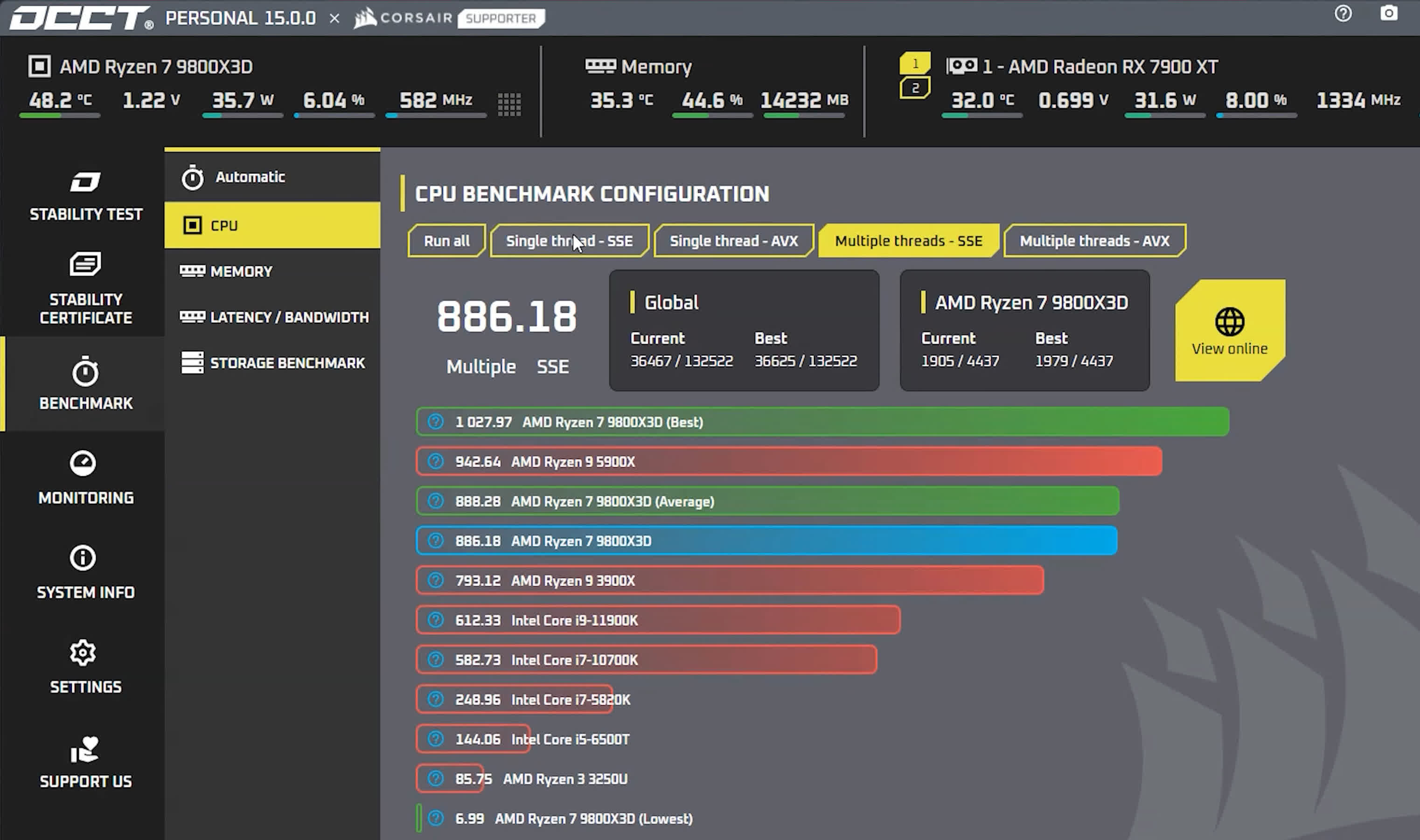
- And finally, the long-awaited return of OCCT skins, with LinusTechTips and Corsair kicking things off!
Storage Test and Benchmark Stable Release
- The new Storage Test is now officially stable and available to all users, including OCCT Pro and Enterprise editions. If you missed it during beta, this feature stress-tests your SSDs and HDDs under heavy workloads and high temperatures to validate performance and reliability. However, keep in mind that this test can be very intense for your components and very frequent use can impact your SSD and HDD lifespan, though normal usage poses no significant risk.
- Alongside it, we're also releasing our new Storage Benchmark. We didn't try to reinvent the wheel here, instead we aimed to deliver metrics people are familiar with. That's why we built our benchmark model around CrystalDiskMark-style metrics, providing results that are efficient, comparable, and easy to interpret. It will take us some time still to build the database and give you more meaningful comparative data overtime.
- With these additions, OCCT continues to evolve toward an all-in-one tool that enthusiasts and professionals can use for reliable data without the need for multiple software.
Major 3D Adaptive Test Update
- OCCT v15 isn't just about storage, it's also a big leap forward for our GPU test. Our 3D Adaptive test has been made significantly more demanding and precise than before.
- The test works the same as before, but we've improved error detection efficiency. Though you might notice lower frequencies or lower power consumption on some GPU's because the test triggers protection mechanism more aggressively at maximum intensity.
- In short: the new 3D Adaptive test pushes your GPU harder, smarter, and catches issues with greater accuracy.
New Coil Whine Detection Feature
- One of the more experimental and fun addition in v15 is the new Coil Whine Detection feature.
- When working in noisy environments, it can be tough to tell whether a system is producing coil whine. While refining the 3D Adaptive Test, we noticed that in Switch mode GPU fan noise varies depending on load intensity, and thought, "what if we could control that and make the GPU 'sing'?"
- Turns out, we can! We're starting with three different tunes, with plans to add more, and maybe even let you create your own in the future.
- It's important to note that results can vary depending on your GPU model and overall configuration, including factors such as the type of coils used on the board, cooling system, and the case.
New OCCT Skins
- Yes, you read that right, OCCT skins are back! Some of you might remember the Cooler Master skin. Sadly, that one's gone, but after taking time to rethink how we handle skins and partnerships, we're thrilled to announce their return in v15.
- You can enable their skins directly from OCCT's settings or download their dedicated versions from our download page. If you own a Corsair pre-built PC, you may even find OCCT preinstalled and already rocking Corsair colors!
- We have more skins lined up for future release, so stay tuned!