RawTherapee is a powerful, cross-platform raw photo processing system, released as Free Software (GPLv3). It is designed for developing raw files from a broad range of digital cameras and targeted at users ranging from enthusiast newcomers who wish to broaden their understanding of how digital imaging works to professional photographers.
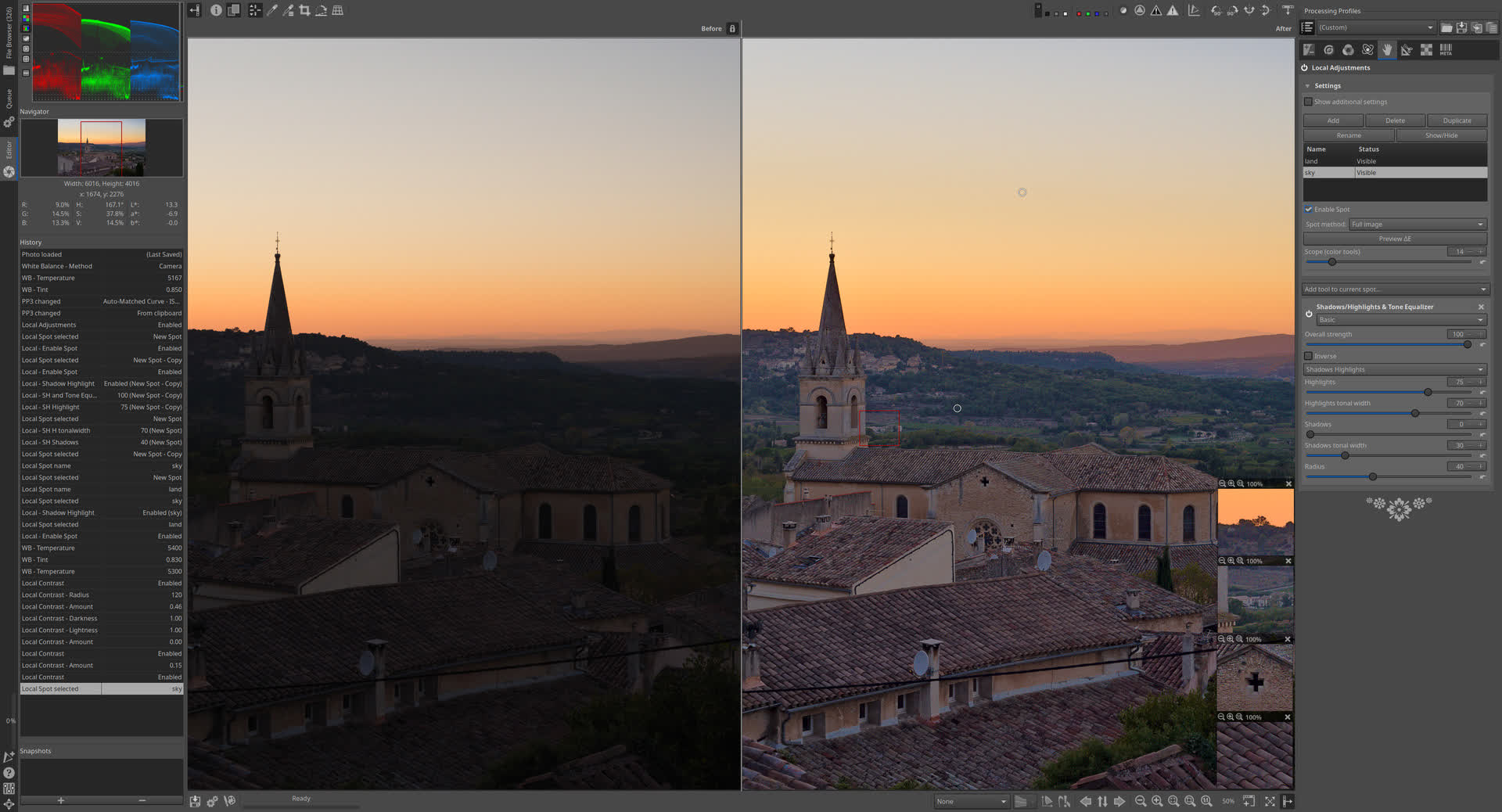
RawTherapee provides a powerful suite of tools for you to produce amazing photos and showcase your creativity. RawTherapee benefits users who take the time to learn what it can do.
Why do my exported images look different from the RawTherapee preview?
This discrepancy often arises due to differences in color management between RawTherapee and other applications. RawTherapee uses specific color profiles during editing and export, and if the viewing application doesn't support or correctly interpret these profiles, the images may appear different. To ensure consistency, it's recommended to use color-managed applications for viewing and to embed appropriate color profiles during export.
How can I learn to use RawTherapee effectively?
RawTherapee has a steep learning curve due to its extensive features and flexibility. New users are encouraged to start with the official documentation, RawPedia, which provides comprehensive guides on various tools and workflows.
Can I use multiple graduated filters in RawTherapee?
By default, RawTherapee allows only one graduated filter per image. However, users seeking more advanced local adjustments can utilize the Local Adjustments (LA) module, which offers greater flexibility, including the use of multiple masks and filters. While this feature is powerful, it may require additional learning to use effectively
Are there presets or LUTs available for RawTherapee?
Yes, RawTherapee supports the use of HaldCLUTs (Look-Up Tables) for applying film simulations and other color grading effects. Users can find various free HaldCLUTs online, and the RawPedia provides guidance on how to apply them. While RawTherapee doesn't natively support .cube or .look files, these can be converted to compatible formats using external tools.
Features
High Image Quality
- 96-bit (floating point) processing engine.
- Non-destructive editing.
- Get the most details and least artifacts from your raw photos thanks to modern and traditional demosaicing algorithms: AMaZE, DCB, AHD, EAHD, HPHD, IGV, LMMSE, VNG4, Mono and Fast.
- Advanced color handling from white balance to HSV (Hue-Saturation-Value) curves, color toning and color management.
- Powerful CIE Color Appearance Model 2002 (CIECAM02) module.
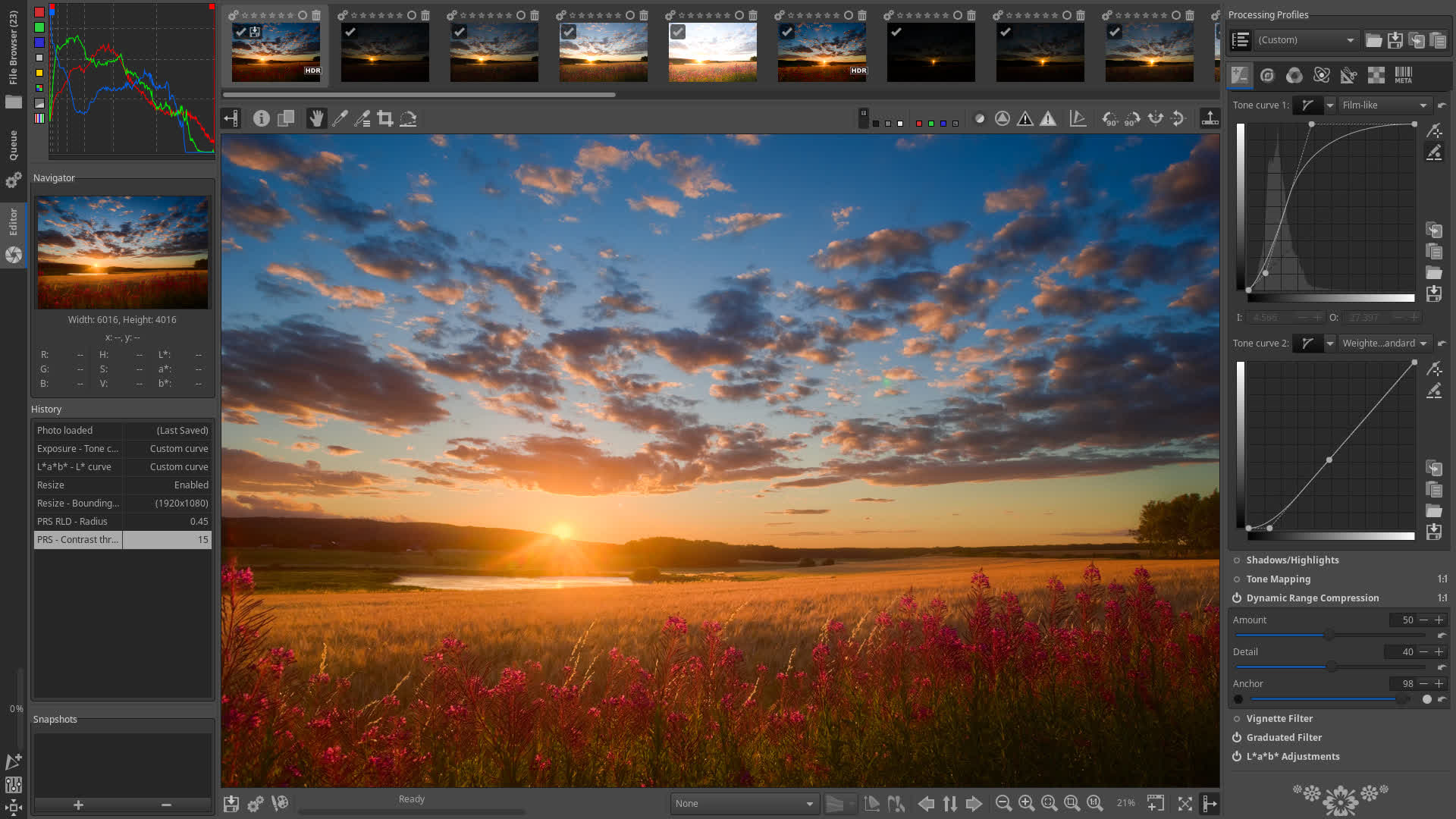
- Enhanced exposure and tonality tools: tone and Lab curves, highlights and shadows tools, tone mapping (HDR-like effect), etc.
- Multiple denoising methods: luminance, chrominance (both rewritten in 2012), impulse (for salt and pepper noise) noise reduction.
- Several tools to enhance details: unsharp mask, RL deconvolution, contrast by detail levels.
Efficiency
- Multi-threaded algorithms for high performance (RawTherapee can utilize modern processor features, like SSE).
- Quick thumbnails load lightning fast and are replaced later with live thumbnails.
- Batch processing: convert all the developed images at once without loading the processor while you work.
- Copy/paste editing parameters from one file to many other. Partially copying and/or pasting is also possible.
- Basic tools immediately at your hands.
- Parallel editing of multiple images in separate editor tabs, and/or all at once from the file browser.
- An optional secondary display can be used.
Versatility
- Wide variety of supported cameras: almost all DSLRs and even some medium format bodies are supported.
- Can load most raw files including 16-, 24- and 32-bit raw HDR DNG images, as well as standard JPEG, PNG (8- and 16-bit) and TIFF (8-, 16- and 32-bit logluv) images.
- Can save JPEG, PNG (8- and 16-bit) and TIFF (8- and 16-bit) images.
- Advanced control over the algorithms with many fine-tuning parameters and curves.
- Can send to GIMP or the editing tool of your choice in one click (16-bit TIFF file).
- Command line usage besides the normal graphical interface.
- Various layouts: multiple tabs, single tab with filmstrip, vertical tab with filmstrip, dual monitor.
Freedom for Free
- RawTherapee is free and open source software, meaning you can use it free of charge, wherever you like on whatever hardware you like, as long as you abide by the copyleft GPLv3 license. Download the source code, modify it, feel free to do what comes to mind. We believe in open software.
- It is cross-platform: Linux, Mac, or Windows, be it 32-bit or 64-bit - you pick, we provide.
- International: it is available in 25 languages
What's New
The Gamut Compression tool received several enhancements:
- The maximum values for the distance limits has been increased.
- The distance limits can be set automatically.
- The tool now shows the maximum red, green, blue, and achromatic values, as well as the estimated distance ratio between the working and target color spaces.
The Abstract Profile tool in Color Management received several enhancements:
- Highlight attenuation can be adjusted rather than simply being on or off.
- There is a new custom destination primaries option that allows changing the primaries by hue and saturation.
- The xy chromaticity diagram in the primaries adjustment shows the Rec2020 primaries for reference.
- The Color Appearance & Lighting tool received several enhancements.
- The Selective Editing's Equalization & Pre-Tone Mapping (formerly Shadows/Highlights, Equalizer & GHS) tool has a new simple tone mapper called Michaelis-Menten.
The Generalized Hyperbolic Stretch (GHS) method in Selective Editing's Equalization & Pre-Tone Mapping (formerly Shadows/Highlights, Equalizer & GHS) tool received several enhancements:
- The Black point and White point can be set automatically.
- The Black point/White point section now shows the maximum red, green, and blue values and the dynamic range.
- There is now a choice of matrix conversions that affect the color handling.
- Several parameters can now be adjusted regardless of what the Stretch Factor (D) is set to.
- The Symmetry point shows a recommended value and can be set automatically.
- Middle gray, RGB maximum, and 3 sigma standard deviation are displayed.
- In Selective Editing's Color Appearance tool, the Source Data Adjustments section has a new TRC based tone mapper with per-channel TRC adjustment and a color inversion option. The RGB channel slope tone mapper also received the color inversion option.
The Blur/Grain & Denoise tool in Selective Editing received several enhancements:
- A new Recovery Based on Luminance Mask in Blur & Noise allows refining the blurred area.
- Denoise has new options to reduce denoising of details.
- Selective Editing's Sharpening tool has a new Capture Deconvolution method which brings the benefits of Capture Sharpening to Selective Editing and works on both raw and non-raw images.
- The Crop tool guides has been revamped to allow multiple guides to be shown simultaneously, the guides' color to be changed, alternative aspect ratios to be shown, and a bleed area to be set.
- The Lens / Geometry tool can scale images horizontally or vertically.
- The Capture Sharpening tool has a new Presharpening denoise option which can improve the sharpening result on noisy images by creating a better contrast mask.
- The File Browser can show color labels from XMPs embedded in image files.
- In the Queue's Output Location template, a new "%e" format specifier is available which expands to the file extension of the output file (for example, "jpg" or "png").
- HiDPI support is improved, most notably making the editor preview and thumbnails sharp.
- All profiles are now shown in the monitor profile selection in Preferences.
- Performance on ARM has been improved.
- All preferences can now be easily reset in Preferences.
- Adapted Olympus lens name detection is improved.
- Added new translations for Hebrew and Korean.
- Updated translations for Simplified Chinese, Dutch, and German.
Added or improved support for cameras, raw formats, and color profiles (not an exhaustive list because unconfirmed support is excluded):
- Canon EOS M50 (white level)
- Canon EOS R5m2
- Canon EOS R6 Mark III (black level)
- Canon EOS R50 V (black level)
- Canon EOS R100 (white level)
- Canon PowerShot V1 (black level, white level)
- Fujifilm GFX 50S II (color matrix)
- Fujifilm GFX 50S II (color matrix)
- Fujifilm GFX 100 II (color matrix)
- Fujifilm X-M5 (color matrix, raw crop)
- Fujifilm X-T30 III (raw crop)
- Hasselblad CFV-100c (color matrix)
- Nikon Z5_2 (color matrix)
- Nikon Z50_2 (color matrix)
- Nikon Z f (white level)
- Olympus OM-3 (color matrix)
- Olympus OM-5MarkII (color matrix)
- Panasonic DC-G97 (color matrix)
- Panasonic DC-S1M2ES (raw crop)
- Panasonic DC-S1M2 (raw crop)
- Panasonic DC-S1RM2 (raw crop)
- Panasonic DC-S9 (raw crop)
- Samsung DNGs (black level, white level)
- Sony DSC-RX1RM3 (raw crop)
- Sony ILCE-1M2 (color matrix, raw crop)
- Sony ILCE-7M5 (black level, raw crop)
- Sony ILCE-6400A (color matrix)
Other Important Changes Since 5.12
- The default working profile is now Rec2020 instead of ProPhoto.
- Why it changed: ProPhoto has a very large gamut. While it is useful for preventing loss of color information during editing, it also allows colors that cannot exist in the real world. Some tools work best when there are only real colors. Rec2020 also has a large gamut, but only allows real colors.
- What it means for you: ProPhoto is still available. Use of Rec2020 is completely optional. If you previously used ProPhoto and decide to switch to Rec2020, be aware that some tools are dependent on the working profile and may behave differently. Examples include, but are not limited to, Exposure, Channel Mixer, HSV Equalizer, Soft Light, RGB Curves, and Color Toning.
LibRaw
LibRaw is a software component used to read raw files. RawTherapee had always used a different raw file reader: an enhanced version of dcraw. dcraw has not been updated in 8 years, making it a burden on RawTherapee developers to support new cameras. Starting in 5.11, RawTherapee can use LibRaw to read raw files. If LibRaw determines it cannot read a raw file, RawTherapee will fall back to the enhanced dcraw. Official packages distributed by the RawTherapee team contain an enhanced LibRaw. Unofficial packages distributed by 3rd parties may decide to use a different version of LibRaw, which may not support as many cameras.
Switching to LibRaw is a significant change. Although LibRaw originated from dcraw and the RawTherapee team made an effort to ensure the smoothest transition, there may be some raw files that LibRaw cannot handle as adequately as the enhanced dcraw. If you encounter this scenario, please submit a bug report as described below in Reporting Bugs. LibRaw can be disabled in the preferences. Keep in mind the enhanced dcraw cannot read certain raw images that LibRaw can. LibRaw will become mandatory in a future version of RawTherapee, so don't keep those bugs to yourself!