The first thing to remember is that Krita is a 2D paint application while other programs such as Photoshop are designed for image manipulation. This means that the other programs may have more features than Krita in general- but Krita has tools that are relevant to digital painting.
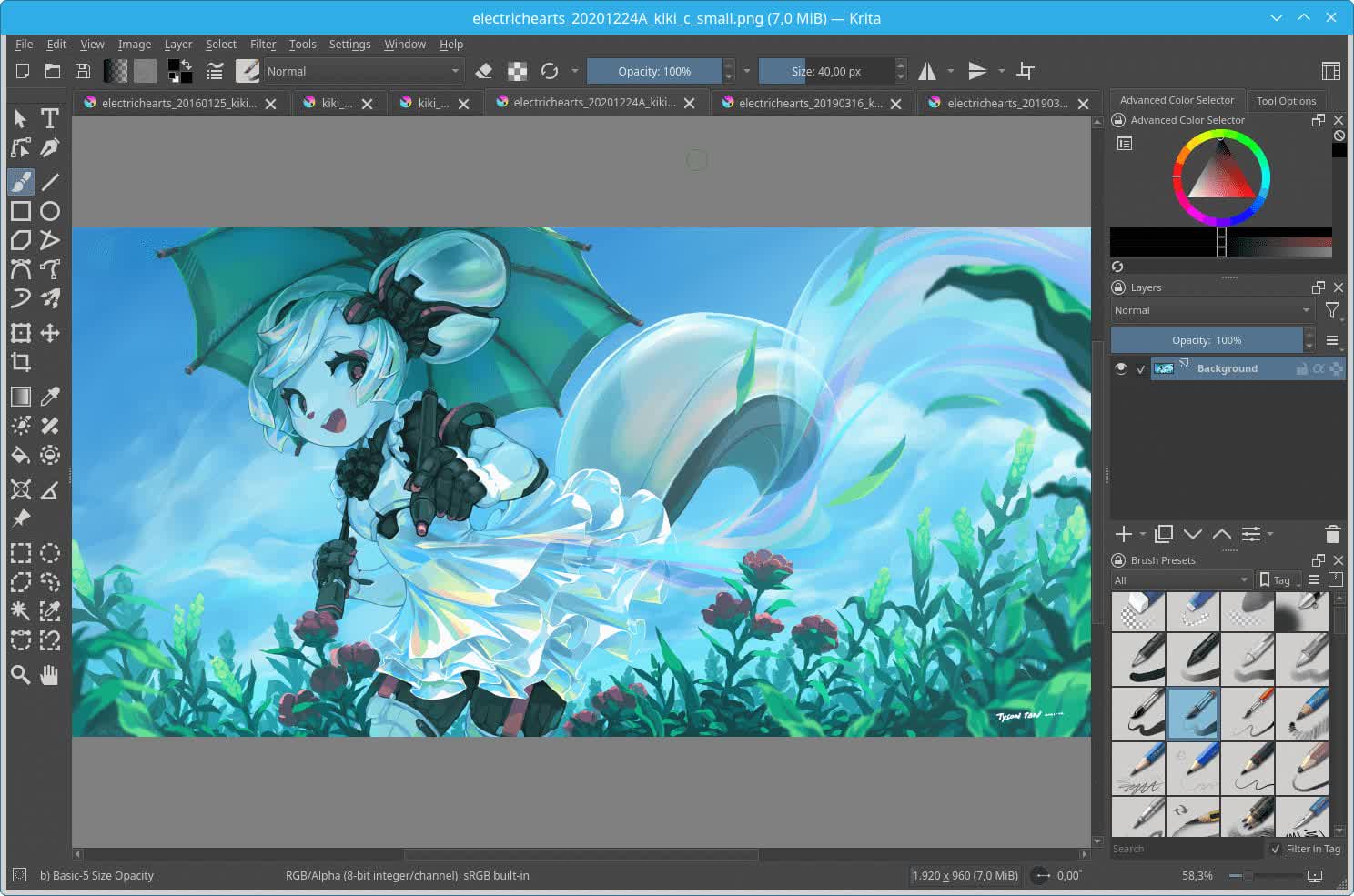
The tools are designed for concept art, creating comics, and textures. If you use a feature that isn't listed, make a quick video tutorial and let us know. We'll put it up to share with everyone.
What are the main differences between Krita and other digital art programs?
Many artists appreciate Krita for its strong brush engine, painting-first workflow, and support for stylus features like tilt and rotation. Compared to apps centered on photo editing, it focuses more on illustration, concept art, and comics. It also offers professional features like HDR painting, wrap-around mode for textures, and animation tools without the heavy subscription overhead.
Why do brushes look pixelated or blurry when I zoom out?
Krita prioritizes performance when scaling, so it may downsample strokes while zoomed out. The actual brushstroke detail is preserved; it just won't render fully at smaller zoom levels to keep navigation fluid. Exported artwork or viewing at 100% scale will show the correct sharpness.
Is Krita good for animation and how far can you take it?
Its timeline-based workflow supports frame-by-frame animation, onion skinning, camera moves, and audio playback. It's widely used for animatics, short loops, and 2D hand-drawn animation. While it isn't a full production pipeline tool with rigging or vector bones, it's capable of polished traditional animation and illustration-focused styles.
Features
User Interface
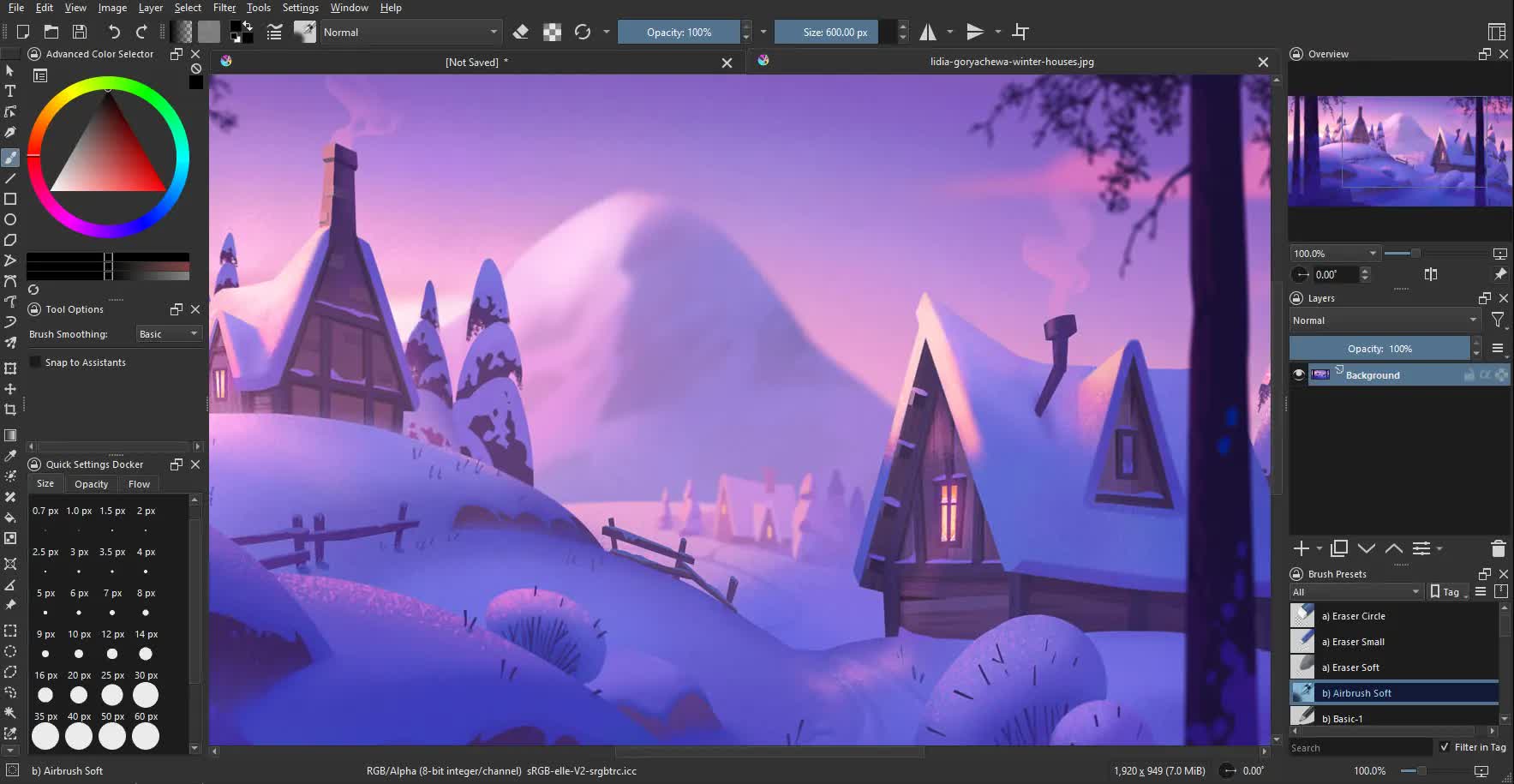
An intuitive user interface that stays out of your way. The dockers and panels can be moved and customized for your specific workflow. Once you have your setup, you can save it as your own workspace. You can also create your own shortcuts for commonly used tools.
Brush Stabilizers
Have a shaky hand? Add a stabilizer to your brush to smoothen it out. Krita includes 3 different ways to smooth and stabilize your brush strokes. There is even a dedicated Dynamic Brush tool where you can add drag and mass.
Pop-up Palette
Quickly pick your color and brush by right-clicking on the canvas. You can also use Krita's tagging system to swap out the available brushes that are displayed. The ring outside of the color selector contains the most recently used colors. These settings can be configured through the preferences.
Brush Engines
Customize your brushes with 9 unique brush engines. Each engine has a large amount of settings to customize your brush. Each brush engine is made to satisfy a specific need such as the Color Smudge engine, Shape engine, Particle engine, and even a filter engine. Once you are done creating your brushes, you can save them and organize them with Krita's unique tagging system.
Wrap-around mode
It is easy to create seamless textures and patterns now. Press the 'W' key while painting to toggle wrap-around mode. The image will make references of itself along the x and y axis. Continue painting and watch all of the references update instantly. No more clunky offsetting to see how your image repeats itself.
Resource Manager
Import brush and texture packs from other artists to expand your tool set. If you create some brushes that you love, share them with the world by creating your own bundles. Check out the brush packs that are available in the Resource area.
Updated Tablet Support for Windows, Linux and macOS
We finally managed to bring together the code we wrote for supporting tablets on Windows (both Wintab as Windows Ink), Linux and macOS with the existing code in our development platform, Qt. This has improved support for multi-monitor setups, more tablets are supported and a host of bugs with tablets have been resolved. This was a huge amount of work!
Note: we needed to patch Qt to make all of this work. The patches have been upstreamed but might not yet be integrated by your linux distribution. Until that happens, you might need to use the Linux AppImage instead of Krita as built by your distribution.
HDR Painting
HDR Animation created in Krita by Agata Cacko
Krita has been able to work with HDR images since 2005, but it's now possible to view your HDR image in HDR, on supported hardware. You can now not only save your HDR image in .kra or OpenEXR files, but also extended PNG. With the right version of FFMPEG you can even create animations in HDR! Having the correct computer setup for this can be rather complicated, so head to the documentation to see what is involved. HDR display is only available on Windows 10.
If you have HDR enabled, the Small Color Selector Docker has an extra "nits" slider that allows you to change the brightness of a specfic color.
Improved brush speed performance with vectorization and lock-free programming
Two of our 2018 Google Summer of Code students sped up Krita with programming techniques called lock-free hashmap for managing the pixel data (Andrey Kamakin) and GPU vectorization (Ivan Yossi). The lock-free hashmap should improve Krita's speed with multithreading, the chart shows the performance gains based off your CPU core count. Vectorization for the Gaussian and Soft-brush tips optimizes Krita by taking advantage of your processor's ability to do similar calculations really quickly, the gif above showing the speed difference for the gaussian brush tip.
The left axis on the graph is time in milliseconds. You can see the painting operations go from 1.5 seconds down to about 1 second with the lock-free hashmap. The blue line shows how Krita previously worked.
Improved Color Palette Docker
An improved color palette from one of our Google Summer of Code students for 2018 --- Michael Zhou. It is more stable as well as some of the following changes:
- Instead of an entry-based docker, a rows and column based docker.
- It can hold empty entries, which is useful for organizing.
- Stable drag and dropping of colors.
- Easy adding in entries by clicking them in the docker.
- Right-clicking removes an entry.
- Palettes can be put into the KRA file.
- You can press the folder icon to open a palette editing dialog where you can set a palette to be stored in the document or resource-folder.
What's New
Several years in the making, Krita 5.3 is a release filled with long anticipated features. The text tool and object has been completely rewritten, but even if text leaves you cold, there's a ton of improvements and useful tools across the board, like gap closing for the fill tool, a selection toolbar, an all new knife tool and much much more.
That's right, this is also a release of Krita 6!
Krita 6 is our Qt6 port of Krita, that is, when you build Krita 5.3 with Qt5, you get Krita 5.3, but when it is build with Qt6, you get Krita 6. We are doing this because several Linux distributions are already dropping support for Qt5. By switching to Qt6 we will have future proofed Krita for years to come.
But support for Qt6 isn't the only thing Krita 6 brings. It also comes with Linux Wayland support, in particular a full featured implementation of the Wayland Color Management protocol. This finally brings HDR support to the Linux version of Krita!
The Wayland Color Management Protocol is still very young. It was the key feature we have been waiting for all these years: where on the older X11 display servers we could always figure out on which monitor we were on and which color profile to associate with that monitor, Wayland's architecture is designed around not giving away that information so easily.
This is a problem for a painting application which core feature is fully integrated color management. Now, the Wayland Color Management Protocol will provide us with all the information we need to provide color managed views of images, including everything we need to know for HDR display. Because this part of Wayland is still very young, using it means you will need an up-to-date window manager that supports it. We ourselves recommend the manager the code has been written against: KWin 6.4.4 and above.
In addition to Color Management, Wayland support also means support for fractional scaling and 10 bit display.
Beyond the Wayland support, Krita 6 and 5.3 share all the same features.
Note that Krita 6 is not available for Android yet, and that Krita 6 on all platforms is considered early access.
There are also so many changes between Qt5 to Qt6 that it is inevitable that there will be bugs in Krita 6 that are not present in Krita 5. Our focus will from now on be on making Krita 6 as stable as possible.
Text Tool
The text tool has been fully overhauled for 5.3! The main attraction is of course that text can now be edited directly on canvas, with full support for the usual keyboard and mouse interactions, as well as IME support. But we did not stop there! Lets go over some of the highlights:
Wrapped Text, Text in shape and Text on Path
Krita now has the ability to make auto wrapped text. You can drag an area to create a simple inline wrapping area, or click on a shape to have the text flow inside. In conformance with SVG 2, the text flow area can be composed of multiple shapes, with some adding and others subtracting from the final flow area.
Aside from wrapped text, you can also set the text to follow a path, as well as control the start position.
Text Properties Docker
The text properties docker allows you to style the text. This separate docker allows not only editing the current text selected with the text tool, but also multiple texts when selected with the shape selection tools. To ensure you do not get lost inside the list of 50+ editable properties, Krita will by default hide properties that have not been set on the selected text or its paragraph. You can configure the visibility rules of each of these to your liking, allowing you to hide properties you never use, or show all properties regardless.
A large part of the work on this was the font selector, as this required special indexing of the fonts on your system. Due this work, you can now select all types of fonts, from obscure postscript to modern opentype variable fonts (all axes included) inside the font selector. Beyond that, fonts are now resources can be tagged, searched, and will show localized names (and samples) if these were present inside the font.
With 50+ properties, it can be hard to remember your favourites. To this end, Krita now also has style presets, which allow you to quickly apply a selection of properties to the current text, or use them as a base for new text.
Glyph Palette
Another new addition is the glyph palette. The glyph palette allows you to select alternate glyphs that may be present in the currently used font. While the text properties docker allows configuring all the OpenType features in a font, the glyph palette is far more convenient. Furthermore, it allows selecting unicode character variations, which will be doubly handy for those typesetting in CJK scripts.
Type Setting Mode
In addition to the Text Properties Docker, you can edit a number of properties on-canvas with the new Type Setting Mode. This separate mode in the text tool provides controls to edit Font Size, Baseline Shift, Line Height and Dominant Baseline directly on canvas. When text is not auto-wrapped, you can even edit the position of every single glyph in detail!
Miscellaneous:
All properties were given a bit of polish, which means that Krita has full support for CSS-Inline-3 Dominant and Alignment baseline. These properties are useful for configuring the alignment of text of different sizes when they are in scripts like Devanagari or Han script.
- The new text widgets are in QML, our first foray into modern QML.
- As a side effect of the text work, vector shape editing is now a little faster, and select all/deselect now work in all vector tools.
- Similarly, we now support SVG 2 paint-order property, which allows the outlines to be drawn behind the text.
Read the complete release notes here.