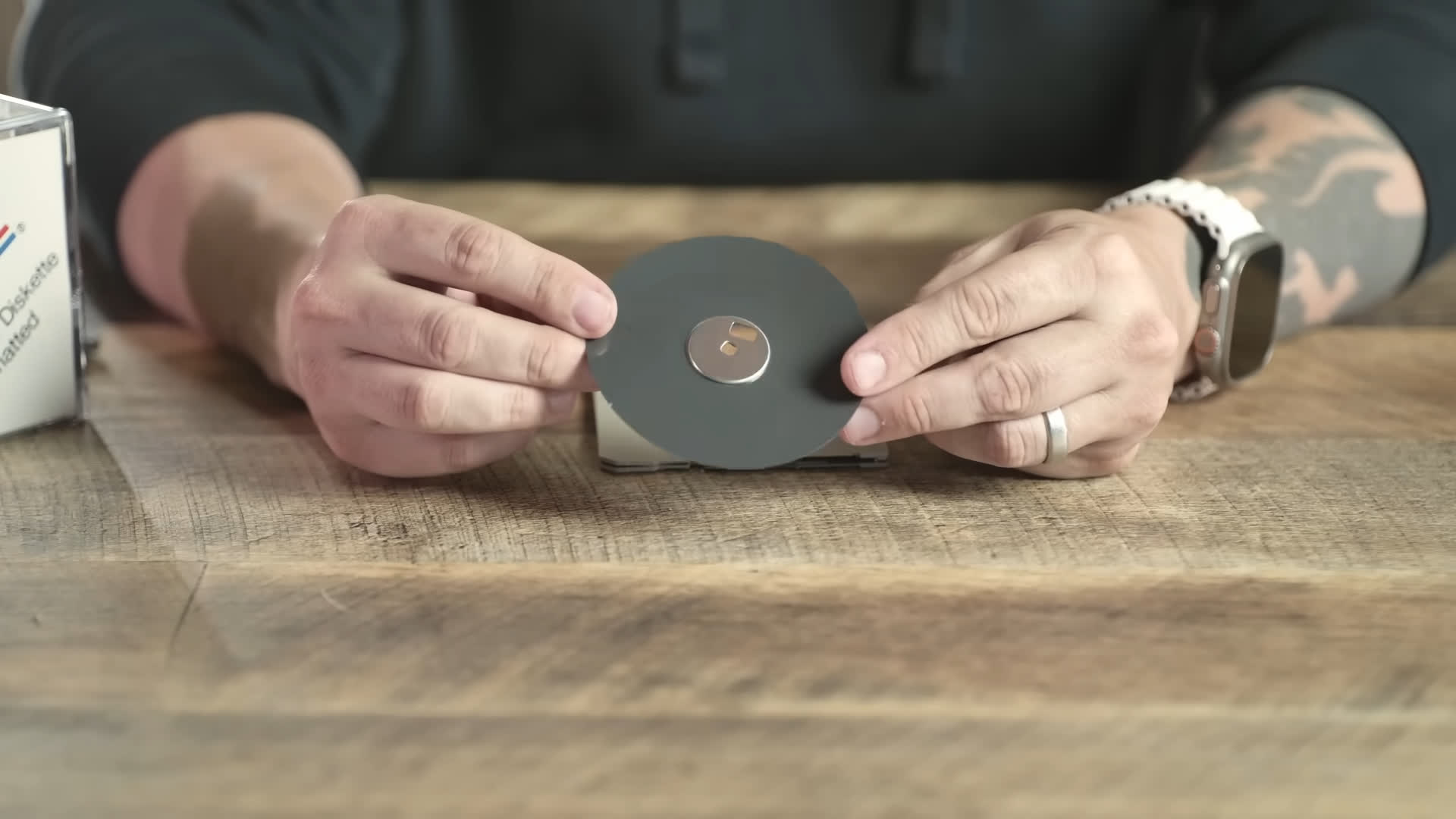
In context: If there's one thing YouTube has shown, it's that almost anything can be built by yourself at home if you have the time, skill, and required parts. Take, for example, polymatt, who managed to build a 3.5-inch floppy disk from scratch.
Outside of their use in some legacy systems and among retro enthusiasts, floppy disks are pretty much obsolete these days – many younger people know them only as a save icon.
But polymatt wanted to see if he could create one of these disks from its bare components. He began by disassembling a commercial floppy disk to study its internals and construction, giving him a blueprint for what he needed to replicate.
The first step of the construction was the recreation of the outer shell. polymatt used CNC milling for the enclosure, which looks great.
Then came the most difficult part: creating the magnetic disk core. A 5-watt laser cutter shaped a thin disk from PET film – floppy enough to work mechanically. It was then flattened and heat-treated using a 3D printer to achieve uniform thickness.
Making the magnetic coating was a particularly impressive and complex feat. It involved mixing iron oxide powder into a binder solution composed of PVA (polyvinyl alcohol), isopropyl alcohol, glycerin, and Tween 20, which is a common surfactant. After adjusting ratios, going through several iterations, and degassing the solution to remove bubbles, polymatt applied the final solution to the PET film disk. The coating measured around 5 – 6 microns thick, approaching the roughly 2-micron thickness of commercial disks.
Initial attempts were unsuccessful as the coating was peeling off at 300 RPM. To fix this, polymatt scuffed the PET surface, heat-treated it, and carefully applied the coating and drying process. This improved adhesion enough for the disk to spin and, critically, store and retrieve small amounts of data.
With the coated disk ready, he assembled it in the aluminum shell, added a center ring, and tested the disk in a real drive. Thankfully, it spun and proved functional. While not flawless, it did demonstrate that homemade magnetic media can work – if you have the resources.