
Through the looking glass: The compact disc's 43-year journey, from technical experiment to a worldwide standard, tells the story of how global collaboration and bold engineering can reshape entire industries. More than just a music format, the CD transformed how people listened, stored, and shared information – laying the groundwork for both modern digital media and personal computing. Its legacy still echoes in music culture and digital technology today.
On August 17, 1982, engineers at a Polygram factory in Langenhagen, Germany, pressed the first commercial compact disc, containing the Swedish pop group ABBA's album The Visitors. The event marked the debut of a format that would reshape both the music and computing industries for decades to come. Although The Visitors had been released in late 1981, its selection as the first CD represented a symbolic transition from analog records and tapes to a future of digital audio.
The idea of the compact disc had been forming for several years. In the late 1970s, both the Dutch electronics giant Philips and the Japanese company Sony were independently working on digital audio disc technologies. Philips had created a prototype CD player and sought to establish an international standard, while Sony had advanced digital encoding and error correction techniques. In 1979, after Philips demonstrated its prototype in Japan, the two companies agreed to collaborate, forming a joint task force to define the technology and specifications that would become the CD.
Several critical engineering decisions were made during the intense collaboration. Among them, the disc's diameter was set at 120mm, and its playing time at just over 74 minutes. This length, according to participants at the time, was based in part on the capacity needed to fit landmark classical recordings such as Beethoven's Ninth Symphony.
The disc used a laser to read digital data encoded onto its surface, employing eight-to-fourteen modulation (EFM) for efficient storage and CIRC (Cross-Interleaved Reed-Solomon Code) for error correction. The resulting Red Book standard, finalized in June 1980, became the technical foundation for the entire CD audio market.
When CDs eventually reached the public, they offered a leap forward in sound quality and durability, eliminating the pops and crackles associated with vinyl. They also introduced new conveniences, such as the ability to skip tracks instantly and replay music without wear, setting them apart from analog formats.
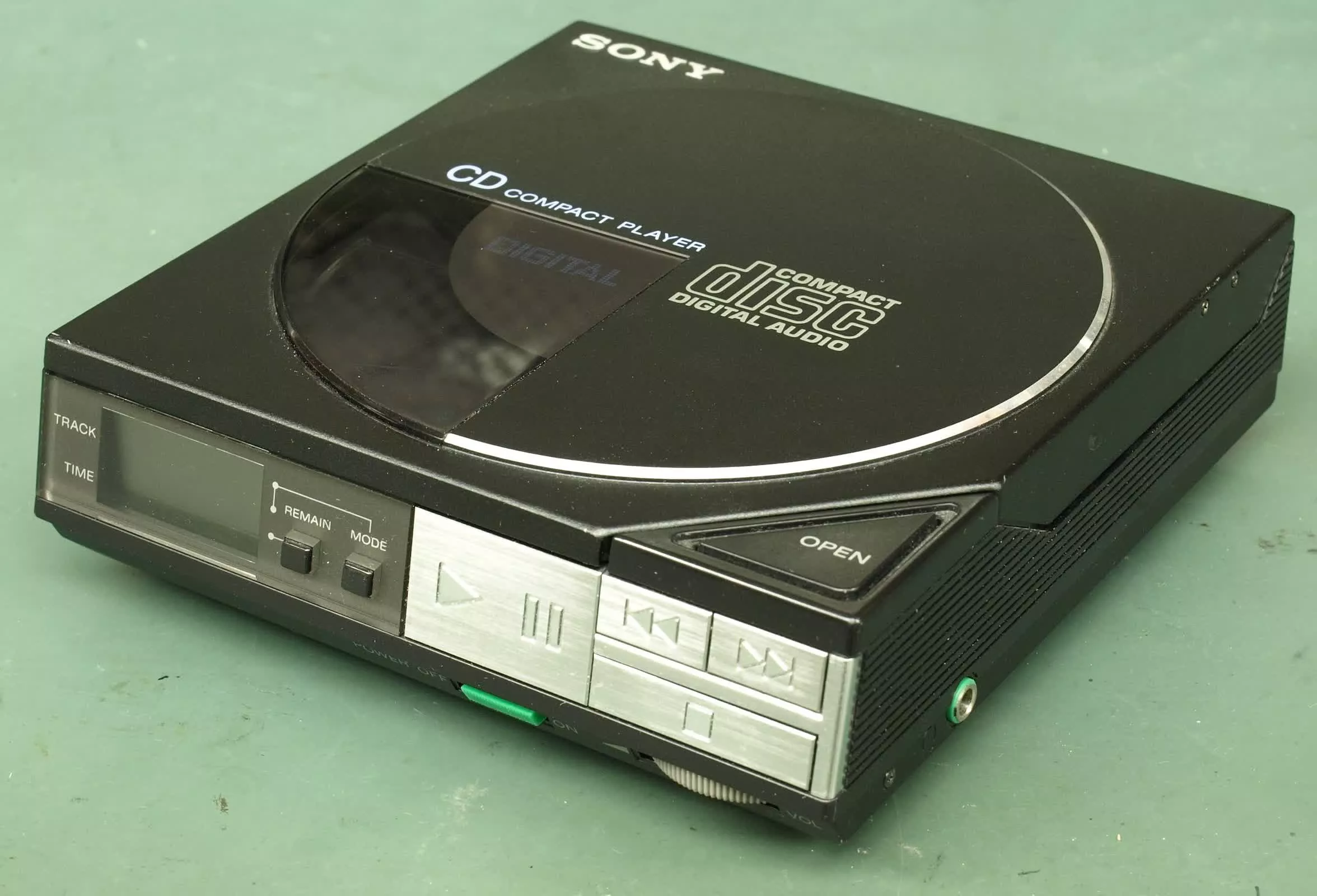
By the early 1980s, several hundred titles became available in the new format, and CD players began to appear in hi-fi shops worldwide. While many were skeptical about the long-term viability of such a new and expensive technology, CD sales rose swiftly. In the United States, shipments of CD albums would peak at nearly 943 million units in 2000.
Trivia time: What happens if a CD spins too fast?
The impact of the CD extended well beyond music. In 1985, the Yellow Book standard defined CD-ROM, enabling discs to store binary data and software. Three years later, the ISO 9660 file system established a cross-platform directory and file structure, which allowed CDs to serve as a universal medium for applications, archives, and multimedia content across operating systems. This portability was a major factor in the widespread adoption of CDs in personal and enterprise computing.
By the early 1990s, the arrival of CD burners and writable discs allowed consumers to create their own audio and data CDs, turning the format into both a distribution channel and a personal storage solution.
For a decade, software installation, driver distribution, and even operating system releases relied on CD-ROMs. Although streaming and digital downloads have since displaced physical media, CDs retain a niche among music enthusiasts for their fidelity and permanence. In computing, the medium has largely vanished from daily use, although different forms of optical drives persist for accessing legacy software and archived data.