
What just happened? Reports have long suggested that Intel will launch a new series of Arrow Lake desktop CPUs in late 2025, and the first concrete evidence has now surfaced on Geekbench. While the performance numbers appear preliminary, the listing indicates that Arrow Lake Refresh may essentially mirror its predecessor, despite the updated naming scheme.
A previously unannounced Intel CPU, the Core Ultra 7 365K, has appeared on Geekbench. The chip likely sits in the mid-range of Arrow Lake Refresh, a lineup Intel plans to launch later this year. The benchmark confirms that the series will carry the Core Ultra 300K label, succeeding the Core Ultra 200K naming used by Arrow Lake desktop chips. Despite the new numbering, the 365K closely resembles its predecessor, the Core Ultra 7 265K.
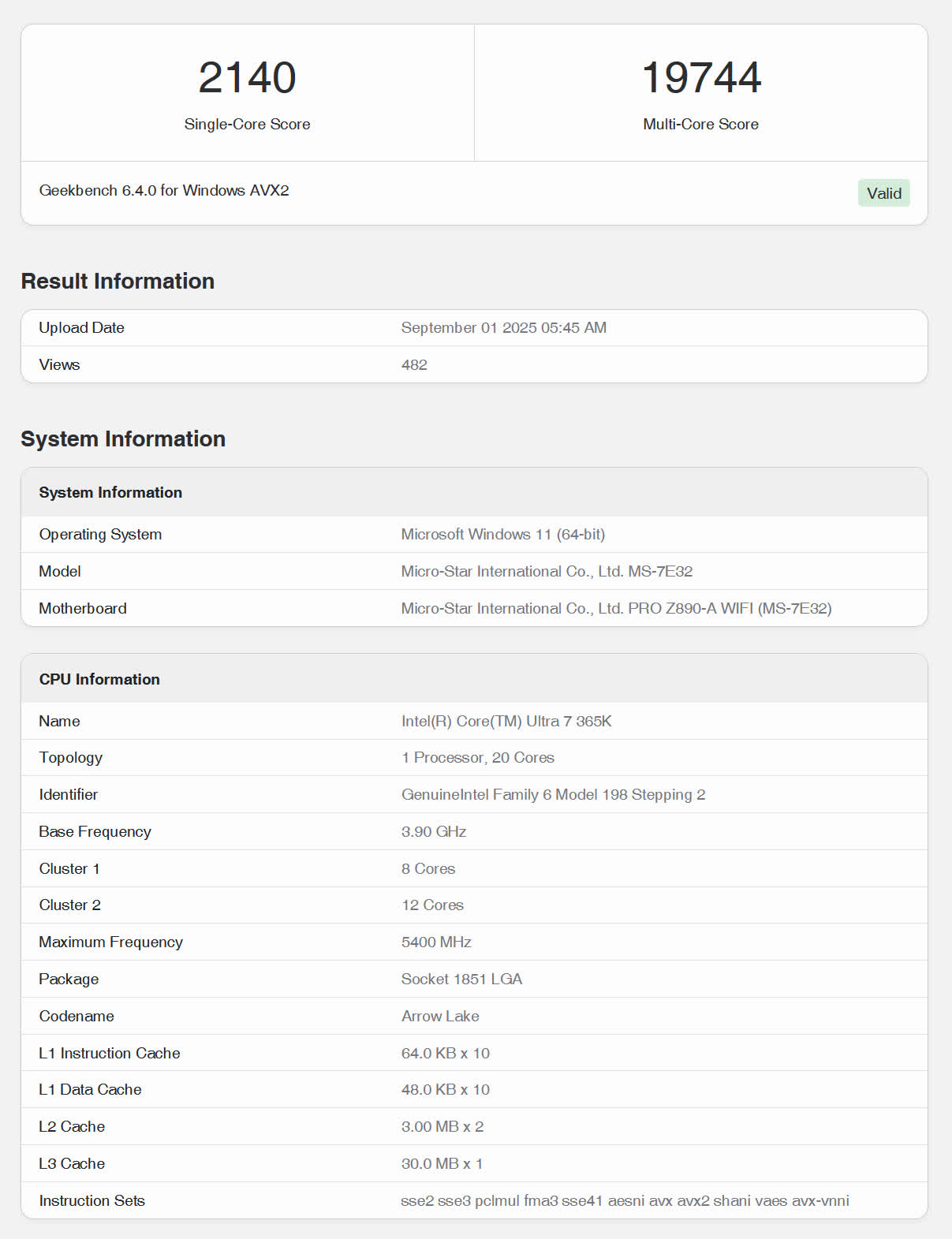
Both processors feature 20 cores, a 3.9GHz base clock, and the same cache configuration, signaling minimal architectural changes between generations. The Core Ultra 300 also retains support for the LGA 1851 socket, giving current Arrow Lake owners a straightforward upgrade path without replacing motherboards.
The tested unit likely wasn't running at full production speeds, as its 2,140 single-core and 19,744 multi-core scores fall well short of many 265K results. Geekbench offers little additional performance detail, but prior reports indicate that Arrow Lake Refresh may not resolve the earlier lineup's underwhelming gaming performance.
Although the Core Ultra 9 285K still ranks among the best productivity CPUs, AMD's Ryzen 7 9800X3D outclasses the entire Arrow Lake lineup in gaming. AMD's chip continues to dominate sales, while Arrow Lake trails behind even older Intel processors. The company tried to fix the performance gap at the software level, but the update proved ineffective.

So far, no reports suggest the Arrow Lake Refresh will deliver a meaningful performance boost. Instead, the new lineup will introduce the first socketable desktop NPUs that support Microsoft's Copilot+ generative AI suite.
Nova Lake, slated to ship late next year, promises a far more ambitious overhaul. By combining Intel's 18A and TSMC's 2nm N2 process nodes, the lineup could deliver a substantial performance boost. Prior rumors also suggest it will include Intel's answer to AMD's 3D V-Cache, a key factor behind the strong gaming performance of processors like the 5800X3D and 9800X3D.