
Bottom line: For now, the 270K Plus remains a prototype-level offering, but its technical profile points to a deliberate effort to recalibrate Arrow Lake's value proposition. Whether through selective OEM partnerships or a wider release, Intel may be betting that incremental innovation can still shift sentiment in a highly competitive market.
Intel appears to be revisiting its Arrow Lake desktop processor lineup with the emergence of a new, unannounced CPU variant that could signal a strategic shift in its consumer silicon roadmap. A previously undocumented model, identified as the Core Ultra 7 270K Plus, recently surfaced in a Geekbench listing, reigniting speculation about Intel's plans to refine its current-generation architecture rather than pivot immediately to next-gen designs.
The benchmark results, revealed by hardware leaker Benchleaks on X, show the Core Ultra 7 270K Plus achieving a multi-core score of 22,206 and a single-core result of 3,205 under Geekbench 6. These figures place it approximately 10% ahead of the existing Core Ultra 7 265K in multi-threaded performance, a meaningful uplift in a market where incremental gains are closely scrutinized.
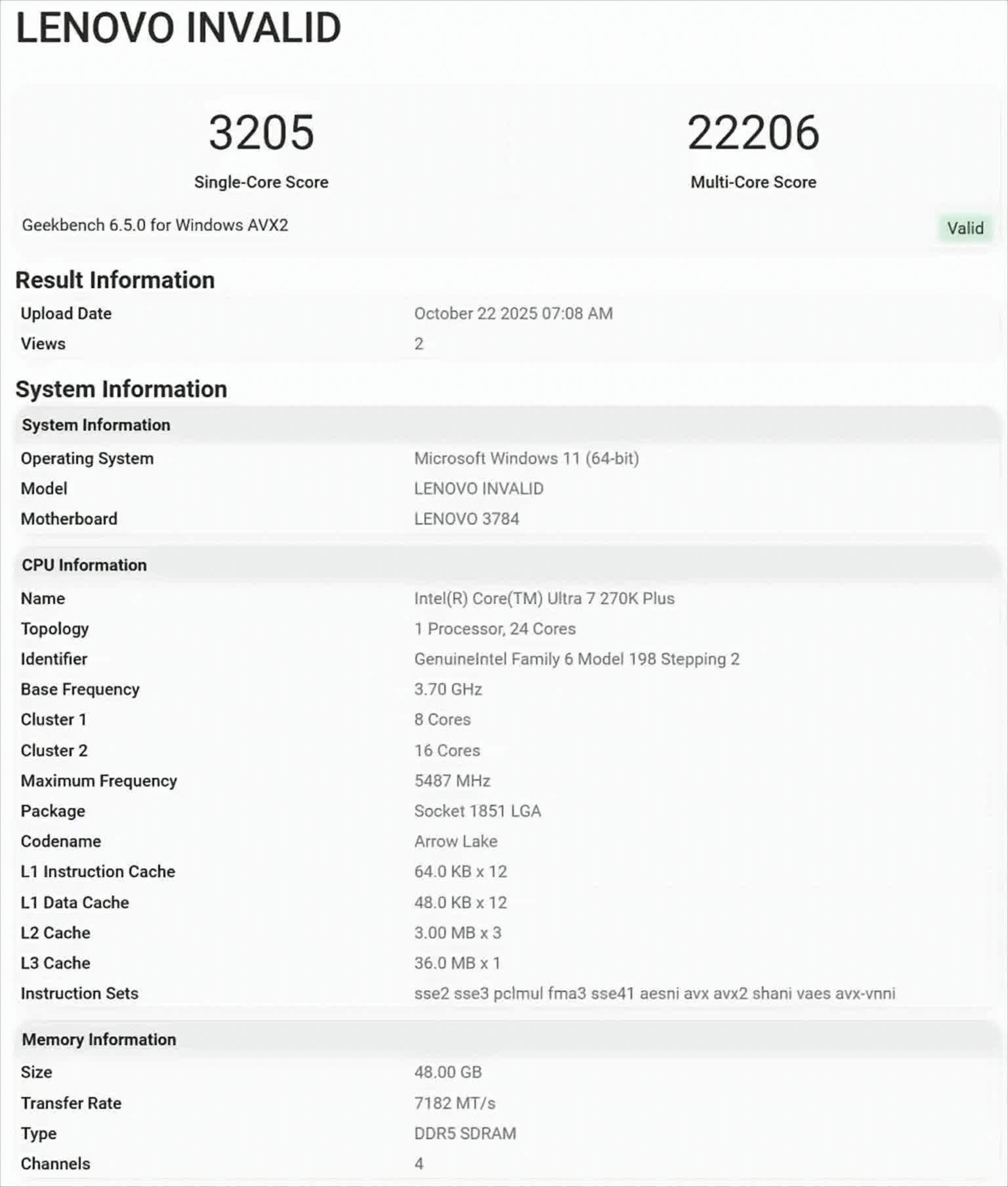
The test configuration included 48GB of DDR5 memory running at 7,182 MT/s – an unusually high speed that exceeds the 6,400 MT/s ceiling supported by current Arrow Lake-S SKUs – suggesting this chip may feature enhanced memory controller capabilities.
Technically, the processor aligns with Arrow Lake's hybrid design, packing 24 cores composed of 8 performance cores and 16 efficiency cores, along with 24 threads. It reaches a peak boost clock of 5.5 GHz, consistent with Intel's high-end desktop offerings.
The system used for testing was Lenovo-branded and equipped with the China-specific RTX 5090D. This raises the possibility that the 270K Plus is intended primarily for system integrators rather than retail distribution.
[GB6 CPU] Unknown CPU
– Benchleaks (@BenchLeaks) October 22, 2025
CPU: Intel Core Ultra 7 270K Plus (24C 24T)
Min/Max/Avg: 5165/5474/5429 MHz
Codename: Arrow Lake
CPUID: C0662 (GenuineIntel)
Single: 3205
Multi: 22206https://t.co/U3Buof359R
Arrow Lake marked a structural turning point for Intel when it launched in October 2024, introducing a chiplet-based design to the consumer desktop segment for the first time. Built on Intel's 20A process technology, the architecture combined a compute die with a separate I/O die, a departure from monolithic designs used in prior generations like Raptor Lake.
The shift was meant to improve yield efficiency and enable faster iteration cycles, but initial market reception was tepid. Despite gains in productivity workloads and power efficiency, the chips underperformed in gaming scenarios relative to AMD's Ryzen 9000 series, and adoption stalled.
Sales data in the months following the launch showed declining momentum, with retailers reporting slower inventory turnover than anticipated. Analysts attributed the lukewarm response to a combination of pricing, platform maturity, and limited performance headroom over previous generations.
The appearance of the 270K Plus suggests Intel is not abandoning Arrow Lake but instead exploring targeted enhancements. The support for higher-speed memory implies a potential refresh – sometimes referred to as Arrow Lake-R – could be in development. Such a move would mirror past strategies, where Intel introduced refined versions of underperforming architectures to regain market footing.
There is no official confirmation from Intel regarding the Core Ultra 7 270K Plus, and the company has not updated its public product stack with this SKU. However, the benchmark data, including proper identification of core configuration and clock speeds, lends credibility to the leak. If Intel proceeds with a broader rollout, the new chip could serve as a bridge to its next major architecture, Panther Lake.