
Forward-looking: A team of physicists from Julius-Maximilians-Universität Würzburg in Germany have created the world's smallest pixel to date. Measuring just 300 by 300 nanometers, the tiny light source is just as bright as a conventional OLED pixel that's five by five micrometers in size and could eventually serve as the building blocking for next-generation, high-resolution wearable displays.
At that scale, a display with a resolution of 1,920 x 1,080 pixels could fit into an area measuring just one square millimeter.
Key to the team's miniaturization effort was the creation of a specially crafted insulation layer separating the pixel's gold antennas. Without the barrier, the gold atoms would eventually grow into the pixel and cause a short circuit.
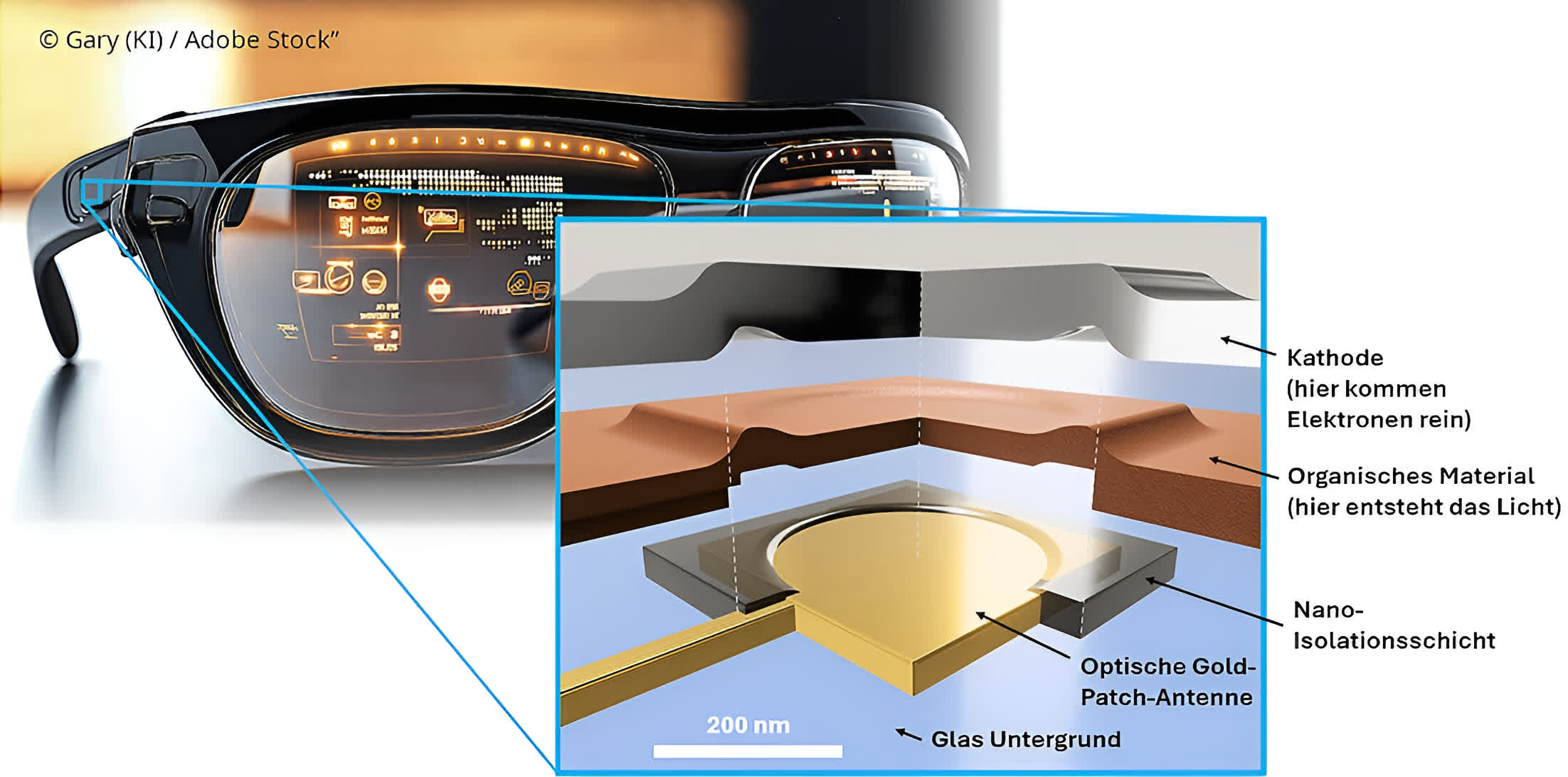
A densely populated display has its obvious benefits, but also some not-so-evident risks. For example, the higher the pixel count, the greater the opportunity for pixels to go bad and tarnish the overall look of the panel. Cost is another consideration, as more of something is typically going to be more expensive than fewer of something – especially when that something is cutting-edge technology.
While promising, there's still a lot of work to be done. The researchers still have to expand the color gamut to cover the RGB spectral range (the current prototype is limited to orange) and improve its efficiency, which currently sits at just one percent. Fortunately, because it is OLED-based, there is no need for a backlight.
Once those hurdles are cleared, however, the ceiling for the tiny pixel tech could be very high. Smart glasses with crisp and vibrant displays are certainly plausible, as are virtual reality goggles with a whole new level of depth and immersion. Using a tiny projector, an image could even be cast onto the lens of a pair of glasses. There's no timeline for commercialization, but here's to hoping it happens sooner rather than later.
Those interested in learning more can check out the team's paper on the subject in the journal Science Advances.
Image credit: Michael Maasen