
Crystal ball: Grokipedia remains a work in progress – version 0.1, according to its homepage. Its future may depend not only on its technical accuracy but also on whether users accept its promise of "unbiased information" as anything more than another reflection of its creator's worldview.
Elon Musk has introduced Grokipedia, a digital encyclopedia that relies on artificial intelligence rather than human editors to compile and update entries. The new platform, developed through his artificial intelligence company xAI, marks his most direct challenge yet to Wikipedia, a site written and curated by human volunteers that he has frequently accused of harboring political bias.
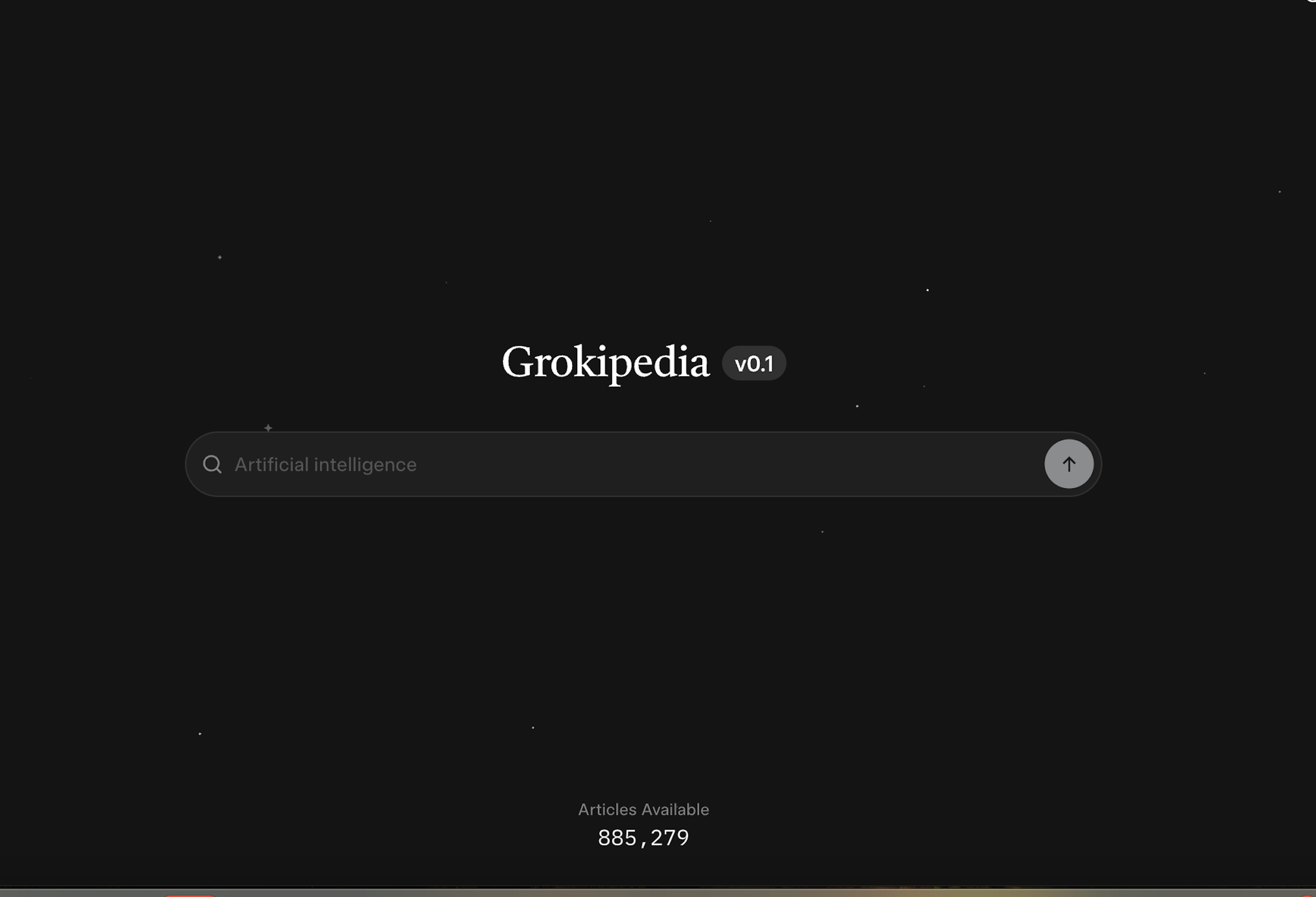
Grokipedia went live at grokipedia.com on Monday afternoon with nearly 885,000 articles, though its debut was briefly interrupted by a site outage about an hour after launch. The interface mimics Wikipedia's format – a simple layout, a sparse logo, and a search bar – but many of its articles appear to reflect Musk's long-standing complaints about online information control. "The goal is to purge out propaganda," Musk wrote on X.
We are building Grokipedia @xAI.
– Elon Musk (@elonmusk) September 30, 2025
Will be a massive improvement over Wikipedia.
Frankly, it is a necessary step towards the xAI goal of understanding the Universe. https://t.co/xvSeWkpALy
In style, Grokipedia adopts the encyclopedic look familiar to internet users. In substance, however, early observers found notable differences. On subjects such as gender, for example, the site's language diverged sharply from Wikipedia's phrasing. Several entries, including those about public figures and contentious political subjects, mirrored positions Musk has publicly expressed.
The encyclopedia appears to draw on the same language model that powers Grok, xAI's conversational chatbot integrated into X. That connection theoretically allows Grokipedia to reference ongoing discussions across X's user base, giving it access to current information at a speed unmatched by traditional editorial processes. However, that same reliance on AI generation opens the project to known risks.
Grok itself has a record of missteps, including promoting conspiracy theories about "white genocide" in South Africa, generating antisemitic language, and crafting sexualized images of users without consent. Musk has attributed those incidents to coding errors and said corrective measures had been put in place. Whether the same technology can build a credible encyclopedia remains uncertain.
Some entries already include factual errors. One profile inaccurately stated that Ohio gubernatorial candidate Vivek Ramaswamy assumed "a more prominent role" in DOGE following Musk's departure, despite public records showing Ramaswamy left the organization around January 20, 2025, long before Musk left. Grokipedia cited BBC and Al Jazeera sources that contain no reference to the claim.
Wikipedia co-founder Jimmy Wales said last week that while he was curious about the new site, he doubted artificial intelligence could produce reliable encyclopedia entries. "AI language models aren't good enough to write encyclopedia articles," he told The Washington Post, citing the volume of errors and unverifiable claims such systems often create.